Are You Buying Based on Intuition?
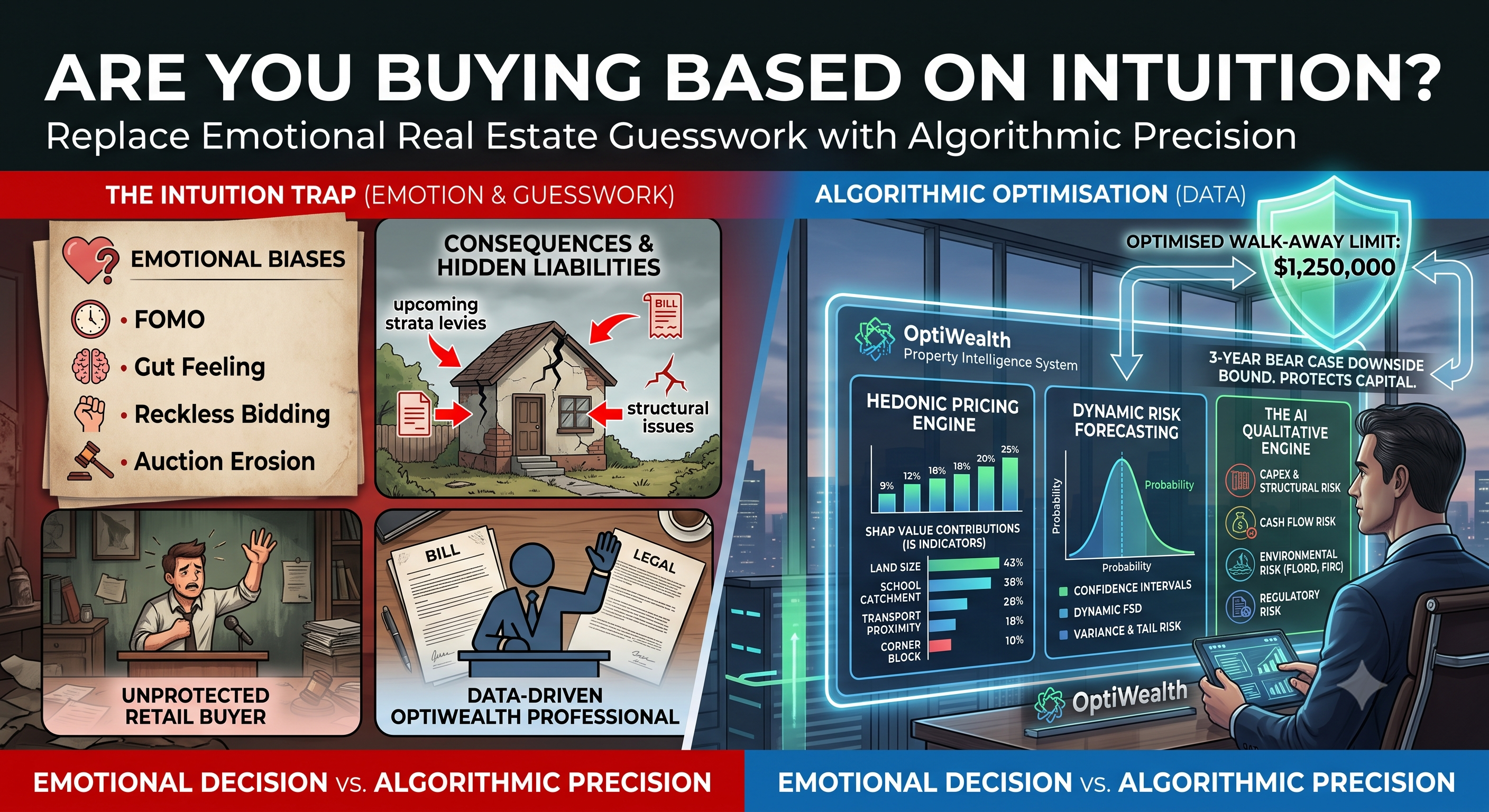
Have you ever stood at a property auction in a bustling Australian suburb, your heart racing, as the auctioneer's gavel hangs in the air? If you're like most retail buyers, your bidding strategy in that moment relies heavily on instinct, gut feeling, and raw emotion.
The harsh reality is that buying based on intuition is one of the fastest ways to destroy capital. Imagine winning an auction for your dream investment, only to discover a $50,000 combustible cladding liability three months later. Your projected yield is instantly wiped out. In an era where institutional funds leverage petabytes of data to calculate downside risk, the everyday property buyer is often left playing a high-stakes guessing game. It is time to replace emotional bidding with algorithmic precision.
The Intuition Trap: Emotional Bidding vs. Algorithmic Precision
As repeatedly noted in the Reserve Bank of Australia's (RBA) Financial Stability Reviews, household debt in Australia—heavily concentrated in residential mortgages—remains amongst the highest in the developed world. When you rely on intuition to determine a property's worth, you expose yourself to "The Intuition Trap"—a cognitive bias where the fear of missing out (FOMO) overrides logical risk assessment.
In contrast, institutional investors operate with surgical, algorithmic precision. They don't buy because a home has a freshly painted facade or is styled with trendy furniture. They evaluate assets based on a rigorous, quantitative framework. A true Hyper-local Hedonic Valuation strips away the emotional sheen and dissects a property into its fundamental, mathematical components.
This is why retail guesswork fails where algorithmic optimisation succeeds. When you guess, you absorb hidden risks like upcoming strata levies or unquantified structural issues. When you optimise, you price those risks in before you even raise your paddle.
The Auction Shield: Informing Your True Walk-Away Limit
The most critical weapon in a property buyer's arsenal isn't pre-approval; it's the walk-away limit. But how do you calculate it?
Most buyers use a flawed, single-dimensional metric: whatever the bank is willing to lend them. This is financially reckless. Your walk-away limit should be a dynamic figure informed by robust data science. We call this the Auction Shield.
By deploying Explainable AI, we can unravel the complex variables that determine a property's estimated fair market value. Instead of guessing, an Auction Shield is mathematically formulated by simulating downside scenarios. By applying a 3-Year Bear Case downside bound—stress-testing the asset against potential RBA cash rate hikes, regulatory shifts, and economic downturns—we provide a mathematically derived ceiling to help you define your own strict walk-away limit. If the bidding surpasses this data-driven threshold, you step back. No emotion, just logic.
Introduction to the OptiWealth Property Intelligence System
To bring institutional-grade analytics to the Australian retail market, we engineered the OptiWealth property intelligence system. It acts as a comprehensive, quantitative barrier against emotional purchasing.
Our architecture evaluates every asset using a strictly Mutually Exclusive, Collectively Exhaustive (MECE) framework. The system operates on three primary engines:
- The Hedonic Pricing Engine: We utilise a multi-factor model to estimate base property value. We calculate SHAP value contributions across 15 precise indicators—ranging from land size and school catchment quality to proximity to transport hubs. It estimates the historical premium the market has assigned to a corner block versus the penalty of being situated on a busy main road.
- Dynamic Risk Forecasting: We measure confidence intervals in our property valuation using a Dynamic Forecast Standard Deviation (FSD). This means we don't just give you a single price; we provide a probability distribution, ensuring you completely realise the variance and tail-risk of your potential investment.
- The AI Qualitative Engine (Conflict Resolution Engine): Unstructured, qualitative data often holds the most severe hidden risks. Our engine rigorously evaluates unstructured risks without overlap, supplementing standard financial models. It assesses:
- Capex & Structural Risk: Identifying liabilities like combustible cladding, age degradation, or strata litigation.
- Cash Flow & Insolvency Risk: Translating negative adjusted net yield or high owner-occupier carrying costs into critical insolvency metrics.
- Environmental Risk: Overlaying flood mapping, bushfire zones, and climate vulnerability.
- Regulatory Compliance Risk: Weighing heritage restrictions against zoning density.
- Infrastructure Tax Risk: Accounting for State and local policy shifts, such as developer contributions and the Victorian Vacant Residential Land Tax (VRLT).
By synthesising these advanced data points, OptiWealth delivers Institutional-Grade Tail-Risk management straight to your dashboard. We transform the opaque Australian property market into a transparent, quantifiable asset class.
Stop guessing. The property market is unforgiving to those who buy on emotion. It's time to leverage Quantitative Synergy and make data-driven decisions that protect and grow your wealth.
Ready to establish your Auction Shield and expose the hidden risks in your next property purchase? Create your free OptiWealth account today and step into the era of algorithmic optimisation.
Disclaimer: The information provided in this article is for educational and data analytics purposes only. It does not constitute personal financial, investment, or legal advice. OptiWealth AU provides data-driven insights; you should always consult with a licensed financial professional before making any purchasing or investment decisions.
Expose Hidden Portfolio & Property Risks
OptiWealth replaces guessing games with algorithmic diagnostics. Create a free account to audit your stock variance or calculate true net property yields.