Stop Building and Pest Cost Waste: $4.99 FairBid Audit for Australian Buyers

This tool is a generic calculator and does not advertise or promote a specific financial product. It is not intended to be relied on for the purposes of making a decision in relation to a financial product. You should consider obtaining advice from a financial services licensee before making any financial decisions.
Stop Building and Pest Cost Waste: $4.99 FairBid Audit for Australian Buyers
In this context, building and pest cost refers to OptiWealth FairBid’s independent digital property audit: a spatial AI valuation combined with defect and overlay screening, not an on-site inspection. Most Australian buyers need this audit before they commit further spend, because it surfaces deal-breakers and hidden holding costs before inspection fees, conveyancing searches and auction-day travel are locked in. The audit is available now through FairBid on iOS and Android.
TL;DR:
- The digital audit offers an independent valuation that can reveal underquoting, helping buyers decide whether a property is within their budget before costly inspections.
- It flags structural, zoning, flood, and bushfire risks from public data, allowing targeted physical inspections rather than full reports on every listing.
- Ordering the audit before bidding, especially on auction properties or remote listings, reduces wasted spending on inspections and conveyancing for unfeasible options.
- The audit’s cost is typically $4.99 for the paid tier, significantly lower than traditional inspections, and provides immediate results to inform quick auction decisions.
- It does not replace physical inspections for issues like asbestos or structural movement, but it narrows down needs for on-site checks based on flagged risks.
Table of Contents
- 1. What the OptiWealth FairBid digital audit includes
- 2. When should you order a digital audit before bidding?
- 3. How a digital audit reduces wasted buyer spend
- 4. Reading the FairBid report and deciding your next move
- 5. What the digital audit does not replace
- 6. Typical cost range for digital audits versus traditional inspections
- 7. The end-to-end timeline from audit to settlement
- 8. Hidden and additional fees buyers often miss
- 9. Why independent digital due diligence changes buyer outcomes
- Getting a FairBid audit before your next inspection or bid
- Where to verify overlays and planning data yourself
- Sources
- FAQ
1. What the OptiWealth FairBid digital audit includes
The FairBid audit is built from several distinct modules, each answering a different question about a target property. The valuation layer uses a spatial AI model with hedonic pricing signals to estimate a property’s fair market value independent of the agent’s price guide, a distinction that matters given how often published guides diverge from eventual sale prices, as detailed in reporting on property auction guides. A defect screening layer flags likely structural and maintenance issues from available data, functioning as a prioritisation tool rather than a physical inspection. Overlay checks cover flood catchment mapping, bushfire prone land designation, zoning restrictions and, for strata properties, indicators of pending special levies.
- Valuation signal: an independent estimate of fair value, built to expose gaps between the price guide and likely sale price.
- Defect flags: data-driven risk indicators that tell you where to send a physical inspector, not a substitute for one.
- Overlay checks: flood, bushfire and zoning flags drawn from public planning layers.
- Holding-cost analysis: council rates, likely special levies, insurance risk indicators and downside scenarios.
The report packages these into risk categories with numeric downside thresholds and a recommended next action, whether that is proceeding, negotiating or commissioning a targeted inspection. Further detail on how the risk layers are constructed is available on OptiWealth’s property risk page.
2. When should you order a digital audit before bidding?
The audit earns its cost most clearly at specific decision points in a purchase, not as a blanket step for every listing you browse.
- Before an auction with a vague price guide, since a spatial AI valuation can flag likely underquoting before you spend on inspections for a property priced out of reach.
- When bidding remotely or interstate, where arranging a same-week physical inspection is impractical and a fast independent read on value and risk matters more.
- When the listing has an unclear planning history, a strata scheme with an ambiguous levy record, or sits near mapped flood or bushfire overlays.
- When red flags appear in the listing itself: a price guide that seems disconnected from comparable sales, no Section 32 or vendor statement available yet, a complex strata minute history, or renovations that look recent and unpermitted.
Ordering the audit at these moments turns a guess into a documented comparison, before any other party is paid.
3. How a digital audit reduces wasted buyer spend
Underquoting is not a marginal issue in the Australian market. Investigative analysis across NSW and Victoria auction data found extensive gaps between published price guides and final sale prices, meaning many bidders were competing for properties they had no realistic chance of winning. Buyer accounts document the practical result: one couple’s experience of spending $500 pursuing a property that sold well above its guide, after paying for inspections, conveyancing and travel they never needed.
Underquoting routinely leads to thousands of dollars in wasted inspection, conveyancing and travel costs for bidders who never stood a chance, according to the same 2025 reporting. Ordering a FairBid audit first, before committing to a building inspection or conveyancer, lets you compare the asking guide against an independent valuation and decide whether the property is realistically within reach.
- Pay for the audit first, then decide whether inspections are worth commissioning at all.
- Skip the audit, and you risk paying full inspection and conveyancing fees for a property that was never within your budget.
An audit reduces this waste, but it does not remove the need for targeted physical inspections once a property clears the valuation and overlay checks.
4. Reading the FairBid report and deciding your next move
The report’s value depends on how you act on it, not just on receiving it.
- Check the valuation divergence between FairBid’s independent estimate and the advertised price guide; a wide gap is your first signal of possible underquoting.
- Review downside thresholds, the numeric worst-case scenarios the report models for holding costs and market movement.
- Prioritise flagged defects and overlays for a physical inspection or a conversation with your conveyancer, rather than commissioning a full inspection on every line item.
- Treat catastrophic overlay flags, such as high bushfire attack level ratings or major strata levy warnings, as an immediate pause point before bidding further.
Pro Tip: Order the audit before you book any physical inspection, then use its flags to decide which rooms, structures or documents actually need a professional’s eyes.
The stepwise sequence is straightforward: order the audit, review the flags, commission targeted inspections only where warranted, then instruct your conveyancer with a clearer risk picture in hand.
5. What the digital audit does not replace
A FairBid audit is a triage tool, not a licensed on-site inspection, and treating it as one would misuse the product.
- It is not a substitute for a licensed building and pest inspector physically walking the property.
- Suspected asbestos, invasive structural movement or roof and subfloor access issues still need a qualified inspector on site.
- Insurer-required checks before settlement remain a separate, physical process.
- Legal review of the Section 32 or vendor statement, and broader contract advice, stays with your conveyancer, informed by consumer due diligence guidance on building permits and approvals.
Used together, the two approaches are efficient rather than redundant: the digital audit narrows down what needs physical attention, and the physical inspection confirms what the data flagged.
6. Typical cost range for digital audits versus traditional inspections
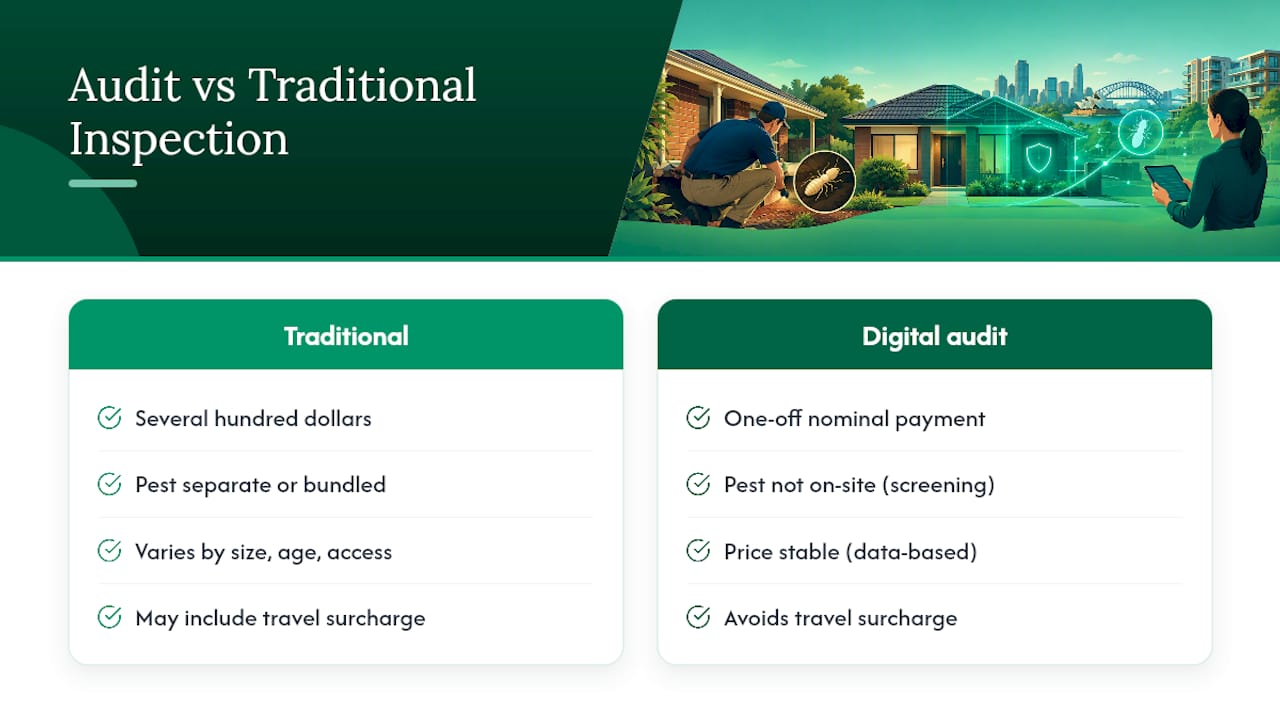
Traditional building inspections in Australia typically cost several hundred dollars, with pest inspections priced separately or bundled, and conveyancing and strata report fees adding further cost on top. A digital audit sits at a different price point entirely: A paid advocate tier is available for a one-off nominal payment, positioning it as a screening step ahead of any physical inspection spend rather than a replacement for it.
Pricing for traditional inspections varies with property size, age, construction type and access difficulty, factors that also drive how long an on-site inspection takes and how many trades need to be involved. A weatherboard cottage on a level block is a faster, cheaper inspection than a multi-storey brick home with a complex roofline or a strata unit requiring common-property access negotiated with the owners corporation. Regional and remote properties often carry a travel surcharge on top of the base inspection fee, a cost the digital audit avoids entirely since it draws on existing spatial and planning data rather than requiring anyone to visit the site.
The practical implication for a buyer is sequencing: the digital audit’s low cost makes it sensible to run before deciding whether the traditional inspection spend is justified for a given property, particularly at auction where the decision window is short and the risk of paying for an inspection on an unwinnable property is real.
7. The end-to-end timeline from audit to settlement
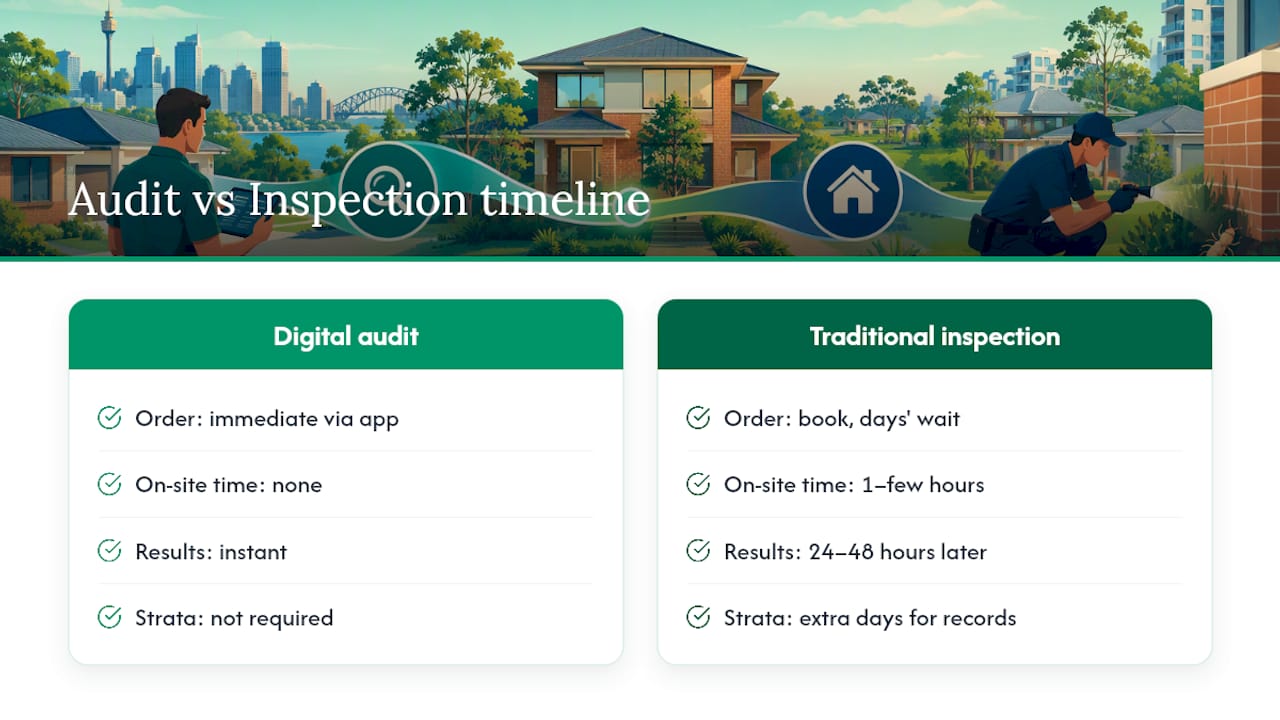
A digital audit compresses a process that traditionally spans days into something closer to instant. Ordering a FairBid report through the app produces results immediately, drawing on existing valuation, overlay and planning data rather than scheduling anyone’s time. A sample of the report format and outputs is visible on the property sample page.
A traditional building and pest inspection follows a slower sequence: booking an inspector, usually a few days out depending on demand in the area, then a site visit lasting one to a few hours depending on the property’s size and complexity, followed by a written report typically delivered within 24 to 48 hours. Strata properties add a further step, since minutes and levy records often need to be requested from the owners corporation or managing agent, which can take another few days.
For an auction purchase, this timeline mismatch is the core problem the digital audit solves. Auction campaigns typically run over several weeks, but a bidder’s decision to spend on a physical inspection often needs to happen quickly once a property looks like a contender. Running the instant digital audit first, then booking a physical inspection only for properties that clear the valuation and overlay checks, keeps the buyer’s spend aligned with genuine intent to bid rather than speculative interest.
8. Hidden and additional fees buyers often miss
Budgeting for a purchase on the headline inspection fee alone is a common mistake, because several costs sit just outside that quote.
- Strata and owners corporation search fees, charged separately from the building inspection, and often overlooked until settlement approaches.
- Travel surcharges for inspectors visiting regional or remote properties, added on top of the base inspection price.
- Re-inspection fees if a first inspection flags an issue requiring a specialist follow-up visit, such as a plumber or structural engineer.
- Council record search fees, separate from the conveyancer’s standard searches, sometimes needed to confirm building permit history referenced in consumer due diligence guidance.
- Natural hazard disclosure gaps, since not every jurisdiction mandates disclosure of flood or bushfire risk in the vendor statement, leaving buyers to source that data independently through planning portals.
These costs stack quickly across a single purchase, particularly when several properties are being seriously considered in parallel during an active buying campaign.
9. Why independent digital due diligence changes buyer outcomes
Underquoting persists partly because enforcement of existing penalties has been inconsistent, leaving buyers to protect themselves rather than rely on agent disclosure. Independent valuation and overlay data close some of that information gap before a buyer spends on inspections or travels to an auction they cannot realistically win. That shift, from reactive spending to informed screening, is the reason digital audits matter more at the pointy end of a purchase than as a passive research tool.
— JeongSuk Lee
Getting a FairBid audit before your next inspection or bid
OptiWealth FairBid offers a Free Tier at no cost for buyers starting their research, alongside a Paid Advocate Tier priced at a one-off $4.99 for a full independent audit report. The paid tier earns its cost whenever you are close to bidding, considering a remote purchase, or facing a listing with ambiguous overlays or strata history, since $4.99 is a modest outlay set against the inspection and conveyancing fees an audit might help you avoid.
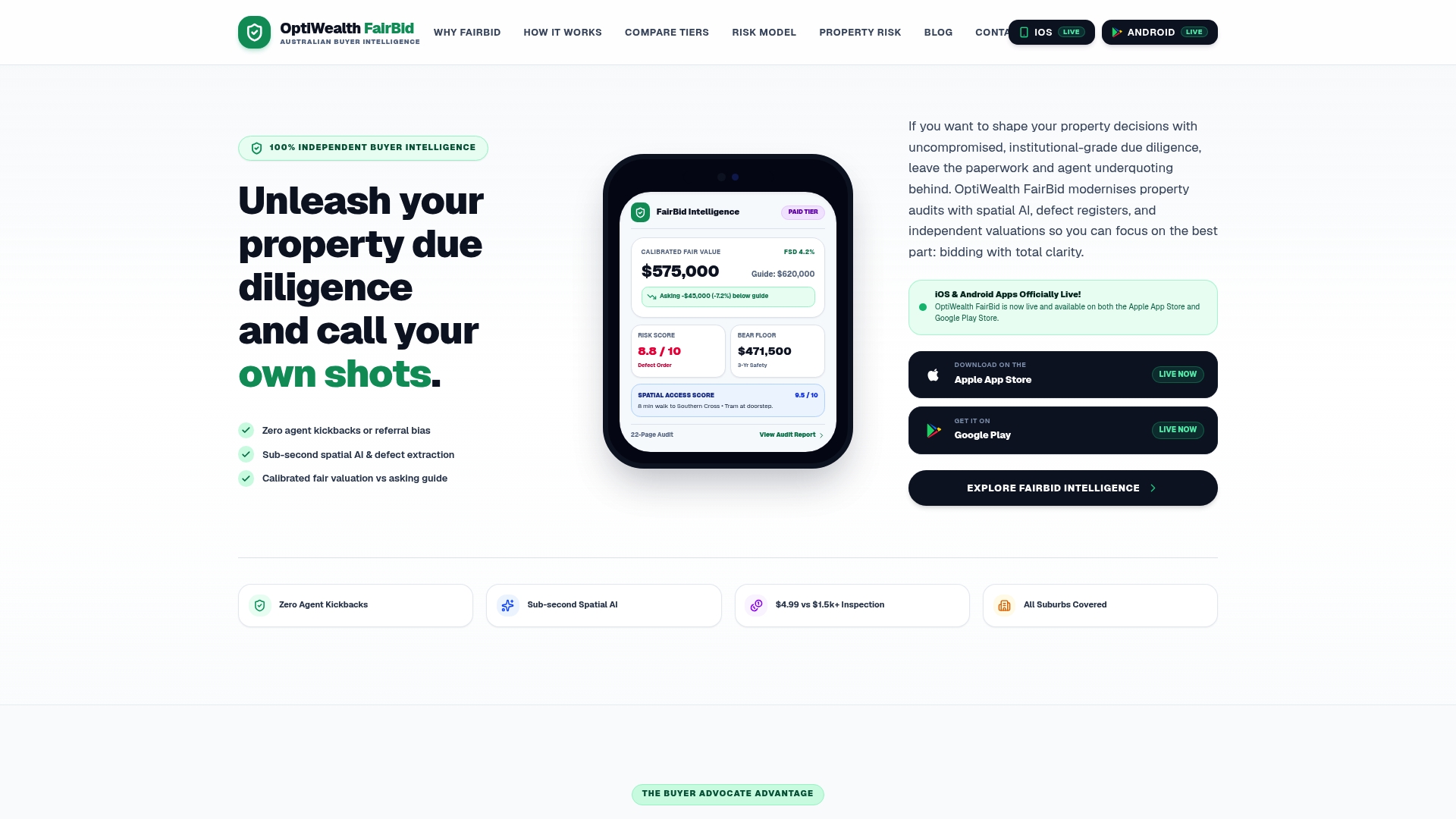
Ordering follows a short flow inside the app: enter the property address, and the report generates instantly, drawing on the spatial AI valuation, defect flags and overlay checks described earlier in this article. Buyers who need a formal document to share with a conveyancer or lender can access the OptiWealth FairBid format.
- Start with the Free Tier to see baseline valuation signals for any address.
- Upgrade to the Paid Advocate Tier before an auction or a remote bid, where the full risk breakdown matters most.
Get your independent property audit at OptiWealth before you spend another dollar on inspections.
Where to verify overlays and planning data yourself
For flood and bushfire mapping, check your council or the NSW bushfire planning guidance, plus Victorian know your risk tools and your local catchment management authority. Consumer Victoria’s due diligence checklist covers building permit records.
Sources
- How we revealed the truth about property auction guides
- Due diligence when buying property (Consumer Victoria)
- Planning circular for bushfire (NSW planning portal)
FAQ
What does “building and pest cost” mean in a FairBid audit?
Here, building and pest cost refers to OptiWealth FairBid’s digital audit fee, not an on-site inspection charge. The Paid Advocate Tier costs a one-off $4.99 and delivers an independent valuation plus defect and overlay screening instantly through the app.
Can a digital audit replace a physical building inspection?
No, a digital audit is a screening tool that flags likely risks from data, while a licensed inspector still needs to physically check for issues such as suspected asbestos or structural movement. The two work best together, with the audit narrowing down what needs a physical look.
How does underquoting affect my inspection budget?
Reporting on NSW and Victorian auctions found substantial gaps between price guides and final sale prices, meaning many buyers pay for inspections on properties priced beyond their reach. Checking an independent valuation before booking inspections can help you avoid that wasted spend.
Where can I check flood and bushfire overlays myself?
Bushfire prone land mapping and BAL requirements are outlined in NSW planning guidance, while flood risk is best checked through your local catchment management authority or state planning portal. These public sources complement the overlay checks included in a FairBid report.
Does the Section 32 or vendor statement cover natural hazard risks?
Not always, since disclosure requirements for natural hazards vary between jurisdictions and are not universally mandated in the vendor statement. That gap is one reason buyers often pull independent overlay data, such as a FairBid audit, alongside their legal review of the Section 32.
Recommended
- FairBid Property Intelligence & Due Diligence
- OptiWealth FairBid
- Property Risk Audit & Quantitative Valuation
The information provided in this publication is for educational and general information purposes only and does not constitute financial, investment, taxation, or legal advice under the Corporations Act 2001 (Cth). Property buyers and investors should conduct independent physical, legal, and strata due diligence and seek advice from a licensed financial advisor, solicitor, or conveyancer tailored to their personal objectives before entering into any legally binding contract of sale.
OptiWealth Research
Transparent Data Science & EngineeringData Science, Software Architecture & Mathematical Risk Modeling Group
Authored by OptiWealth’s Quantitative & Data Engineering division. Our team specializes in full-stack software architecture, open-source data science, and spatial econometric property valuation (such as hedonic price regression, environmental zoning overlay synthesis, and cash-flow yield analytics). All underlying algorithms and calculation formulas are fully transparent, open to inspection, and designed purely for financial and property data visualization.
Expose Hidden Property Risks & Liabilities
OptiWealth replaces guessing games with algorithmic diagnostics. Use FairBid to audit council overlays, building defects, and calculate true net property yields.