Avoid settlement shocks: contaminated land checks in Australia from $34
This tool is a generic calculator and does not advertise or promote a specific financial product. It is not intended to be relied on for the purposes of making a decision in relation to a financial product. You should consider obtaining advice from a financial services licensee before making any financial decisions.
Avoid settlement shocks: contaminated land checks in Australia from $34
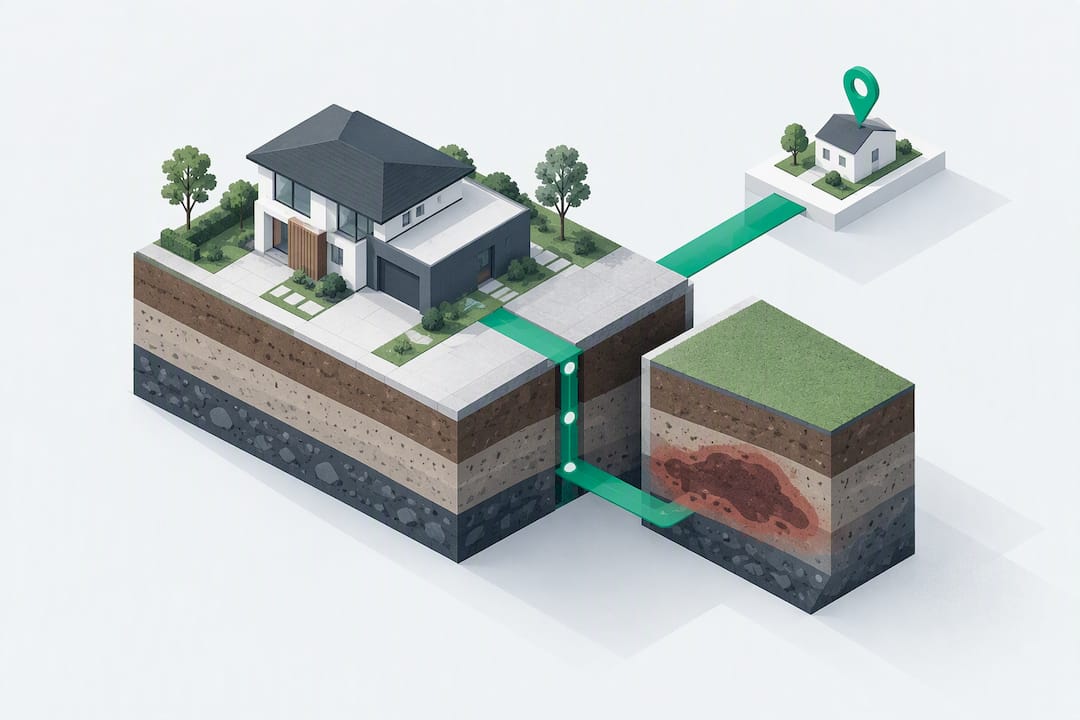
Start your contaminated land check with the official state register for the property’s jurisdiction, then back that up with historical research and, where needed, an independent audit. Prepare the Lot and Plan details or title reference before you search, and expect fees and turnaround times to vary by state. A “no match” result is not proof of a clean site: treat it as a prompt for further enquiry, not a conclusion.
TL;DR:
- Queensland’s contaminated land register costs around $34 per lot for same-day results, while Western Australia’s full report request costs $44 with a 10-15 day wait.
- New South Wales’s EPA record of notices is free but excludes some notifications, so a nil result does not guarantee a clean site.
- Official register results classify sites as confirmed or flagged, but a “no match” may hide past contamination due to boundary or name changes.
- Historical research and independent audits can reveal additional risks like overlays, structural defects, or past land uses that registers do not cover.
- Conducting early due diligence by combining register checks with an independent audit grants negotiation leverage and manages financial exposure before signing.
Table of Contents
- Which official registers and tools cover each state
- How to run an effective contaminated land search
- What search results mean and where they fall short
- State highlights and practical differences
- Augmenting official searches with an independent property audit
- If a search flags an issue: next steps for buyers and agents
- Why treating contamination checks as risk management pays off
- OptiWealth FairBid: a buyer-focused way to close the gap
- FAQ
- Sources
Which official registers and tools cover each state
Every Australian jurisdiction maintains its own contaminated land framework, and the register you need depends entirely on where the property sits. Queensland’s Environmental Management Register and Contaminated Land Register are accessible through CITEC Confirm or the state’s own fee service, with results usually returned the same day. New South Wales relies on the EPA’s public record of notices, searchable free of charge by local government area or suburb. Victoria consolidates its data into Victoria Unearthed, an interactive mapping tool covering priority sites, licensed premises and audit history. Western Australia splits its system in two: a free online database for classified sites, and a paid Form 2 request for the full reported sites register.
- Queensland: EMR/CLR via CITEC Confirm, fee-based, same-day email turnaround.
- New South Wales: EPA record of notices, free online search by LGA or suburb.
- Victoria: Victoria Unearthed map tool, free, instant access.
- Western Australia: free database for classified sites, Form 2 for the full BSR.
- ACT, South Australia and Tasmania: direct enquiry through the relevant planning or environment authority, typically by email or formal request.
How to run an effective contaminated land search
A contaminated land search is only as accurate as the identifiers you feed into it. The Lot and Plan number, or the title reference, is usually printed on the contract of sale, the Section 32 vendor statement, or a council rates notice, and it is far more reliable than searching by street address alone, since addresses and suburb boundaries do change over time.
- Locate the Lot and Plan (or DP) number from the contract, vendor statement or rates notice.
- Choose the correct search type: a specific Lot/Plan search for a known property, or an LGA/suburb search when scoping a wider area.
- Submit the search through the relevant state portal and pay any applicable fee.
- Record the notice or area number returned, since it is needed for any follow-up enquiry.
Queensland’s internet search fee sits at around $34 per lot, with results emailed the same day in most cases, while Western Australia’s Form 2 request for a Basic Summary of Records carries a $44 fee and a 10 to 15 working day turnaround. Budget for both the cost and the wait when contamination checks sit inside a tight settlement timeframe.
What search results mean and where they fall short
Register results generally sort properties into two categories: classified or confirmed sites, which have been formally investigated and listed, and reported or unclassified sites, which have been flagged for potential contamination but not yet assessed. A Basic Summary of Records, the document Western Australia issues on request, typically lists the site’s classification history, any management orders and references to environmental audits conducted on the land.
- Classified sites carry a confirmed contamination status and often a management order restricting use or redevelopment.
- Reported sites are flagged but unconfirmed, meaning further investigation may still be warranted.
- Priority site lists and audit records indicate a site has already drawn regulatory attention.
Pro Tip: Cross-check historical Lot/Plan numbers and old suburb names before accepting a “no match” result, since boundary and naming changes can hide a genuine entry.
NSW EPA’s own search guidance notes that its record excludes some notification types, including section 60 notifications, so a clean search result there does not cover every regulatory action that might exist for a site.

State highlights and practical differences
Each state’s process reflects its own legislative history, and the practical steps differ enough to catch out buyers moving between jurisdictions.
- Queensland: search by Lot on Plan through CITEC Confirm or the government’s own service; the standard internet search fee is about $34 and results typically arrive by email within the same day.
- New South Wales: the EPA record of notices can be searched by LGA, suburb, date range or notice type, but excludes certain notifications, so read the disclaimers before relying on a nil result.
- Victoria: Victoria Unearthed is a consolidated mapping layer across priority sites, licensed sites and groundwater areas, explicitly positioned as a starting point rather than definitive evidence of contamination.
- Western Australia: the public database covers classified sites only; a Form 2 application unlocks the full reported sites register, which holds more than 4,600 listings, for a $44 fee and a 10 to 15 working day wait.
- ACT, South Australia and Tasmania: these jurisdictions generally require a direct approach to the relevant planning or environment department, with turnaround depending on the specific request.
Augmenting official searches with an independent property audit
Official registers answer a narrow question: has this site been formally notified or classified. They rarely explain what that notification means for finance, insurance or resale, and they say nothing about structural defects, strata special levies or flood and bushfire overlays sitting alongside the contamination risk. An independent audit closes that gap by layering register findings against historical aerial imagery, planning overlays and valuation data.
A thorough buyer-focused audit should include:
- A summary of relevant register results and their classification status.
- Historical land use indicators, including aerial imagery where available.
- Likely contaminant types based on prior site use.
- Suggested next investigative steps and an overall risk indicator.
OptiWealth FairBid applies spatial AI modelling to build exactly this kind of layered picture, combining structural defect screening and council overlay checks with the kind of independent valuation context a sample property audit illustrates, operating with no agent commissions or listing kickbacks.
If a search flags an issue: next steps for buyers and agents
A flagged result is a prompt to escalate, not a reason to walk away automatically. The appropriate next step depends on how much the register result actually confirms.
- Commission a Preliminary Site Investigation (PSI) when the register shows a reported but unconfirmed site, to establish whether intrusive testing is warranted.
- Progress to a Detailed Site Investigation (DSI) when the PSI or existing audit history indicates likely contamination requiring intrusive soil or groundwater testing.
- Use the BSR, Form 2 response or any environmental audit statement as a basis for negotiating price or inserting a conditional clause before exchange.
- Retain copies of all register results, audit statements and management orders for settlement and future disclosure.
Pro Tip: Request any BSR, PSI or DSI documentation in writing before exchange, since verbal assurances from a vendor or agent carry no evidentiary weight if a dispute arises later.
Why treating contamination checks as risk management pays off
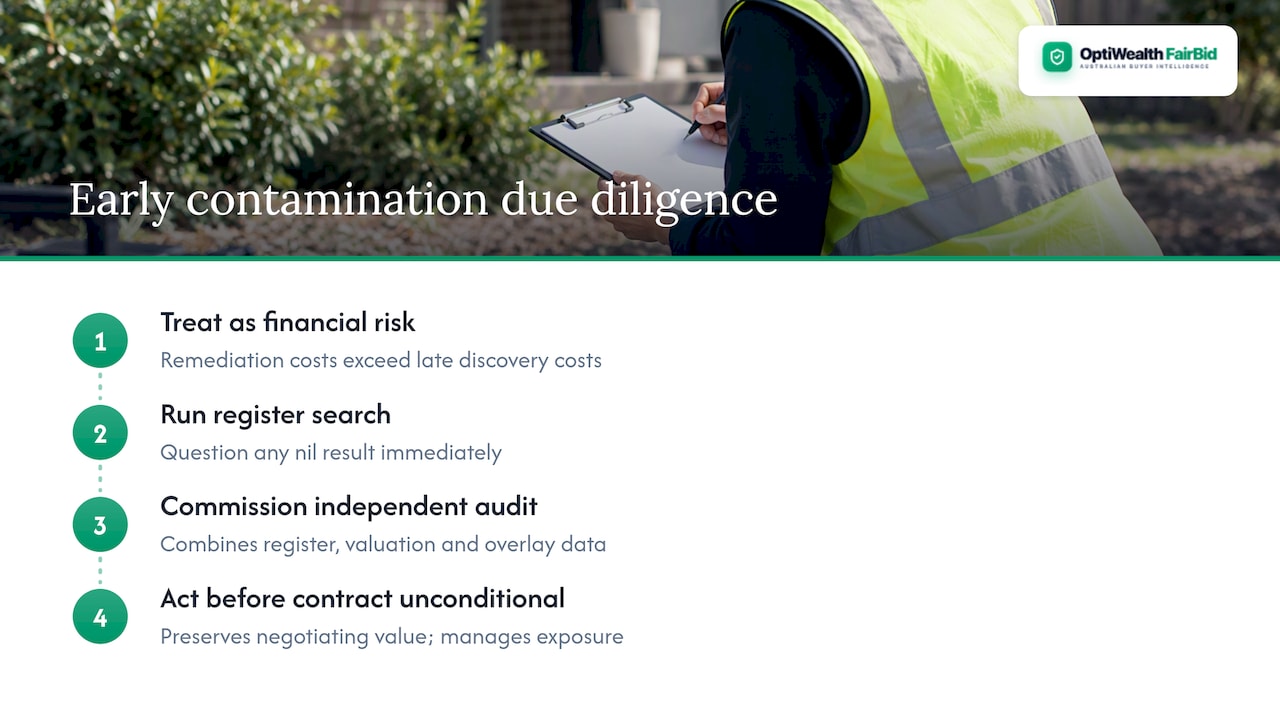
Contamination is a balance sheet problem disguised as a planning issue. A remediation order discovered after settlement is a liability that falls on the new owner, and the cost of fixing that surprise almost always exceeds the cost of finding it early. Buyers who run a register search, question a nil result and commission an independent audit before signing are managing financial exposure, not just satisfying a compliance checkbox.
Acting early in due diligence, before a contract becomes unconditional, is the only point where a flagged contamination risk still has negotiating value. An independent audit strengthens that position by putting register findings alongside valuation and overlay data in one document.
— JeongSuk Lee
OptiWealth FairBid: a buyer-focused way to close the gap
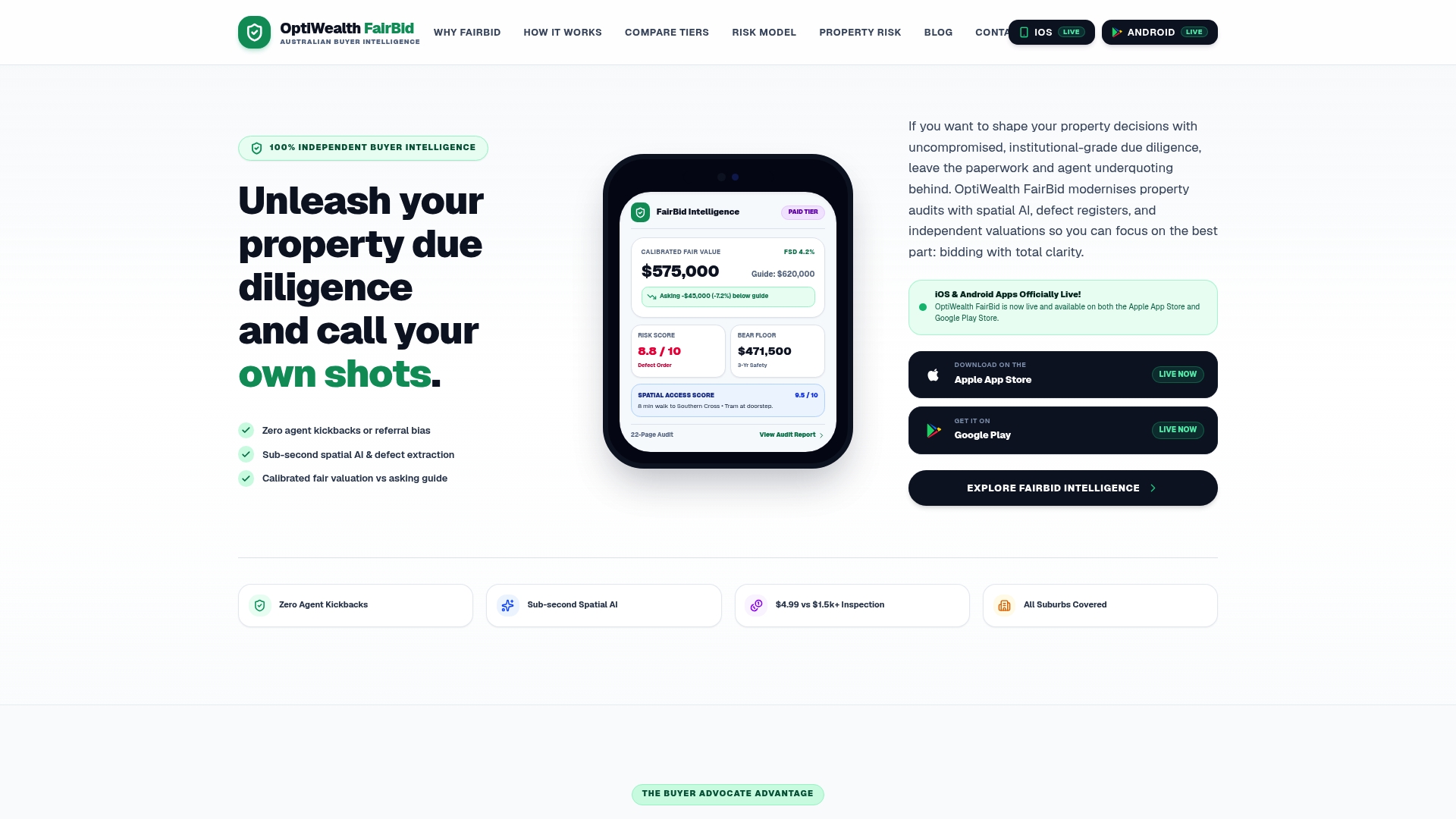
Official registers tell you whether a site has been notified. They say nothing about whether the asking price reflects genuine market value, whether a strata special levy is coming, or whether a flood or bushfire overlay sits quietly in the planning file. OptiWealth FairBid pairs spatial AI valuation modelling with structural defect and overlay screening, built specifically for buyers rather than selling agents, with zero commissions or advertising kickbacks shaping the result.
- A free tier provides users with a starting valuation snapshot at no cost.
- A paid tier unlocks the full audit report including overlay and defect findings for a one-off fee.
- A sample audit report shows exactly what buyers receive before they commit to a purchase.
Check a property’s fair value and hidden risk profile at Optiwealth before your next offer.
FAQ
How to find out if a site is contaminated?
Search the official contaminated land register for the state the property sits in, using the Lot and Plan number or title reference rather than the street address. A nil result is not conclusive, so follow up with historical research or a Preliminary Site Investigation if the land’s past use raises concern.
How can I search for contaminated land in Queensland?
Queensland’s Environmental Management Register and Contaminated Land Register can be searched by Lot on Plan through CITEC Confirm or the state’s fee service. The standard internet search fee is around $34 per lot, with results typically emailed the same day.
Who is responsible for contaminated land?
Responsibility generally sits with whoever caused the contamination, though current landowners can inherit management obligations under a site’s classification. The National Environment Protection (Assessment of Site Contamination) Measure sets the national framework that state regulators apply when assigning these obligations.
What is the contaminated sites database in Western Australia?
Western Australia’s public database lists classified contaminated sites free of charge, but it does not include the full reported sites register. Buyers seeking the complete record, which covers over 4,600 sites, need to submit a Form 2 for a Basic Summary of Records, at a $44 fee with a 10 to 15 working day turnaround.
Sources
- Department of Energy, Tourism, Innovation and Sport (fees & services)
- NSW Environment Protection Authority — record of notices
- Victoria Unearthed — Victorian Government
- Real estate and the Contaminated Sites Act 2003 — Western Australian Government
- National Environment Protection (Assessment of Site Contamination) Measure 1999 — Federal Register of Legislation
Recommended
- FairBid Property Intelligence & Due Diligence
- FairBid Property Intelligence & Due Diligence
- FairBid Property Intelligence & Due Diligence
- FairBid Property Intelligence & Due Diligence
The information provided in this publication is for educational and general information purposes only and does not constitute financial, investment, taxation, or legal advice under the Corporations Act 2001 (Cth). Property buyers and investors should conduct independent physical, legal, and strata due diligence and seek advice from a licensed financial advisor, solicitor, or conveyancer tailored to their personal objectives before entering into any legally binding contract of sale.
OptiWealth Research
Transparent Data Science & EngineeringData Science, Software Architecture & Mathematical Risk Modeling Group
Authored by OptiWealth’s Quantitative & Data Engineering division. Our team specializes in full-stack software architecture, open-source data science, and spatial econometric property valuation (such as hedonic price regression, environmental zoning overlay synthesis, and cash-flow yield analytics). All underlying algorithms and calculation formulas are fully transparent, open to inspection, and designed purely for financial and property data visualization.
Expose Hidden Property Risks & Liabilities
OptiWealth replaces guessing games with algorithmic diagnostics. Use FairBid to audit council overlays, building defects, and calculate true net property yields.