House Price Negotiation in Australia: Underquoting, Strata Levers & AI

This tool is a generic calculator and does not advertise or promote a specific financial product. It is not intended to be relied on for the purposes of making a decision in relation to a financial product. You should consider obtaining advice from a financial services licensee before making any financial decisions.
House Price Negotiation in Australia: Underquoting, Strata Levers & AI
The most effective way to negotiate a house price in Australia is to present a defensible offer backed by recent comparables and property-specific risk evidence, including inspections, strata records and overlay checks. Before you approach an agent, confirm your finance pre-approval and gather your comparable sales data, or commission a targeted property audit. These two steps convert a vague opinion about value into a position a vendor’s agent has to respect.
TL;DR:
- Effective negotiation relies on well-supported offers based on recent comparable sales and verified property-specific risks, not gut feelings.
- Reading disclosures like the Statement of Information or Section 32 provides key clues to accurate valuation and boundaries on vendor pricing expectations.
- Inspections, strata records, and specialist reports should be quantified into dollar amounts to strengthen negotiation and guide repair or price reduction requests.
- Market conditions and vendor motivation influence negotiation leverage, with time-sensitive vendors often more flexible on price and settlement terms.
- Using independent valuation tools like OptiWealth FairBid enhances your ability to make data-backed offers, especially when facing uncertain or hidden property issues.
Table of Contents
- Do your homework: how to research price and comparable evidence in Australia
- Offer tactics: how to set your offer, present it and negotiate
- Auctions vs private sale: negotiation dynamics and buyer risks in Australia
- Use inspections, specialist reports and strata checks as bargaining chips
- Contract levers, cooling-off and legal protections buyers should use
- Practical negotiation checklist and scripts for phone, email and offers
- How current market conditions influence negotiating power
- How independent property due diligence strengthens negotiation outcomes
- Establishing seller motivation and timing
- Strategies for effective communication and persuasion during negotiation
- Common seller tactics and how to counter them
- Legal considerations and potential risks in negotiation
- How to negotiate repairs and contingencies based on inspection findings
- Role of real estate agents in negotiation and how to leverage their input
- Negotiating fairly without losing ground
- OptiWealth FairBid: an independent due diligence option for buyers
- Sources
- FAQ
Do your homework: how to research price and comparable evidence in Australia
House price negotiation in Australia stands or falls on the quality of your comparable sales evidence. A buyer who arrives with three recent, genuinely comparable transactions and a clear read on suburb medians negotiates from a fundamentally stronger position than one relying on gut feel.
Start with the vendor’s own disclosure. In Victoria, agents must provide a Statement of Information that sets out an estimated selling price and lists comparable sales used to arrive at that figure, and Consumer Affairs Victoria explains that advertising a price below the agent’s own estimate, or below a price the vendor has already rejected, may constitute underquoting. In New South Wales this document takes the form of the Section 32 or vendor statement, and reading it closely often reveals price-range clues the marketing copy does not.
Regulatory reform is tightening these disclosure duties further. Recent changes to property and stock agents laws in New South Wales strengthen record-keeping obligations around how agents set estimated selling prices, which gives buyers a legitimate basis for asking an agent to justify an advertised range.
Before drafting an offer, assemble the following:
- Recent comparable sales for the same suburb, ideally within a similar block radius and property type.
- The vendor’s Statement of Information or Section 32, read line by line for the estimated price and listed comparables.
- Suburb median price movement over the past two to three quarters.
- Auction clearance rates for the immediate area, where available.
- A written request to the agent for the three comparable sales underpinning any quoted range.
If the agent’s quoted range sits well below your own comparable evidence, or shifts materially between your first enquiry and a later conversation, treat that as a signal to ask direct questions rather than to assume the property is underpriced.
Offer tactics: how to set your offer, present it and negotiate
A defensible opening offer is built, not guessed. Take your comparable sales, adjust for genuine differences in land size, condition and aspect, then subtract a quantified allowance for any defect or cost identified in an inspection or strata review. This produces a number you can explain in one sentence, which matters more in negotiation than the number itself.
Three structural choices shape how that number is presented:
- A Clayton’s offer, an offer designed to look generous while being conditional on terms that quietly limit the vendor’s actual position, can backfire once an experienced agent identifies the tactic and treats the whole approach with suspicion.
- Best-and-final requests from the agent should be treated cautiously. They compress your negotiating room into a single round and often favour whichever bidder is willing to move fastest rather than whichever offer is fairest.
- Leading with your genuine best offer works well when comparable evidence is strong and competition is thin, because it signals seriousness without inviting a drawn-out bidding sequence.
Pre-auction offers carry their own logic. A vendor who accepts a pre-auction offer avoids auction-day risk and marketing costs, so an offer that is unconditional, or close to it, with a firm deposit and a settlement date that suits the vendor’s circumstances, often succeeds even when it sits below what a full auction campaign might extract. Conditional offers, by contrast, preserve your right to walk away if a building inspection or strata review turns up a serious issue, at the cost of some negotiating leverage.
Deposit size, settlement timing and inclusions are all negotiation currency in their own right. A vendor moving into aged care may value an early settlement more than an extra few thousand dollars, while a vendor mid-purchase elsewhere may need a longer settlement window you can offer in exchange for a lower price.
Pro Tip: Ask the agent directly what settlement timeframe would suit the vendor before you finalise your offer terms; it often costs you nothing and buys real goodwill.
Auctions vs private sale: negotiation dynamics and buyer risks in Australia
Auction and private-sale negotiation operate under different rules, and confusing the two is one of the more expensive mistakes a buyer can make. At auction, bidding continues until the property either sells under the hammer at or above the reserve, or is passed in when bidding stalls below reserve. NSW Government guidance on buying at auction confirms that a successful bidder must sign the contract and pay the deposit immediately, with no cooling-off period attached.
- A winning auction bid is an unconditional commitment: there is no statutory cooling-off period to fall back on.
- When a property is passed in, the highest bidder typically gets first right to negotiate directly with the vendor, though not always at a discount to the last bid.
- Private-sale offers can be made conditional on finance or a satisfactory building inspection, and in most states carry a statutory cooling-off period.
- Vendors sometimes counter a private offer by threatening to take the property to auction instead, a tactic worth testing against your own read of local demand before you concede ground.
The practical rule is simple: walk away from an auction once your ceiling is reached, because there is no legal exit afterwards, but hold firmer in a private-sale negotiation where a conditional offer still protects you.
Use inspections, specialist reports and strata checks as bargaining chips
An inspection report is not just a safety check, it is negotiation ammunition. A building inspection, pest inspection, and, for older or unusual properties, a structural engineer’s report each carry different weight: a building inspection catches moisture and movement issues, a pest inspection catches termite damage that can cost tens of thousands to remediate, and an engineer’s report settles genuine doubt about foundations or load-bearing walls.
For units and apartments, the owners corporation records matter as much as the building report. Consumer Affairs Victoria’s checklist for buying an apartment or unit recommends reviewing owners corporation minutes, budgets, proposed works and any special levies, because these can materially change the real cost of ownership well beyond the purchase price.
- Building and pest inspections: reveal defects that translate directly into a repair-cost deduction.
- Structural or engineering reports: settle disputes over foundation, wall or roof integrity on older stock.
- Owners corporation minutes and budgets: reveal planned works, insurance status and reserve fund adequacy.
- Special levy notices: reveal imminent, sometimes substantial, one-off costs not reflected in the listing price.
The sequencing matters. Consumer Affairs Victoria recommends engaging a qualified inspector before you remove any finance or inspection condition, and using the findings while your offer is still conditional gives you room to renegotiate price or request repairs rather than simply walking away.
Pro Tip: Present inspection findings as a dollar figure, not a description; a vendor’s agent responds far more readily to “$14,000 in remedial works” than to “there were some issues”.
Contract levers, cooling-off and legal protections buyers should use
Standard contract conditions exist precisely because they give buyers room to negotiate after signing, not just before. The most useful are a finance clause, a satisfactory building and pest inspection clause, and, for apartments, a strata review clause allowing withdrawal if owners corporation records reveal a material issue.
- Include a finance condition tied to a specific approval date, giving your lender adequate time without exposing you to a forfeited deposit.
- Include a building and pest inspection condition with a right to negotiate or withdraw based on the findings.
- For units, include a strata records review condition covering minutes, budgets and special levies.
- Instruct your conveyancer or solicitor to review the contract and any Section 32 or vendor statement before you remove conditions, not after.
- Insist that any verbal assurance from the agent or vendor, about inclusions, repairs or settlement flexibility, is written into the contract before you sign.
Cooling-off periods vary by state and rarely apply to auction purchases. NSW Government guidance confirms there is no cooling-off period once the hammer falls, and Victorian private-sale cooling-off exceptions can apply when a contract is signed close to an advertised auction date. Treat cooling-off as a safety net for private-sale mistakes, never as a substitute for due diligence done properly before you sign.
Practical negotiation checklist and scripts for phone, email and offers
A short, disciplined checklist beats improvisation every time an agent calls with a counter-offer.
- Confirm finance pre-approval is current and covers your intended offer amount.
- Gather your comparable sales and note the suburb median trend.
- Complete building, pest and, for units, strata document reviews.
- Prepare a one-line justification for your offer figure, tied to comparables and any deductions.
- Decide your ceiling price before you make contact, and write it down.
Scripts help keep the conversation on your terms:
- “Can you share the comparable sales that support the Statement of Information estimate?”
- “Has the vendor received or rejected any previous offers on this property?”
- “Our building inspection identified EX in required repairs. We’d like to discuss adjusting the offer accordingly.”
- “We’re prepared to move to unconditional at EX with a 30-day settlement, but we need a response by Friday.”
If an offer is rejected outright, ask what figure or terms would secure agreement rather than simply raising your number. Red flags that should trigger walking away include an agent refusing to disclose any comparable evidence, mounting pressure to remove conditions before your inspection is complete, or a vendor who repeatedly changes the stated reason for selling.
How current market conditions influence negotiating power
National figures set the mood, but they rarely set the price of the specific house in front of you; for a broader perspective, see market-context insights on separating macro forecasts from property-specific value. ABS data shows dwelling values fell 0.3% in the June quarter 2026, with movement varying by state.
A national dip does not guarantee a discount on any given property: the ABS figure describes an aggregate quarterly movement, and local supply and demand can run in the opposite direction to the national trend.
Reserve Bank commentary makes a similar point, cautioning that local outcomes vary substantially and that buyers are better served negotiating from property-level evidence than from national forecasts. Use the national trend as context for how much urgency to bring to the table, then let your local comparables and inspection findings set the actual number.
How independent property due diligence strengthens negotiation outcomes
OptiWealth FairBid applies spatial AI technology to produce independent market valuations for Australian property buyers, separate from any agent-supplied estimate. The tool breaks a valuation down into components a buyer can use directly in negotiation.
- Structural defect indicators drawn from property-specific data, which can be quantified into a repair allowance.
- Council overlay checks, including flood and bushfire zoning, that affect insurance and future holding costs.
- Hidden holding-cost estimates that go beyond the advertised price.
A buyer who identifies a $20,000 overlay-related insurance loading through an audit, for example, has a concrete figure to attach to a lower conditional offer, rather than a general sense that the price feels high.
Establishing seller motivation and timing
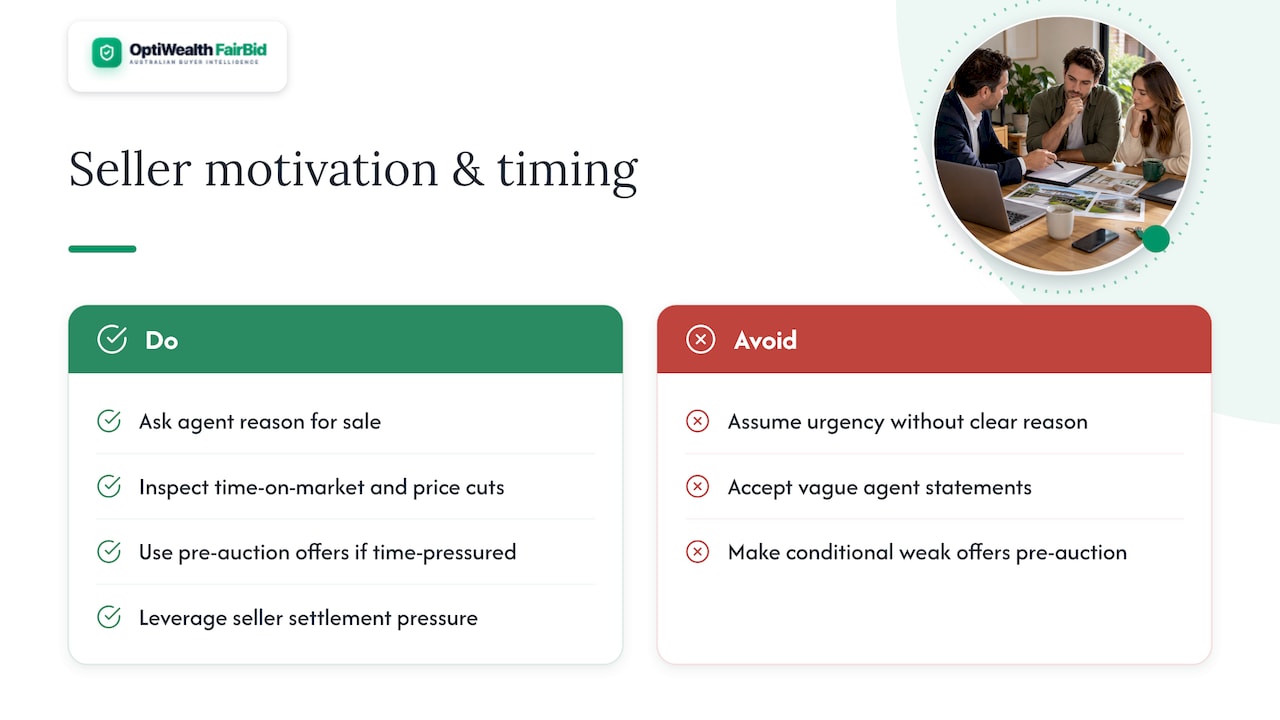
Vendor motivation shapes how much room exists in a negotiation more than almost any other factor. A vendor relocating for a new job on a fixed start date, or managing a deceased estate, typically values certainty and speed over an extra increment on price. A vendor who has already bought their next home carries settlement pressure you can use as leverage on timing rather than price alone.
Ask the agent directly why the property is being sold and how long it has been on the market. A property that has sat unsold for an extended period, especially past a second price reduction, usually signals a vendor whose motivation is shifting toward accepting a lower offer for certainty.
Pre-auction offers work best against genuine time pressure. A vendor facing an auction date they would rather avoid, due to cost, stress or a tight settlement need, will often accept a firm pre-auction offer below what the auction might theoretically achieve, provided the offer is close to unconditional and the settlement terms suit their circumstances. Where an agent is vague or contradictory about the reason for selling, treat that as a cue to hold firmer rather than assume urgency that may not exist.
Strategies for effective communication and persuasion during negotiation
Negotiation with an agent is a conversation with someone whose fee depends on the final price, so precision and calm carry more weight than emotion. State your offer once, clearly, with the comparable evidence and any inspection-based deduction attached, then wait for a substantive response rather than immediately increasing your figure.
Written communication, particularly email, creates a record of what was said and by whom, which matters if a dispute arises later about disclosed comparables or verbal assurances. Keep tone factual: “our comparable evidence supports a figure of $X” lands better than language that sounds like a complaint.
Silence is a legitimate tactic. Agents are trained to fill pauses, and a buyer who states a firm position and stops talking often extracts more information about the vendor’s actual flexibility than one who keeps negotiating against themselves by volunteering concessions unprompted.
Common seller tactics and how to counter them
Vendors and their agents use a predictable set of tactics, and recognising them removes most of their power.
The “another buyer is interested” line is common and sometimes true, but rarely verifiable. Respond by asking whether a second offer has actually been received in writing, and proceed at your own pace regardless of the answer.
Artificially tight deadlines, such as “we need an answer by 5pm today”, are designed to prevent you from completing due diligence. A genuine vendor with a serious offer will generally accommodate a short, reasonable extension to allow a building inspection or strata review to finish.
Price anchoring through an unrealistically high initial quote is designed to make a genuinely fair price feel like a bargain by comparison. Your comparable sales evidence is the direct counter: it lets you state a figure independent of the anchor the agent has set.
Legal considerations and potential risks in negotiation
A negotiated price is only as good as the contract that records it. Verbal assurances about inclusions, repair commitments or settlement flexibility carry no weight unless written into the contract before exchange, which is why every agreed term needs to appear on paper, not in a phone call summary.
Underquoting carries real legal consequences for agents, and Consumer Affairs Victoria’s guidance sets out what buyers can reasonably expect in terms of price disclosure. If an advertised range appears inconsistent with the Statement of Information or Section 32 disclosure, that discrepancy is worth raising directly with the agent, and in serious cases, reporting to the relevant state regulator.
Removing a finance or inspection condition before you are genuinely ready exposes your deposit to forfeiture if the deal later falls through, so never let negotiation urgency push you into signing an unconditional contract ahead of your own readiness. A conveyancer or solicitor should review every material term before you commit, not merely check the paperwork after the fact.
How to negotiate repairs and contingencies based on inspection findings
Inspection findings only carry weight in negotiation when they are quantified. A vague description of “some cracking” invites a vague response, while a documented estimate of remedial cost invites a specific counter-offer.
Once your inspection report is in hand, decide whether you want a price reduction, a pre-settlement repair carried out by the vendor, or a combination of both. A price reduction suits buyers who would rather manage the repair themselves, while a pre-settlement repair suits issues that require specialist trades and verification before settlement, such as roof leaks or subfloor moisture.
Present the figure alongside the specific defect and its likely cause, not just the total. An agent is more likely to secure vendor agreement to a $9,000 reduction tied to a documented termite treatment and timber replacement than to an unexplained round-number request. Where a strata report reveals an imminent special levy, treat that the same way: as a quantifiable, negotiable cost rather than a reason to walk away outright, unless the levy is disproportionate to the purchase price.
Role of real estate agents in negotiation and how to leverage their input
The agent represents the vendor, not the buyer, and every negotiation strategy should account for that fact without treating the agent as an adversary. Agents are, however, a genuine source of information: they know how many other parties have inspected the property, how long it has sat on the market, and often how firm the vendor’s price expectations actually are.
Ask direct questions rather than open-ended ones. “Has the vendor rejected any offers already?” and “What settlement timeframe would suit the vendor?” tend to produce more useful answers than “What’s the vendor thinking?”
An agent who consistently avoids specifics about comparable sales or vendor motivation is behaving predictably within their role, not necessarily withholding something sinister. Treat the agent as a channel for testing offers and gauging vendor flexibility, while keeping your own decisions anchored to your independent comparable evidence rather than anything the agent volunteers.
Negotiating fairly without losing ground
Evidence-based negotiation protects buyers and, over time, makes the market fairer for everyone, because it forces price discussions back onto verifiable comparables and property-specific facts rather than pressure tactics. Firmness and respect are not opposites: a buyer who states a position clearly, backed by inspection and comparable evidence, rarely needs to raise their voice to be taken seriously. Independent professional checks, rather than an agent’s assurances alone, remain the most reliable way to know what you are actually negotiating over.
— JeongSuk Lee
OptiWealth FairBid: an independent due diligence option for buyers
Every tactic in this article works better with independent numbers behind it, which is what OptiWealth FairBid is built to supply. The Free Tier gives buyers an entry point into spatial AI valuation, while the Paid Advocate Tier is available for 4.99 AUD as a one-off purchase, delivering a full audit report covering structural defect indicators, council overlay checks and hidden holding-cost estimates.
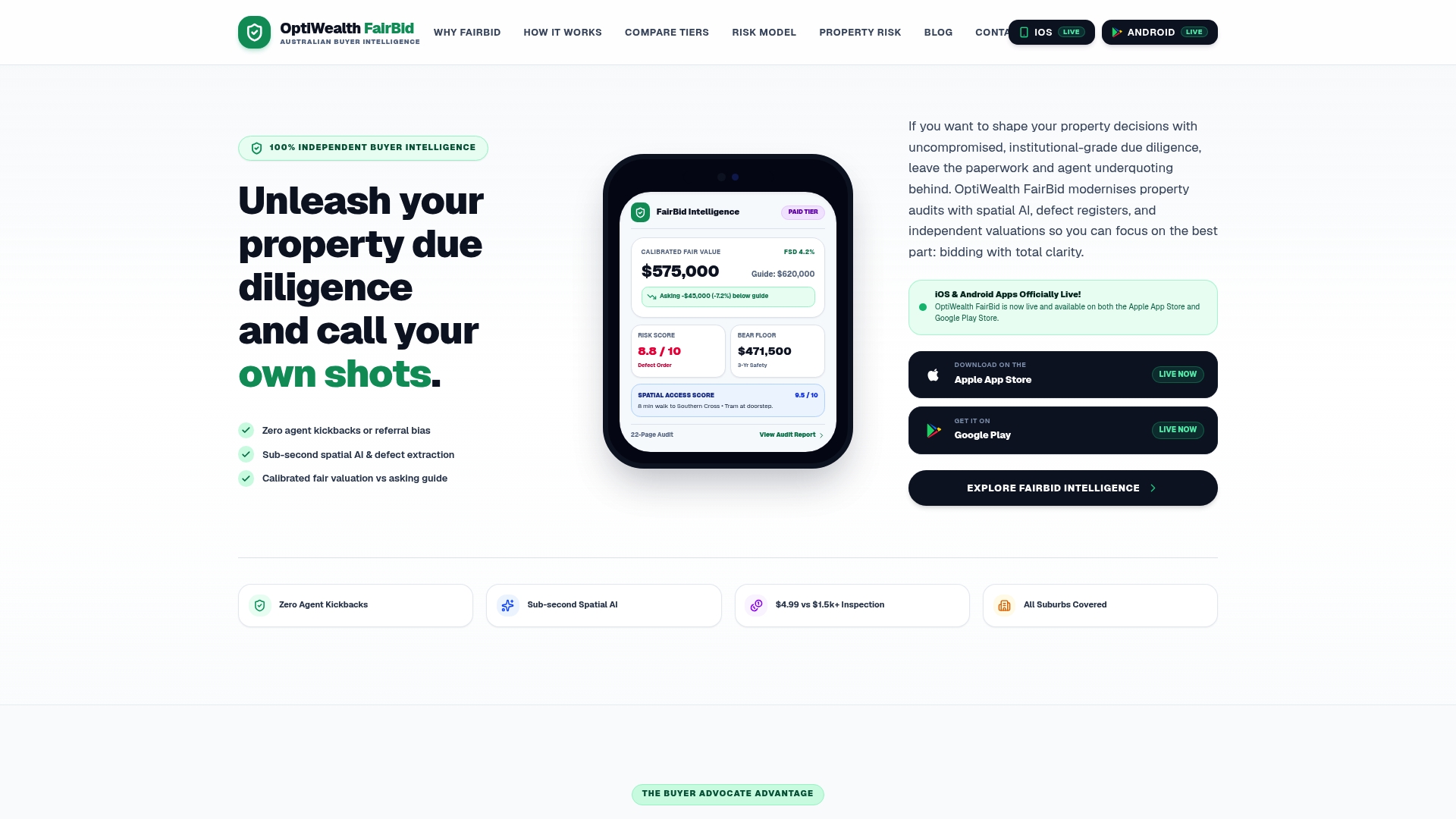
A buyer preparing a conditional offer can use a FairBid report the same way they would use a building inspection: to attach a specific dollar figure to a risk the agent’s marketing has not disclosed, whether that is a flood overlay, a bushfire zoning constraint or an underestimated strata liability. You can view a sample report on the property sample page before deciding whether to commission one for a specific address, and check the property risk audit page for a technical breakdown of what the valuation model covers.
Sources
For state-specific detail on cooling-off periods, auction rules and underquoting protections, consult Consumer Affairs Victoria and NSW Government auction guidance directly, and treat these regulator pages as the current source of truth over any summary here.
- Understanding property prices and underquoting for buyers — Consumer Affairs Victoria
- RBA speech on housing market conditions — Reserve Bank of Australia
- Value of dwellings falls 0.3% — ABS media release
FAQ
Are house prices going to drop in Australia?
National figures move over time, and ABS data recorded a 0.3% fall in dwelling values in the June quarter 2026, with results varying by state. Local suburb comparables matter far more to your negotiation than any national forecast, since a national movement does not guarantee the same direction in your target suburb.
Should I sell my house now or wait until 2026 in Australia?
This decision depends on individual circumstances, local demand and your own settlement flexibility rather than a single national indicator. Reserve Bank commentary suggests treating local, property-level evidence as more reliable than trying to time a national market shift.
What is the hardest month to sell a house in Australia?
There is no single official figure establishing one universally hardest month across all Australian markets, and seasonal patterns vary by state and suburb. Buyers negotiating during quieter selling periods, such as parts of winter, may find vendors more open to firm offers, though this should be confirmed against local listing volumes rather than assumed nationally.
What are the predictions for house prices in 2026?
Forecasts vary and no single source in this article sets out a specific national prediction for 2026 that can be stated as settled fact. The more reliable approach for a buyer is to track recent ABS dwelling value data and RBA commentary for the general trend, then negotiate on the specific comparables for the property in front of you.
Recommended
- OptiWealth Insights
- Decoding Real Estate Risk: The AI Qualitative Engine
- Property Risk Audit & Quantitative Valuation
The information provided in this publication is for educational and general information purposes only and does not constitute financial, investment, taxation, or legal advice under the Corporations Act 2001 (Cth). Property buyers and investors should conduct independent physical, legal, and strata due diligence and seek advice from a licensed financial advisor, solicitor, or conveyancer tailored to their personal objectives before entering into any legally binding contract of sale.
OptiWealth Research
Transparent Data Science & EngineeringData Science, Software Architecture & Mathematical Risk Modeling Group
Authored by OptiWealth’s Quantitative & Data Engineering division. Our team specializes in full-stack software architecture, open-source data science, and spatial econometric property valuation (such as hedonic price regression, environmental zoning overlay synthesis, and cash-flow yield analytics). All underlying algorithms and calculation formulas are fully transparent, open to inspection, and designed purely for financial and property data visualization.
Expose Hidden Property Risks & Liabilities
OptiWealth replaces guessing games with algorithmic diagnostics. Use FairBid to audit council overlays, building defects, and calculate true net property yields.