From July 1, 2027 Negative Gearing in Australia Plus a Checklist

This tool is a generic calculator and does not advertise or promote a specific financial product. It is not intended to be relied on for the purposes of making a decision in relation to a financial product. You should consider obtaining advice from a financial services licensee before making any financial decisions.
From July 1, 2027 Negative Gearing in Australia Plus a Checklist
Negative gearing lets Australian property investors deduct a rental loss, the gap between rental income and deductible expenses, against their other taxable income. The 2026-27 Federal Budget limits this to new builds from 1 July 2027, with contracts signed before 7:30pm AEST on 12 May 2026 grandfathered under the old rules. Below, we cover the mechanics, the tax treatment, a worked calculation and the ATO’s compliance expectations.
TL;DR:
Negative gearing primarily benefits investors with high marginal tax rates and those aiming for capital growth, especially on new builds bought before May 12, 2026.
From July 1, 2027, negative gearing will only apply to new residential properties, with existing investments able to carry forward losses but not offset against income immediately.
The main costs influencing cash flow include mortgage interest, rates, insurance, repairs, and depreciation, with accurate recordkeeping essential for compliance.
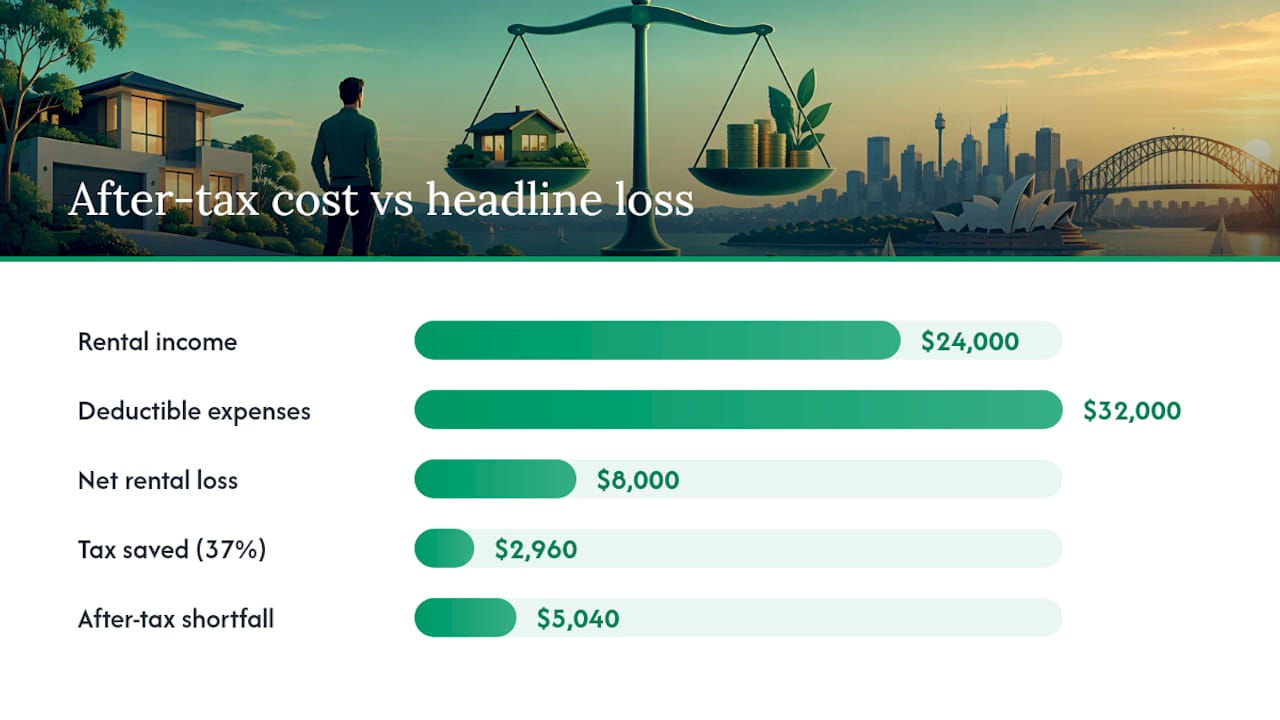
The tax saving on a $8,000 loss at 37% marginal rate is $2,960, reducing the actual cash shortfall to about $5,040 annually.
Independent property assessment tools are recommended to verify rental yields, costs, and downside risks before purchasing under the new regulations.
Table of Contents
-
How negative gearing works: deductible expenses and tax treatment
-
2026 Budget reforms: timing, grandfathering and the new-build exemption
-
ATO practical rules: apportionment, mixed use and recordkeeping
-
OptiWealth due diligence checklist before buying to negative gear
-
OptiWealth FairBid: a different way to test the numbers before you buy
How negative gearing works: deductible expenses and tax treatment
A rental property is negatively geared when its running costs exceed the rent it earns. That shortfall, the net rental loss, has historically been deductible against an investor’s salary or other income, cutting the tax bill in the same financial year.
Under current ATO guidance, common deductible expenses include:
-
Mortgage interest on the loan used to buy or improve the property
-
Council rates and land tax
-
Building and landlord insurance
-
Repairs and maintenance (as distinct from capital improvements)
-
Property management and letting fees
-
Decline in value, commonly called depreciation, on eligible plant and equipment
The calculation is simple in principle: rental income minus these deductible expenses equals the net result. When that number is negative, the loss can generally offset other assessable income, such as wages, reducing the investor’s overall taxable income for the year. A property earning more rent than it costs to hold is positively geared instead, adding to taxable income rather than reducing it. Most investors accept a short-term cash shortfall on a negatively geared property because they are backing capital growth over time, not annual rental profit.
2026 Budget reforms: timing, grandfathering and the new-build exemption
The 2026-27 Federal Budget restricts negative gearing to new residential builds from 1 July 2027. According to the Budget factsheet, a qualifying new build genuinely adds housing supply, such as a dwelling on previously vacant land or a rebuild that increases the number of dwellings on a site. A knock-down rebuild that simply replaces one house with another does not qualify.
Timing matters more than almost anything else in this reform. Contracts entered into before 7:30pm AEST on 12 May 2026 are grandfathered and keep access to the existing rules, regardless of when the purchase settles. Investors who exchange after that moment and buy an established property face a different regime: rental losses on that property can no longer offset salary, business income or other personal earnings.
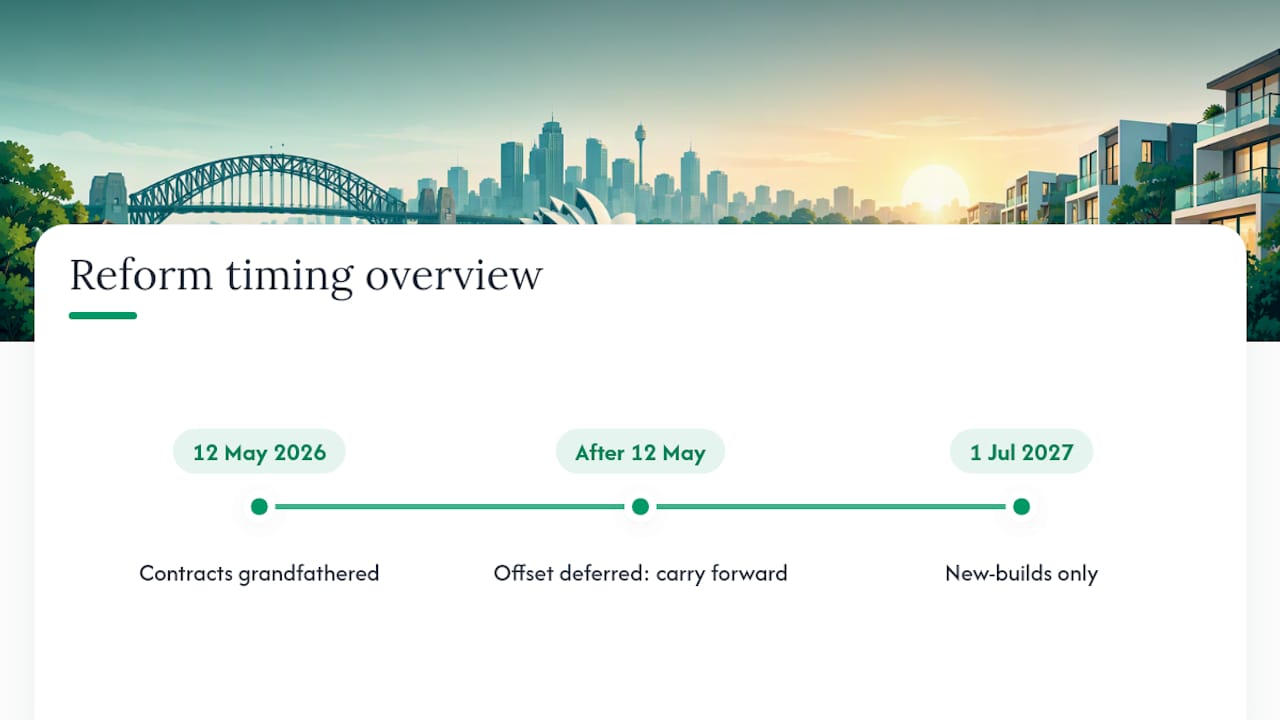
Those post-announcement losses on established homes are not lost outright. The ATO’s explainer confirms unused losses can be carried forward to offset future residential rental income or a future capital gain on sale. The trade-off is timing: the tax benefit shifts from an immediate annual deduction to a deferred one, which changes the cash-flow case for holding an established investment property.
Who benefits and the main criticisms of negative gearing
Negative gearing has always delivered its biggest dollar benefit to investors on higher marginal tax rates, because a deduction is worth more the higher the rate it is claimed against. Investors chasing capital growth rather than rental yield have also benefited disproportionately, since the strategy accepts an annual loss in exchange for a larger, concessionally taxed gain on eventual sale.
That pairing with the capital gains tax discount is central to the policy debate. The Grattan Institute argues negative gearing functions less as a housing policy and more as a tax mechanism that, combined with the CGT discount, tilts returns toward existing property investment over other assets. Critics have long linked this combination to added demand pressure on established housing stock, arguing it crowds out first-home buyers and does little to expand supply.
Supporters counter that negative gearing simply applies the same loss-offset principle available to any other investment or business. The 2026 reforms attempt to keep that principle intact for new housing, where extra investor demand adds dwellings, while withdrawing it from established homes, where it does not.
Worked example: calculate the cash shortfall and tax saving
Take an illustrative investor earning enough rental income and paying enough expenses to produce a loss, taxed at a 37% marginal rate.
-
Rental income for the year: $24,000
-
Deductible expenses (interest, rates, insurance, management, depreciation): $32,000
-
Net rental loss: $8,000
-
Tax saved at a 37% marginal rate: $2,960
-
After-tax cash shortfall: $5,040
The $8,000 loss reduces taxable income under current ATO deduction rules, turning a full cash shortfall into a smaller after-tax one once the tax saving is applied. That $5,040 is the real cost of holding the property for the year, not the $8,000 headline loss.
Rather than wait for a refund at tax time, many investors apply for a PAYG withholding variation, which spreads the expected tax benefit across each pay cycle instead of a lump sum. Under the post-2027 rules, an equivalent loss on an established property would instead carry forward, reducing tax on future rental income or a future capital gain rather than this year’s salary.
ATO practical rules: apportionment, mixed use and recordkeeping
Where a property is used for both private and rental purposes, PCG 2026/2 sets out how to apportion expenses. Time-based apportionment splits costs by the days the property was genuinely available for rent; area-based apportionment applies when only part of a property, such as a granny flat, is rented out.
Interest deductions need care too. Where a loan is refinanced or partly redrawn for private use, only the portion still attributable to the income-producing purpose remains deductible, and rent charged well below market rate to family or friends can limit deductions to the income actually received.
The ATO expects investors to keep:
-
Lease agreements and rent ledgers
-
Loan statements showing interest charged and any redraws
-
Invoices and receipts for repairs, rates and insurance
-
A logbook or diary supporting any area or time-based apportionment
Pro Tip: Keep a running spreadsheet of every rental expense as it happens rather than reconstructing records at tax time, since gaps in evidence are one of the most common triggers for an ATO review.
OptiWealth due diligence checklist before buying to negative gear
The maths above depends entirely on the rental income and expense assumptions you feed into it. Before committing, check the property’s true market value against the asking price, a conservative bear-case rental yield rather than the agent’s figure, and likely repair or maintenance exposure over the next few years. OptiWealth’s OptiWealth FairBid shows how a defect screen and downside yield scenario can shift the numbers behind a negative-gearing decision before you sign anything.
When negative gearing makes sense for Australian investors
Negative gearing suits investors with a genuine cash buffer, a marginal tax rate high enough to make the deduction meaningful, and a specific reason to expect capital growth in that property or suburb. It suits fewer people than the tax talk suggests. Treat it as one input to a purchase decision, never the reason for it, and get independent tax advice before relying on any of these figures for your own return.
OptiWealth FairBid: a different way to test the numbers before you buy
Negative gearing calculations are only as good as the rent and cost assumptions underneath them, and agents have every incentive to overstate the first and underplay the second. OptiWealth’s Free Community Tier gives you an independent read on a property’s likely value at no cost, while the Paid Advocate Tier, priced at $4.99 one-off, adds a full audit covering defect screening, historical valuation data and a conservative downside yield estimate.

Because this service takes no agent kickbacks, the numbers it returns are not shaped by whoever is trying to sell you the property. If you are weighing up a new build against an established home under the post-2027 rules, check a sample report before you exchange contracts.
This article is general information, not a substitute for advice from a qualified financial advisor. Consult a qualified financial professional about your own circumstances before acting on anything here.
Sources
-
Tax reform – Boosting home ownership – Reforming negative gearing and capital gains tax (ATO)
-
Tax explainer – Negative gearing and capital gains tax (Budget 2026 factsheet)
FAQ
How does negative gearing work in Australia for dummies?
Negative gearing means your rental property costs more to run than it earns, and under current ATO rules that loss can reduce your other taxable income. From 1 July 2027, this benefit applies only to new builds, unless your purchase contract is grandfathered.
Who really benefits from negative gearing?
Investors on higher marginal tax rates gain the largest dollar benefit from each deduction, and those targeting capital growth over rental yield have historically relied on it most. The Grattan Institute frames this as a tax-policy effect amplified by the CGT discount rather than a housing supply measure.
What is the new rule on negative gearing in Australia?
From 1 July 2027, negative gearing applies only to new residential builds, as set out in the 2026-27 Federal Budget. Contracts signed before 7:30pm AEST on 12 May 2026 keep the old treatment, and losses on established properties bought after that time can still be carried forward against future rental income or capital gains.
Is Australia the only country that has negative gearing?
No, Australia is not the only country with this kind of arrangement, though its specific rules and thresholds are set locally and are changing from 2027. The Australian settings described here, including the new-build limit and grandfathering date, apply only to properties held under Australian tax law.
OptiWealth Research
Transparent Data Science & EngineeringData Science, Software Architecture & Mathematical Risk Modeling Group
Authored by OptiWealth’s Quantitative & Data Engineering division. Our team specializes in full-stack software architecture, open-source data science, and spatial econometric property valuation (such as hedonic price regression, environmental zoning overlay synthesis, and cash-flow yield analytics). All underlying algorithms and calculation formulas are fully transparent, open to inspection, and designed purely for financial and property data visualization.
Expose Hidden Property Risks & Liabilities
OptiWealth replaces guessing games with algorithmic diagnostics. Use FairBid to audit council overlays, building defects, and calculate true net property yields.