Avoid CGT surprises: depreciation schedules for Australian investors

This tool is a generic calculator and does not advertise or promote a specific financial product. It is not intended to be relied on for the purposes of making a decision in relation to a financial product. You should consider obtaining advice from a financial services licensee before making any financial decisions.
Avoid CGT surprises: depreciation schedules for Australian investors
A property depreciation schedule commonly increases allowable deductions and improves after‑tax cash flow for Australian investment properties. It is prepared by a qualified quantity surveyor and relies on Division 43 capital works provisions alongside the Australian Taxation Office’s guidance on depreciating assets. Two caveats temper this benefit: the post‑9 May 2017 limits on second‑hand asset claims, and the effect depreciation has on your cost base when calculating capital gains tax at sale.
TL;DR:
- A depreciation schedule separates claims into capital works and plant and equipment, with the former usually claimed at 2.5% or 4% annually over 25 or 40 years.
- Only new assets installed after settlement are generally eligible for depreciation deductions, while second‑hand fixtures bought with the property are mostly ineligible since 2017.
- Engaging a qualified quantity surveyor ensures accurate asset value allocation and compliance, with fees typically deductible and best ordered early after settlement.
- The choice between prime cost and diminishing value methods affects deduction timing, with the latter front-loading claims for investors prioritizing early-year cash flow benefits.
- An independent valuation before scheduling can help identify structural issues or levies, and maintaining detailed records supports accurate long-term capital gains calculations.
Table of Contents
- What a depreciation schedule is and what it covers
- How deductions are calculated: prime cost versus diminishing value
- What a comprehensive schedule includes: line items and examples
- Who prepares a depreciation schedule and why a qualified quantity surveyor matters
- Timing, cost and when to update a schedule
- Key traps: second‑hand assets, missed claims and CGT impact
- Worked example: how a schedule affects year‑one cash flow
- How independent due diligence complements a depreciation schedule
- Treating depreciation as part of long-term tax planning
- OptiWealth FairBid: independent valuation before you order a schedule
- Sources
- FAQ
What a depreciation schedule is and what it covers
A tax depreciation schedule is a formal report that quantifies the decline in value of an investment property’s structure and its fixtures over time, translating that decline into a dollar figure you can claim against assessable rental income each financial year. For an investor, its practical purpose is straightforward: it converts a non‑cash cost (the ageing of a building and its contents) into a legitimate tax deduction, which in turn lifts net cash flow without requiring any further outlay.
The schedule separates claims into two distinct categories, and understanding the distinction matters because each is governed by different rules:
- Capital works (Division 43): the structural components of the building itself, such as brickwork, concrete, roofing and fixed internal fit‑out, claimed at a fixed annual rate over an extended period.
- Plant and equipment (decline in value): removable or mechanical assets such as air conditioning units, carpets, hot water systems and kitchen appliances, each depreciated according to its own effective life.
A comprehensive schedule typically delivers a year‑by‑year claim table projected across the asset’s effective life, an itemised asset list with purchase or construction cost allocations, and a statement of the assumptions and inspection evidence the quantity surveyor relied on. Investors should treat this document as a working financial model rather than a one‑off certificate, since it underpins every subsequent tax return for as long as the property is held.
How deductions are calculated: prime cost versus diminishing value
Two calculation methods govern how a depreciating asset’s value declines for tax purposes, and the choice between them changes the timing, though not usually the total lifetime amount, of deductions. The prime cost method spreads the deduction evenly across the asset’s effective life, calculated as cost multiplied by days held over 365, divided by effective life in years. The diminishing value method instead applies a higher rate to the asset’s remaining base value each year, which front‑loads deductions into the early years of ownership when cash flow pressure is typically greatest.
Effective life is the period over which the Commissioner of Taxation determines (or a taxpayer reasonably estimates) that an asset can be expected to generate income before it needs replacement. These determinations are published and updated periodically, and a quantity surveyor references them when allocating effective life to each item on the schedule rather than guessing at a figure.
- Prime cost deductions remain level across the asset’s life, which suits investors who prefer predictable annual claims.
- Diminishing value deductions start higher and taper, which suits investors prioritising deductions in the first few years of ownership.
The ATO’s Depreciation and capital allowances tool is built into myTax and can be used to verify decline‑in‑value calculations rather than relying solely on a third‑party estimate. Running a schedule’s figures through this tool before lodgement is a reasonable check for an investor who wants independent confirmation that the numbers reconcile.
What a comprehensive schedule includes: line items and examples
A well‑prepared schedule itemises dozens of individual components rather than presenting a single lump‑sum figure, and knowing what should appear helps an investor spot a vendor‑supplied or abbreviated report that under‑claims.
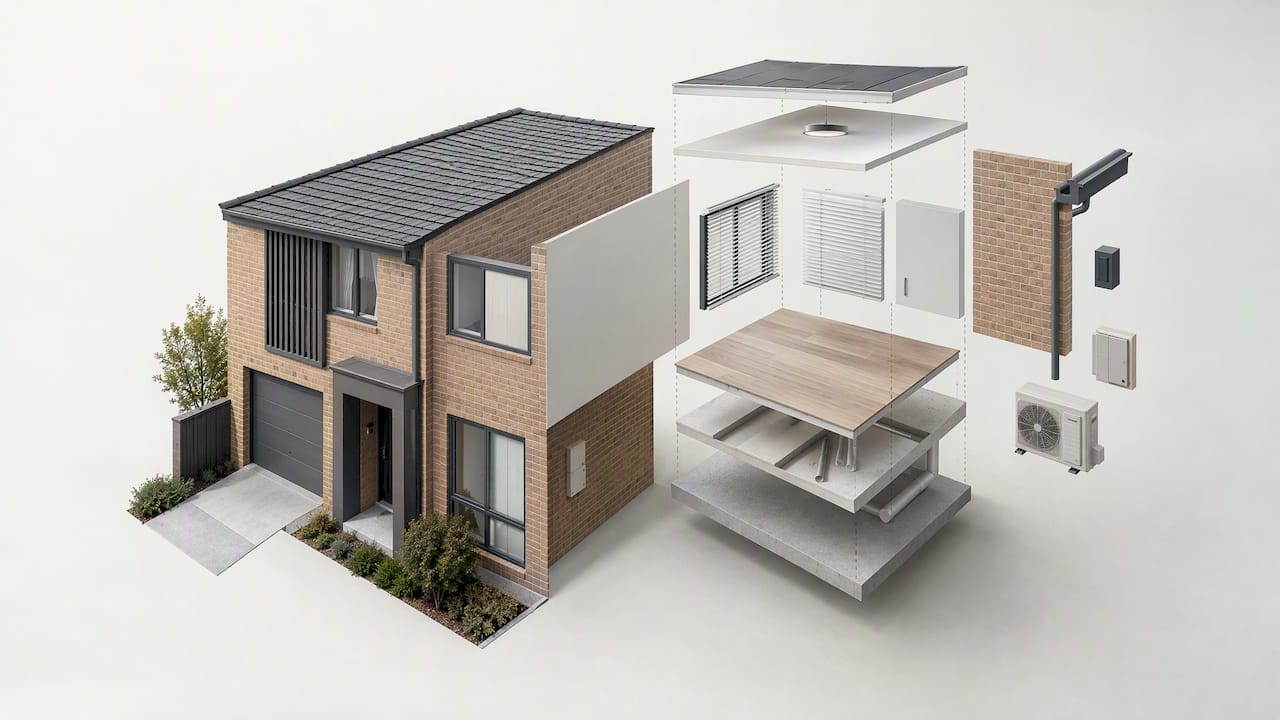
Representative capital works items include the building structure, driveways, fencing, retaining walls and built‑in cupboards, each claimed under Division 43 rules at either 2.5% per year over 40 years or 4% per year over 25 years, depending on the construction date and building type.
Representative plant and equipment items include:
- Hot water systems, split‑system air conditioners and ceiling fans.
- Carpets, blinds, curtains and freestanding furniture supplied with the property.
- Kitchen appliances such as ovens, cooktops and dishwashers.
Newness and installation date matter here: an asset installed by the current owner after settlement is treated differently from one inherited from a previous owner, which is where the second‑hand asset rule becomes relevant later in this guide. Common omissions in abbreviated reports include smoke alarms, garden sheds, letterboxes and solar hot water boosters. If any of these are absent from a report you have been given, query the quantity surveyor directly rather than assuming they were deliberately excluded, since a missing item often reflects an incomplete site inspection rather than an ineligibility, and keeping pests out of your holiday rental property can also help maintain the asset’s value.
Who prepares a depreciation schedule and why a qualified quantity surveyor matters
The ATO specifically recommends engaging a qualified quantity surveyor to prepare a depreciation schedule, because a quantity surveyor holds the construction costing expertise needed to allocate a purchase price accurately between land, capital works and depreciable plant. Before engaging one, check their professional membership (typically with the Australian Institute of Quantity Surveyors) and ask whether their reports reference the relevant tax rulings their allocations rely on.
A qualified quantity surveyor’s work typically includes:
- A physical site inspection to confirm construction type, age and the condition of fixtures.
- A cost‑segregation exercise splitting the purchase price across capital works and depreciable assets.
- A compliant written report citing the tax rulings and effective life determinations used.
Pro Tip: Ask the quantity surveyor whether their fee is itemised separately from any bundled conveyancing or buyer’s agent package, since a stand‑alone fee is easier to substantiate as a deductible expense.
Quantity surveyor fees are generally tax deductible in the year they are incurred, which meaningfully reduces the net cost of commissioning a schedule once the tax effect is taken into account.
Timing, cost and when to update a schedule
Ordering a schedule promptly after settlement tends to capture more claimable value than leaving it for a later tax season, since early engagement reduces the chance that renovation evidence or vendor‑installed assets go unrecorded. For a newly built or substantially renovated property, commissioning the report within six months of settlement is a sensible target so the quantity surveyor can still verify recent works against invoices or building certifications.
- Order soon after settlement, ideally before the first tax return covering the property is lodged.
- Expect cost to scale with complexity: a standard house typically sits at the lower end of a quantity surveyor’s fee range, while a strata unit with shared common property or restricted building access usually costs more due to the extra research required.
- Update the schedule after major events, such as a significant renovation, replacement of a major plant item, or the later discovery of an asset the original report omitted.
A schedule is not a static document once events change the property’s composition. Investors who add a second storey, replace a kitchen or install new air conditioning should treat that as a trigger to have the quantity surveyor revise the asset list, rather than attempting to estimate the new deduction independently.
Key traps: second‑hand assets, missed claims and CGT impact
The single most common trap for investors buying an established property is assuming they can claim depreciation on plant and equipment the previous owner installed. From 1 July 2017, deductions for the decline in value of most second‑hand depreciating assets in residential rental properties are limited, and in most cases cannot be claimed at all unless a specific exception applies, such as the asset being installed brand new by the current owner after acquisition.
- Capital works deductions on the building structure are unaffected by the second‑hand asset rule and remain claimable regardless of when the property last changed hands.
- Previously owned plant and equipment acquired with the property is, in most residential cases, no longer eligible for decline‑in‑value claims under the 2017 change.
- A new asset the investor purchases and installs after settlement is generally depreciable in the normal way.
Many investors mistakenly expect to inherit a prior owner’s depreciation entitlement on second‑hand fixtures, and the 2017 rule is one of the more frequent triggers for an audit adjustment when this assumption goes unchecked.
Where depreciation has been missed in earlier returns, amending a prior‑year return is often possible within the relevant time limit, and a quantity surveyor can typically produce a schedule that reaches back to the original settlement date to support the amendment. It is also worth remembering that depreciation claimed during ownership affects the property’s cost base and can increase the taxable capital gain on sale, so retaining every schedule and amendment alongside purchase and sale contracts is essential for an accurate CGT calculation down the track.
Worked example: how a schedule affects year‑one cash flow
Consider a hypothetical investment property purchased for $600,000, with the quantity surveyor’s report allocating $350,000 to capital works and $40,000 to plant and equipment (figures used here purely to illustrate the mechanics).
- Capital works claimed at 2.5% of $350,000 produces a first‑year deduction of $8,750.
- Plant and equipment, depreciated under the diminishing value method, might produce a combined first‑year deduction in the order of $6,000 depending on each asset’s effective life.
- Combined, these deductions of roughly $14,750 reduce taxable rental income by that amount, and at an illustrative 32.5% marginal tax rate, the approximate tax saved is around $4,794.
These figures are illustrative only and will vary with the actual cost allocation, asset mix and the investor’s own marginal rate. The ATO’s depreciation and capital allowances tool remains the appropriate reference for an exact calculation against your own schedule.
How independent due diligence complements a depreciation schedule
Accurate pre‑purchase valuation and renovation history speed up a quantity surveyor’s cost allocation and reduce the uncertainty baked into any post‑settlement cost‑segregation exercise. OptiWealth FairBid applies spatial AI and hedonic pricing models to generate independent valuations, alongside strata and council overlay checks, through its sample property audit reports. None of this replaces a quantity surveyor’s formal inspection, but it gives an investor a documented valuation baseline and defect history to hand over, which a quantity surveyor can use alongside their own site inspection and retained for later CGT cost‑base substantiation.
- Independent valuation data can help narrow uncertainty during purchase price allocation.
- Strata and overlay checks can surface renovation‑relevant history before the quantity surveyor’s inspection.
- Retaining these reports alongside the final schedule can strengthen the audit trail for future capital gains calculations.
Treating depreciation as part of long-term tax planning
Depreciation schedules are too often treated as a one‑off tax hack rather than what they actually are: a long‑dated financial instrument whose benefits and costs span the entire holding period. The near‑term cash flow gain is real, but so is the corresponding reduction in cost base that surfaces as a larger capital gain on sale, and investors who ignore that trade‑off are deferring a tax bill rather than avoiding one. Pair every schedule with disciplined record keeping and an independent valuation at acquisition, and revisit both at each portfolio review rather than only at tax time.
— JeongSuk Lee
OptiWealth FairBid: independent valuation before you order a schedule
Before commissioning a quantity surveyor, an investor benefits from knowing the property’s independent market value and whether any structural defects, strata special levies or council overlays sit behind the listing price. OptiWealth FairBid operates with zero real estate agent commissions or kickbacks, which keeps its valuation and overlay data free of the incentives that shape agent‑supplied figures.

- The Free Tier gives you access to baseline property reports at no cost, available at Optiwealth.
- The Paid Advocate Tier, priced at 4.99 AUD one‑off, unlocks the full audit report with defect screening and overlay detail.
FairBid complements a quantity surveyor’s depreciation schedule rather than replacing it: one values the property and flags its risks, the other quantifies its tax position. View a sample property audit report to see what the independent check covers before you order your next schedule.
FAQ
What is the depreciation schedule for rental property in Australia?
A depreciation schedule for an Australian rental property is a report, usually prepared by a quantity surveyor, that itemises the decline in value of the building’s structure (capital works) and its fixtures (plant and equipment) so you can claim both as tax deductions. It typically covers the asset’s full effective life and follows ATO depreciation rules.
What are the new depreciation rules for 2026?
There is no newly announced change to depreciation rules since the 2017 second‑hand asset limits; the governing framework remains the capital works provisions and the 2017 second‑hand asset limits. Investors should check the ATO’s website directly for any update before relying on this answer for a current return.
Where can I get a depreciation schedule?
A depreciation schedule is prepared by a qualified quantity surveyor, who conducts a site inspection and allocates the purchase price across capital works and depreciable assets in line with ATO guidance. Check the surveyor’s professional membership before engaging them, since the ATO specifically recommends using a qualified practitioner rather than a generic estimate.
How much does a house depreciate per year in Australia?
The annual depreciation amount depends on the property’s construction cost, build date and asset mix, calculated using either the prime cost or diminishing value method against figures from a quantity surveyor’s report. Capital works are claimed at a fixed 2.5% or 4% rate depending on construction date, while plant and equipment items each depreciate at their own effective life rate.
Recommended
- OptiWealth FairBid
- FairBid Property Intelligence & Due Diligence
- FairBid Property Intelligence & Due Diligence
The information provided in this publication is for educational and general information purposes only and does not constitute financial, investment, taxation, or legal advice under the Corporations Act 2001 (Cth). Property buyers and investors should conduct independent physical, legal, and strata due diligence and seek advice from a licensed financial advisor, solicitor, or conveyancer tailored to their personal objectives before entering into any legally binding contract of sale.
OptiWealth Research
Transparent Data Science & EngineeringData Science, Software Architecture & Mathematical Risk Modeling Group
Authored by OptiWealth’s Quantitative & Data Engineering division. Our team specializes in full-stack software architecture, open-source data science, and spatial econometric property valuation (such as hedonic price regression, environmental zoning overlay synthesis, and cash-flow yield analytics). All underlying algorithms and calculation formulas are fully transparent, open to inspection, and designed purely for financial and property data visualization.
Expose Hidden Property Risks & Liabilities
OptiWealth replaces guessing games with algorithmic diagnostics. Use FairBid to audit council overlays, building defects, and calculate true net property yields.