Stress Test Rental Yield in Australia: Formula, ATO/APRA & Buyer Audit

This tool is a generic calculator and does not advertise or promote a specific financial product. It is not intended to be relied on for the purposes of making a decision in relation to a financial product. You should consider obtaining advice from a financial services licensee before making any financial decisions.
Stress Test Rental Yield in Australia: Formula, ATO/APRA & Buyer Audit
Gross rental yield equals annual rent divided by property price, multiplied by 100. Net rental yield equals annual rent minus annual expenses, divided by property price, multiplied by 100. To annualise rent, multiply a weekly figure by 52 or a monthly figure by 12. Net yield requires an accurate tally of deductible expenses, which the following sections set out in detail.
TL;DR:
- Relying solely on gross yield can mask high holding costs in properties with substantial strata levies or maintenance expenses, leading to overestimated returns.
- Accurate net yield calculations require thorough inclusion of deductible expenses like loan interest, management fees, insurance, and rates, adjusted for private use or partial occupancy.
- Lenders apply conservative rent assumptions, including vacancy buffers and levies, which should be factored into investors’ cash flow models to ensure serviceability.
- A high gross yield does not guarantee strong long-term performance, as location-specific factors and capital growth prospects must also be considered.
- Using independent tools like OptiWealth FairBid helps verify rental estimates, identify hidden costs, and improve the accuracy of yield assessments before purchase.
Table of Contents
- What rental yield measures and how gross differs from net
- Rental yield formulas and step-by-step worked examples in AUD
- Which expenses to include for net yield under ATO rules
- How lenders and prudential guidance treat usable rental income
- Typical rental yields and what counts as good in Australia
- How to improve rental yield through practical levers
- Rental yield calculators and what assumptions to check
- Weighing capital growth against rental yield
- Tax implications of rental income beyond deductible expenses
- Interpreting yield in real transactions
- How OptiWealth FairBid checks rental yield and hidden holding costs
- Sources
- FAQ
What rental yield measures and how gross differs from net
Rental yield expresses a property’s rental income as a proportion of its value, giving investors a standardised figure to compare dwellings of different prices. It answers a narrow but useful question: how hard is this asset working relative to what it costs to hold, independent of whether its price later rises or falls.
Gross yield is the faster of the two calculations, built from listed rent and purchase price alone. It works well as a screening tool when comparing a shortlist of properties across different suburbs or price bands, because it strips away financing structure and lets an investor rank options quickly. Net yield, by contrast, deducts the recurring costs of ownership, including council rates, strata levies, insurance, agent fees and maintenance, producing a figure closer to actual cashflow.
The distinction matters because a high gross yield can mask a property with elevated strata contributions, an ageing roof, or council overlays that push holding costs well above what the headline number implies. A buyer relying on gross yield alone risks mistaking a leaky, levy-heavy apartment for a strong-performing asset.
Both metrics share the same structural limits:
- Neither yield accounts for capital growth, so a low-yield property in a high-growth suburb can still outperform a high-yield property in a stagnant one.
- Neither reflects the timing of tax deductions, which can shift an investor’s effective cashflow position across a financial year.
- Neither captures financing costs directly, meaning two investors with identical net yields can have very different after-loan cashflow depending on their loan-to-value ratio and interest rate.
Treat gross yield as a filter and net yield as the figure that determines whether a property is financially sustainable to hold.
Rental yield formulas and step-by-step worked examples in AUD
The two formulas, restated precisely, are:
Gross rental yield = (annual rent ÷ property price) × 100
Net rental yield = ((annual rent − annual expenses) ÷ property price) × 100
Weekly rent converts to an annual figure by multiplying by 52; monthly rent converts by multiplying by 12. Annual expenses should include every recurring holding cost, not just the obvious ones like council rates and insurance.
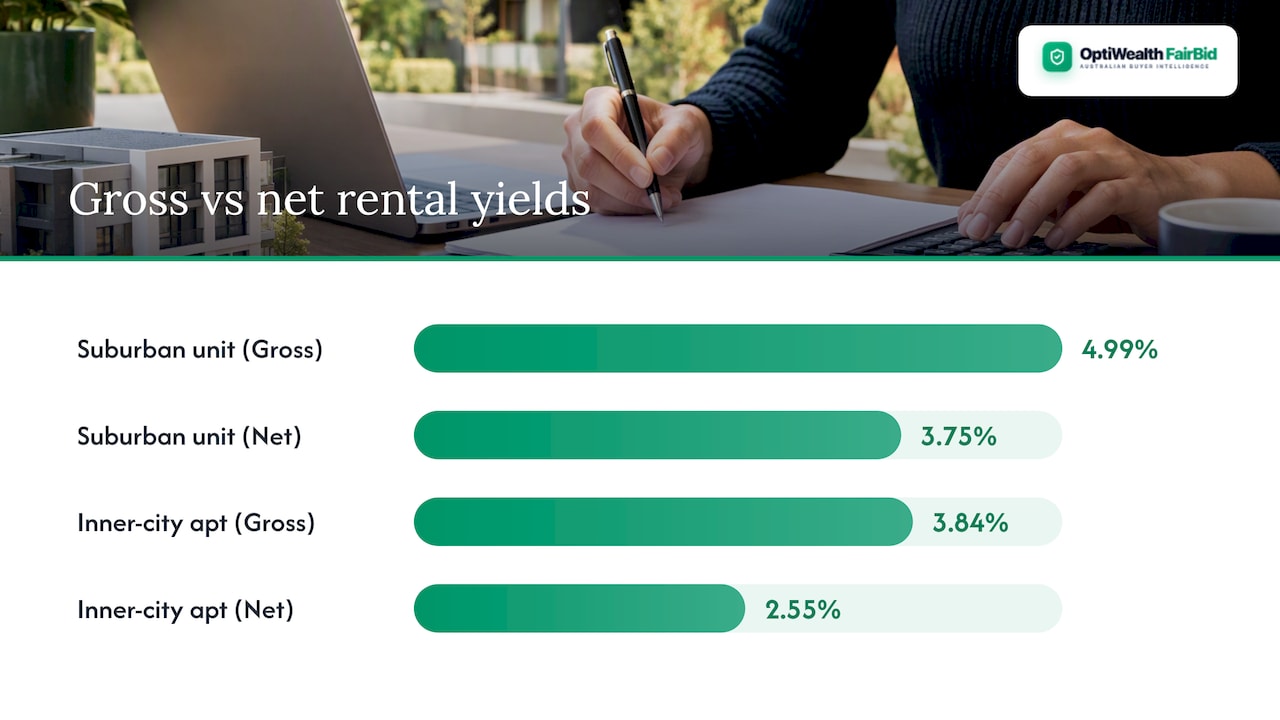
- Suburban unit example. Say a unit costs $500,000 and leases for $480 a week. Annual rent is $480 × 52 = $24,960. Gross yield is ($24,960 ÷ $500,000) × 100 = 4.99%. If annual expenses (strata, council rates, insurance, agent fees, minor repairs) total $6,200, net yield is (($24,960 − $6,200) ÷ $500,000) × 100 = 3.75%.
- Inner-city apartment example. Say an apartment costs $750,000 and leases for $2,400 a month. Annual rent is $2,400 × 12 = $28,800. Gross yield is ($28,800 ÷ $750,000) × 100 = 3.84%. This apartment carries a heavier strata levy, say $5,800 a year, plus council rates, insurance and management fees totalling $3,900, for combined annual expenses of $9,700. Net yield is (($28,800 − $9,700) ÷ $750,000) × 100 = 2.55%.
- Sensitivity check. A $20-a-week rent reduction on the suburban unit drops annual rent by $1,040, pulling net yield down to roughly 3.54%. A special strata levy of $2,000 on the inner-city apartment reduces net yield further to about 2.28%, illustrating how sensitive net yield is to levy volatility in strata-titled buildings.
These worked figures are illustrative only, built to demonstrate the arithmetic rather than to represent typical market pricing. The gap between the two examples’ gross and net results, roughly 1.24 percentage points for the unit and 1.29 points for the apartment, shows why relying on gross yield alone can overstate a property’s real return, particularly in buildings with higher strata contributions.
Which expenses to include for net yield under ATO rules
An accurate net yield depends on capturing every deductible expense the Australian Taxation Office recognises for a rental property that isn’t a holiday home. Expenses incurred in earning rental income are deductible, and several categories recur in almost every net yield calculation.
- Loan interest on funds borrowed to purchase or improve the property, one of the largest ongoing costs for a geared investment.
- Property management and letting agent fees, typically charged as a percentage of collected rent.
- Building and landlord insurance, covering structural risk and loss of rental income.
- Council rates and, where applicable, water rates, billed quarterly by the local authority.
- Strata levies, covering building insurance, common area maintenance and any sinking fund contribution.
- Repairs and maintenance, provided the work restores rather than improves the asset.
- Advertising for tenants and reasonable legal fees tied to lease preparation or disputes.
Where a property is used partly for private purposes, such as a holiday home occupied by the owner for part of the year, the ATO requires expenses to be apportioned rather than claimed in full. The ATO’s guidance on claiming rental expenses sets out a time-based formula: (days used to produce income + days held to produce income) ÷ number of days in the income year the property was owned, multiplied by the expense. Area-based apportionment applies a similar logic where only part of a dwelling produces income, such as a granny flat rented out while the owner occupies the main residence.
APG 223 confirms that Australian lenders are directed to apply conservative haircuts to expected rental income when assessing loan serviceability, a practice covered in the next section, which has a direct bearing on how much borrowing capacity a given net yield actually supports.
One-off acquisition costs, including stamp duty, conveyancing and building inspections, sit outside the net yield formula entirely. These are capital costs that affect overall investment return and capital gains calculations but do not recur annually, so including them in a net yield figure would understate the property’s ongoing performance.
How lenders and prudential guidance treat usable rental income
Lenders don’t take listed rent at face value when assessing whether a borrower can service a loan. The Australian Prudential Regulation Authority’s Prudential Practice Guide APG 223 expects authorised deposit-taking institutions to treat expected rental income conservatively, applying a margin or haircut and factoring in vacancy periods and property expenses before counting that income toward serviceability. The rationale is straightforward: rent is not guaranteed, tenants vacate, and maintenance costs fluctuate, so a bank’s serviceability model needs a buffer that a simple gross yield calculation does not provide.
Investors modelling their own numbers should adopt the same discipline rather than assuming full-year occupancy at advertised rent.
- Build in a vacancy allowance, even for properties in tightly held suburbs, rather than assuming 52 weeks of continuous tenancy.
- Assume strata levies on units can rise, particularly in older buildings facing large-scale capital works, and budget above the current published levy.
- Treat net yield as the baseline serviceability figure rather than gross yield, since it reflects what a lender is more likely to credit.
Pro Tip: Model your net yield using a rent figure roughly 10 to 20% below the advertised rate to approximate the kind of haircut a lender applies, then check whether the property still holds up financially.
Lenders also do not treat anticipated tax refunds or depreciation benefits as monthly cashflow. A property that looks sustainable only once a future tax offset is included is not sustainable on a serviceability basis, and investors should model cashflow on net rental income after buffers rather than on a post-tax position that assumes everything goes to plan.
Typical rental yields and what counts as good in Australia
There’s no single number that qualifies as a universally good yield, because the right benchmark depends on location, dwelling type and what the investor is optimising for. A yield only makes sense compared against similar properties: same suburb, same dwelling type, similar price bracket.
ABS analysis on rental markets shows that changes in investor interest costs pass through to rents only to a very small degree, which means rental yields don’t move in lockstep with interest rate cycles the way some investors expect. Rent movements and capital growth also behave differently across capital cities and regional areas, and the ABS’s ongoing rent inflation data tracks that divergence over time.
- A higher headline yield in a regional centre often comes with a trade-off: slower long-term capital growth compared with established metropolitan suburbs.
- Inner-city apartments in capital cities frequently carry lower gross yields but have historically shown different capital growth patterns than houses in outer suburbs, reflecting differences in land content and supply.
- Comparing a unit’s yield against a house’s yield in the same postcode can mislead, since the two asset classes carry different expense structures, particularly around strata levies.
The only reliable benchmark is a like-for-like comparison against comparable stock in the same market segment, not a flat national figure.
How to improve rental yield through practical levers
Lifting net yield comes down to increasing rent, reducing costs, or both, without spending more on improvements than the resulting rent increase justifies.
- Renovate selectively: a fresh coat of paint, updated kitchen fixtures or better lighting can lift achievable rent without the overcapitalisation risk of a full structural renovation.
- Furnish sensibly if targeting the short-term or executive rental market, since furnished properties can command a higher weekly rate in the right location; a furniture cost guide is useful for budgeting this outlay realistically.
- Reduce vacancy by pricing rent in line with comparable listings rather than chasing a top-of-market figure that extends the time a property sits empty.
- Stay ahead of maintenance shocks, including pest issues in holiday or share-economy rentals, where ignoring pest control can produce costly structural damage over time.
- Review the loan itself periodically: refinancing to a lower rate or switching to an interest-only structure where appropriate can improve net cashflow even when rent stays flat.
Pro Tip: Before committing to a renovation, calculate the rent increase needed to justify the spend against your target net yield, not just against the sale price uplift.
Any tax timing decision, including how repairs are classified versus capital improvements, should go through an accountant rather than be assumed from general guidance.
Rental yield calculators and what assumptions to check
Not all online calculators produce a usable net yield figure, and many return gross yield only, which overstates real returns. Before trusting a calculator’s output, check what it actually asks for.
- Confirm the calculator requests a vacancy rate assumption rather than defaulting to 100% occupancy.
- Check that strata levies, council rates and insurance are separate line items, not bundled into a vague “expenses” field.
- Look for a management fee input, since self-managed and agent-managed properties produce materially different net figures.
- Verify whether one-off costs like stamp duty are excluded from the net yield calculation, as they should be.
Where a calculator lacks Australian-specific defaults, cross-check rent assumptions against ABS rental data and expense categories against the ATO’s rental deduction guidance, and err toward conservative vacancy and expense assumptions rather than optimistic ones.
Weighing capital growth against rental yield
Rental yield and capital growth are two separate return components, and a sound investment decision weighs both rather than optimising for one in isolation.
The trade-off between the two tends to be structural rather than coincidental. Established suburbs with limited land supply and strong owner-occupier demand often compress yields because purchase prices run ahead of achievable rent, while their capital growth trajectory has historically been more resilient. Outer suburban and regional markets frequently show the opposite pattern: higher yields because prices are lower relative to rent, but growth that depends more heavily on local economic drivers such as employment and infrastructure investment.
An investor focused purely on cashflow should weight net yield more heavily in the decision. An investor with a longer horizon and stronger serviceability position can reasonably accept a lower yield in exchange for a suburb with stronger structural growth drivers, such as proximity to transport upgrades or employment hubs. Neither approach is inherently superior, but conflating the two metrics, or assuming a high yield implies strong growth, is a common and costly error.
Tax implications of rental income beyond deductible expenses
Net yield calculations typically stop at deductible expenses, but two further tax considerations affect the real return an investor keeps. First, rental income is assessable in full, and the ATO’s rental properties guidance clarifies that this includes not just weekly or monthly rent but associated payments such as retained bond amounts, letting fees charged to the tenant, and insurance payouts that compensate for lost rent. Omitting these from income calculations understates assessable earnings.
Second, capital gains tax applies when the property is eventually sold, and this sits entirely outside the annual yield formula. A property with a modest net yield but strong capital growth can still generate a substantial tax liability on sale, reducing the net benefit of that growth. The interaction between depreciation claimed during the holding period and the cost base used for capital gains tax calculations is a further complexity that affects the property’s true lifetime return, separate from its yearly rental yield figure.
Because these tax effects compound over the holding period rather than showing up in a single year’s net yield, they’re best modelled with an accountant rather than estimated from general rules of thumb.
Interpreting yield in real transactions
Headline yields quoted in a listing or by a selling agent often assume full occupancy at an optimistic rent, and auction campaigns compound this by pairing an underquoted price guide with an inflated rental estimate, producing a yield figure that looks stronger than what the property will realistically deliver. This is a common distortion in Australian property marketing rather than an occasional exception.
Independent verification before contracts are signed matters more than the yield calculation itself. Strata levies, council overlays and structural risk rarely appear in a listing’s rental yield claim, yet each can shift net yield by a full percentage point or more once uncovered. A buyer-advocate approach that audits these factors before bidding, rather than trusting vendor-supplied figures, produces a materially more reliable basis for a purchase decision.
— JeongSuk Lee
How OptiWealth FairBid checks rental yield and hidden holding costs
OptiWealth FairBid gives Australian property buyers an independent way to stress-test a headline yield before they bid, built on spatial AI valuation models rather than agent-supplied estimates. Because FairBid operates with zero agent kickbacks, its rental-yield estimates and audit findings are not shaped by the incentive to make a listing look stronger than it is.

A FairBid property audit refines the net yield inputs that matter most to serviceability and long-term cashflow.
- Independent rental-yield estimates benchmarked against comparable properties, rather than a single agent-supplied figure.
- Structural defect and likely repair flags that reveal maintenance costs a listing won’t disclose.
- Strata levy and council overlay checks, including flood and bushfire overlay data, that expose special levies before they hit your first annual statement.
You can preview how this works on a real address through the OptiWealth FairBid, or start with the Free Tier on the OptiWealth landing page and upgrade to the Paid Advocate Tier, priced at $4.99 one-off, for a full audit report before your next auction or private treaty offer.
Sources
- Deductions for a rental property that isn’t a holiday home | Australian Taxation Office
- Prudential practice guide APG 223 residential mortgage lending | APRA
- Do housing investors pass‑through changes in their interest costs to rents? | ABS
This article is general information, not a substitute for advice from a qualified financial advisor. Consult a qualified financial professional about your own circumstances before acting on anything here.
FAQ
Is 4.5% a good rental yield?
It should also be assessed as a net figure once strata levies, council rates and other expenses are deducted, since the true cashflow position is usually lower than the gross number suggests.
What is the 30% rent rule in Australia?
It’s used informally to assess rental affordability and is separate from the rental yield formulas landlords use to assess an investment property’s return.
Is 3.7% rental yield good?
Whether it’s genuinely good depends on the resulting net yield after expenses and on how it compares against similar properties in the same location and price bracket.
What does 12% rental yield mean?
Such a high figure warrants closer scrutiny of the property’s condition, tenancy stability and any hidden holding costs, since unusually high yields can signal elevated risk rather than an exceptional opportunity.
Recommended
The information provided in this publication is for educational and general information purposes only and does not constitute financial, investment, taxation, or legal advice under the Corporations Act 2001 (Cth). Property buyers and investors should conduct independent physical, legal, and strata due diligence and seek advice from a licensed financial advisor, solicitor, or conveyancer tailored to their personal objectives before entering into any legally binding contract of sale.
OptiWealth Research
Transparent Data Science & EngineeringData Science, Software Architecture & Mathematical Risk Modeling Group
Authored by OptiWealth’s Quantitative & Data Engineering division. Our team specializes in full-stack software architecture, open-source data science, and spatial econometric property valuation (such as hedonic price regression, environmental zoning overlay synthesis, and cash-flow yield analytics). All underlying algorithms and calculation formulas are fully transparent, open to inspection, and designed purely for financial and property data visualization.
Expose Hidden Property Risks & Liabilities
OptiWealth replaces guessing games with algorithmic diagnostics. Use FairBid to audit council overlays, building defects, and calculate true net property yields.