$4.99 FairBid Audit Verifies Reserve Price at Auction in Australia

This tool is a generic calculator and does not advertise or promote a specific financial product. It is not intended to be relied on for the purposes of making a decision in relation to a financial product. You should consider obtaining advice from a financial services licensee before making any financial decisions.
$4.99 FairBid Audit Verifies Reserve Price at Auction in Australia
A reserve price is the minimum amount a vendor will accept for a property sold at auction, fixed before the sale and disclosed only to the auctioneer. When bidding reaches that threshold, the auctioneer declares the property “on the market,” and from that point the highest bidder at the fall of the hammer is contractually bound to sign an unconditional contract and pay the deposit immediately.
TL;DR:
- A reserve price is a confidential minimum the vendor is willing to accept, set before the auction and only disclosed to the auctioneer.
- Bidders should verify the reserve through independent valuations and inspections, as the actual reserve often remains undisclosed until the property goes “on the market.”
- If bidding does not reach the reserve, the property is passed in, allowing the vendor to negotiate privately without legal obligation.
- Setting the reserve too high often results in a passed-in outcome, while a reserve close to recent comparable sales fosters a more genuine auction process.
- Conducting thorough pre-auction due diligence and using independent audit tools like FairBid helps buyers determine a realistic walk-away price and reduce the risk of overpaying.
Table of Contents
- How reserve prices work at an Australian auction: mechanics and common terms
- How reserve prices are set and disclosed across Australian jurisdictions
- What buyers must do before bidding: a pre-auction due diligence checklist
- If the reserve isn’t met: what “passed in” means and what happens next
- How sellers calculate a reserve price and common pitfalls to avoid
- How independent audits and neutral valuation change bidding strategy
- Historical background and purpose of reserve prices in auctions
- How a reserve price differs from a starting bid
- How bidders try to work out the reserve during the auction
- How reserve price transparency changes bidder behaviour
- What happens legally when a property fails to meet reserve
- Reserve prices beyond real estate: art, collectibles and other auction types
- Why transparency and buyer-focused checks matter at auction
- OptiWealth FairBid: a practical tool to verify reserve realism and uncover hidden risks
- Authoritative government and regulator links for verification
- Sources
- FAQ
How reserve prices work at an Australian auction: mechanics and common terms
The reserve price functions as a private instruction from vendor to auctioneer, generally required in writing before the auction begins under Queensland’s auction rules. The vendor sets this figure, often with agent input, and the auctioneer is bound to work within it: no property can be sold below the reserve without the vendor’s separate authorisation on the day.
Before the reserve is reached, auctioneers frequently use vendor bids to build momentum in the room. These are bids made on the vendor’s behalf rather than by a genuine buyer, and Queensland guidance is explicit that they must be announced to bidders at the time they occur. A vendor bid exists to nudge the price towards the reserve, not to inflate it beyond that figure. Once the reserve has actually been reached, any further vendor intervention would constitute a false bid, which is why auctioneers stop using them the moment the property goes “on the market.”
That phrase, “on the market,” marks the legal turning point of the auction. According to Consumer Affairs Victoria, once bidding reaches the reserve, the auctioneer announces the property is on the market, and the highest bidder at the fall of the hammer may be required to sign the contract on the spot. If bidding stalls below reserve, the auctioneer may pause to consult the vendor privately, but nothing is binding until the property is declared on the market and the hammer falls.
For bidders, the practical consequences are significant and immediate:
- The winning bid becomes an unconditional contract the moment the hammer falls, with no cooling-off period, as Consumer Affairs Victoria confirms for auction sales.
- The deposit, typically 10% of the purchase price, is payable immediately or within the timeframe stated in the contract of sale.
- Any building, pest, strata or finance checks must be finished before auction day, because there is no conditional period to arrange them afterwards.
- Vendor bids announced during the auction do not affect the buyer’s obligations once the property is on the market and a genuine bid wins.
This unconditional structure is what separates auction purchases from private treaty sales, where a cooling-off period and finance clauses typically offer some room to move. At auction, the moment of sale and the moment of commitment are the same moment, which is why every piece of due diligence has to happen before the bidding starts, not after.
How reserve prices are set and disclosed across Australian jurisdictions
Reserve price disclosure rules differ from state to state, and understanding the local position matters more than most buyers assume when they are relying on an advertised price guide. In most jurisdictions the vendor must give the reserve in writing to the auctioneer before the auction, but the auctioneer is not permitted to reveal that figure to bidders during the sale, as set out in Queensland’s guidance on selling by auction.
Victoria has moved to close some of the gap between advertised estimates and actual reserves. Under changes described by Consumer Affairs Victoria, agents in that state will be required to publish the reserve price at least a week before auction from 16 October 2026, a shift intended to reduce the gap between advertised price guides and the figure a vendor will actually accept.
Underquoting, where an advertised price sits below what an agent genuinely expects the property to sell for, remains one of the most persistent complaints from buyers nationally. NSW Fair Trading’s underquoting guidelines require agents to avoid advertising below their estimated selling price and set out disclosure obligations designed to protect buyers from this practice. The guidance exists precisely because advertised price guides and true reserves can diverge, and buyers who take a guide at face value risk arriving at auction unprepared for the actual figure needed to compete.
Before auction day, buyers can and should check the documentation their state requires:
- In Victoria, review the statement of information attached to the listing, which must include an indicative selling price range.
- In New South Wales, check the agency agreement and any published price guide against comparable sales in the area.
- Ask the agent directly whether the reserve has been set and, where state rules allow early disclosure, request it in writing.
- Cross-reference the advertised range against an independent valuation rather than relying solely on agent commentary.
None of these checks guarantee access to the exact reserve figure before auction day in most states, but they narrow the gap between guesswork and an informed walk-away price. NSW government guidance for buyers reinforces that the reserve, the vendor bid process and the moment a property goes on the market are all matters buyers should understand before they register to bid, not concepts to absorb mid-auction.
What buyers must do before bidding: a pre-auction due diligence checklist
Because an auction contract becomes unconditional the instant the hammer falls, every check a buyer would normally complete during a cooling-off period has to happen beforehand. Consumer Affairs Victoria is direct on this point: auctions are unconditional sales, and buyers should complete their due diligence before auction day rather than assuming any post-sale flexibility.
A sensible sequence looks like this:
- Obtain an independent valuation or price audit and use it to set a firm walk-away price that does not move once bidding starts.
- Commission building and pest inspections, and for units or apartments, request strata certificates and the special levy history to check for looming special levies or unresolved defects.
- Secure finance pre-approval and confirm the deposit funds are cleared and ready for immediate transfer, since payment is due at the fall of the hammer.
- Check planning overlays and hazard history, including flood and bushfire overlay maps held by the relevant council, and estimate ongoing holding costs such as council rates and any body corporate fees.
- Review the Section 32 vendor statement in full, checking title, easements, zoning and any outstanding notices before registering to bid.
Pro Tip: Set your walk-away price in writing the night before auction, based on evidence rather than the mood in the room, and treat it as non-negotiable once bidding begins.
Skipping any of these steps does not just risk overpaying. It risks binding yourself to a structural defect, an undisclosed special levy, or a property sitting inside a flood or bushfire overlay that affects insurance and future resale. Because there is no cooling-off period once the contract is signed at auction, the due diligence window closes the moment bidding opens, not the moment the hammer falls.
If the reserve isn’t met: what “passed in” means and what happens next
When bidding stalls below the reserve, the auctioneer withdraws the property from sale, a result known as “passed in.” Consumer Affairs Victoria confirms that when this happens, the seller is under no obligation to accept the highest bid, but the highest bidder typically gets first opportunity to negotiate directly with the vendor once the auction officially ends.
This negotiation window operates outside the auction’s unconditional framework, which changes the dynamic considerably. Key points for both sides:
- The highest bidder usually has the first right to negotiate with the vendor immediately after the property is passed in.
- The vendor can reject that bid entirely and choose to re-list the property, negotiate with another interested party, or wait for a stronger offer.
- Marketing and auction fees the vendor has already incurred do not disappear simply because the property failed to sell under the hammer, which can affect how motivated a vendor is to negotiate.
- Any agreement reached after passing in is typically negotiated as a private treaty sale, which may allow for conditions and a cooling-off period depending on the state and the terms agreed.
For a buyer standing as the highest bidder after a passed-in result, the leverage is real but not unlimited. The vendor has already spent on marketing and auctioneer fees, which can make a fair, well-evidenced offer more attractive than starting the campaign again. A buyer who has already done the due diligence, building reports, strata checks, an independent valuation, walks into that negotiation with a defensible number rather than a guess, and that preparation tends to matter more in a private negotiation than it did in the auction room itself.
How sellers calculate a reserve price and common pitfalls to avoid
A defensible reserve price starts with evidence, not aspiration. Vendors and their agents typically draw on recent comparable sales in the immediate suburb, a formal comparative market analysis from the agent, and, increasingly, an independent valuation that sits outside the agent’s own incentive to secure a higher asking price for marketing purposes.
Setting the reserve too high is one of the most common ways a vendor damages their own outcome. According to Queensland’s guidance on selling by auction, auctions perform best when the reserve aligns with genuine market conditions, and an unrealistic reserve often leads to a passed-in result that saps urgency from the bidders who do turn up. A property that passes in publicly also carries a stigma that can suppress interest in any subsequent private treaty campaign.
Vendors should work through a short checklist before auction day:
- Base the reserve on recent comparable sales and, where possible, an independent valuation rather than the agent’s advertised estimate alone.
- Put the reserve in writing to the auctioneer ahead of the auction, as required in jurisdictions such as Queensland.
- Decide in advance how a strong pre-auction offer will be assessed against the reserve, rather than making that call under pressure.
- Keep the reserve consistent with the advertised price guide to avoid breaching underquoting rules, particularly the standards set out by NSW Fair Trading.
Pro Tip: A reserve that sits close to the top of the advertised price range, rather than well above it, tends to protect both the vendor’s underquoting compliance and the credibility of the campaign.
Marketing spend also interacts with reserve setting in a way vendors sometimes overlook. Money already committed to photography, signage and advertising does not change what the market will actually pay, and a reserve set to recover that spend rather than reflect comparable sales is a common route to a passed-in auction.
How independent audits and neutral valuation change bidding strategy
Agent-supplied price guides are a starting point, not a substitute for independent verification, and the underquoting guidance published by NSW Fair Trading exists precisely because advertised ranges and actual reserves can diverge. OptiWealth FairBid applies spatial AI modelling to produce an independent fair market valuation for a specific address, alongside a breakdown of council overlays, special levy exposure for units and apartments, and structural defect risk flags, all without any commission or kickback from the selling agent.
A buyer preparing for auction can use that audit the same way they would use a building inspection: as an input to a fixed walk-away price rather than a figure to negotiate against on the day. Where the audit valuation sits meaningfully below the advertised price guide, that gap is worth investigating before registering to bid. Where it sits close to or above the guide, it supports a more assertive pre-auction offer.
Buyers who treat the advertised price guide as the reserve are pricing themselves against a marketing figure, not a market figure.
The FairBid report is available through the OptiWealth AU app on iOS and Android, giving buyers a comprehensive audit report before they set foot in the auction room.
— JeongSuk Lee
Historical background and purpose of reserve prices in auctions
Reserve prices predate residential property auctions by centuries, originating in general commercial auction practice as a protection for sellers against a thin or uninterested crowd. Without a reserve, a seller offering goods, livestock or land at auction risked a sale at a price far below genuine value if only one or two bidders turned up on the day.
The mechanism transferred naturally into real estate auctions because property, unlike a mass-produced good, is unique to its location and condition, making a single bad auction day potentially very costly for a vendor. A reserve gives the vendor a floor while still allowing the auction’s competitive bidding process to find the true ceiling the market will pay.
In the Australian context, the reserve now sits inside a broader regulatory structure designed to balance vendor protection against buyer transparency, which is precisely why states such as Victoria are tightening disclosure timeframes rather than removing reserves altogether. The purpose has not changed since the practice began: give the seller a guaranteed minimum while letting competition do the rest of the work.
How a reserve price differs from a starting bid
A reserve price and a starting bid are frequently confused, but they serve entirely different functions in the same auction. The reserve is the vendor’s confidential minimum acceptable price, known only to the vendor and auctioneer. The starting bid, sometimes called the opening bid, is simply the first figure the auctioneer invites from the floor to get bidding underway, and it is often set deliberately low to attract early participation.
A low opening bid does not signal a low reserve. Auctioneers frequently open well under the expected reserve specifically to draw hesitant bidders into the process, then rely on vendor bids and genuine competition to climb towards the reserve figure. Because vendor bids must be announced under rules such as those in Queensland, a bidder can track how much of the early momentum is vendor-driven versus genuine competing interest, which is a more reliable signal than the opening figure itself.
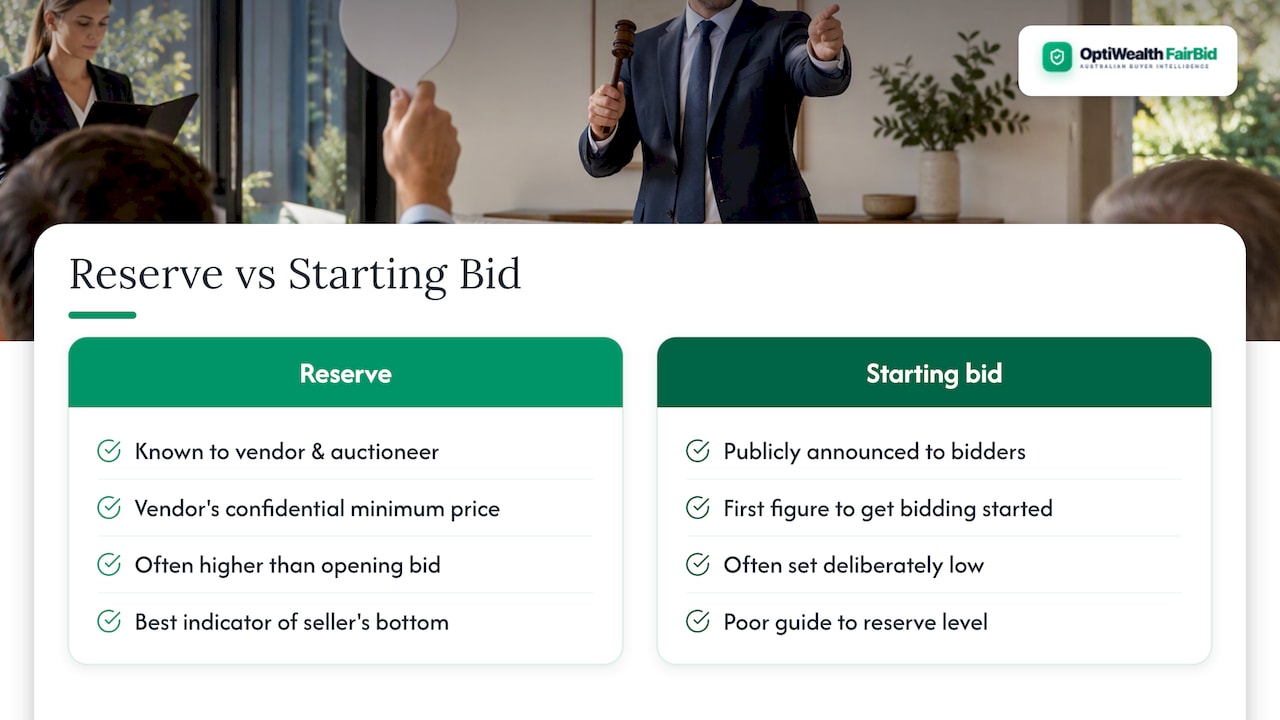
Treating the starting bid as any kind of guide to the reserve is a common mistake among first-time auction bidders, and one that an independent valuation corrects quickly by giving a buyer their own reference point instead.
How bidders try to work out the reserve during the auction
Because the reserve is never announced, experienced bidders read the auction room for indirect signals instead. The clearest cue is the auctioneer’s declaration that the property is “on the market,” which confirms the reserve has just been met and that every subsequent bid is now competing purely against other buyers rather than the vendor’s floor.
Before that point, bidders often watch for a pause in proceedings where the auctioneer steps away to consult the vendor privately, a common sign that bidding has stalled near, but not yet reached, the reserve. The pattern and size of vendor bids can also hint at how far the price still has to travel, since these bids are announced under state auctioneer rules and are meant to move the price towards the reserve rather than past it.
None of these signals are precise, and relying on them alone still leaves a bidder guessing. Pairing room observation with an independent valuation gives a buyer a number to bid against, rather than a feeling about where the vendor’s floor might sit.
How reserve price transparency changes bidder behaviour
Where reserve prices are disclosed earlier, buyer behaviour shifts noticeably in how a campaign unfolds. Victoria’s upcoming requirement to publish the reserve at least seven days before auction, detailed by Consumer Affairs Victoria, is designed to close the gap between an advertised price guide and the figure a vendor will actually accept.
Earlier disclosure tends to reduce the number of bidders who turn up expecting a price well below the true reserve, only to disengage once the figure becomes clear on the day. It also gives serious buyers more time to complete finance and inspection steps against a real number rather than a marketing estimate, which can support stronger attendance from genuinely qualified bidders rather than a mix of curious lookers and underprepared hopefuls.
For vendors, the trade-off is less room to use an ambiguous price guide to generate early interest before revealing a higher reserve on the day. The net effect regulators are targeting is a auction environment where the advertised figure and the vendor’s actual floor sit closer together, reducing the frustration that underquoting complaints have generated for years under guidance such as NSW Fair Trading’s underquoting rules.
What happens legally when a property fails to meet reserve
Failing to meet the reserve carries no legal penalty for either party: it simply means no contract has formed, because the vendor’s minimum condition for sale was never triggered. Consumer Affairs Victoria is clear that when bidding does not reach the reserve, the property may be passed in and the seller is under no obligation to accept the highest bid, regardless of how close that bid came to the reserve figure.
This is a materially different legal position from what happens once the property is declared on the market. At that point, the fall of the hammer on the highest bid creates a binding, unconditional contract, and the buyer cannot walk away without breaching that contract and risking loss of deposit or further legal exposure. Before the reserve is met, no such obligation exists on either side, which is why a passed-in result carries no contractual consequence of the parties moving to a private negotiation if they choose to.
The practical legal lesson for buyers is timing: everything before the property goes on the market is negotiation and posturing, while everything after is a signed, unconditional commitment with no cooling-off period to reconsider.
Reserve prices beyond real estate: art, collectibles and other auction types
Reserve prices are not unique to residential property, and the same core logic, a confidential seller floor beneath which the item will not be sold, applies across most auction formats used in Australia and internationally. Fine art auctions commonly use reserves to protect a vendor from a work selling for far less than its assessed value if bidding is thin on the night, with the auction house typically confidential about the exact figure in the same way a real estate auctioneer is.
Collectibles auctions, including memorabilia, wine, vehicles and rare items, follow a similar structure, often with the reserve set jointly by the seller and the auction house’s specialist valuers based on recent comparable sales of similar pieces. Online auction platforms sometimes display whether a reserve exists and whether it has been met, without revealing the actual figure, giving bidders a version of the “on the market” signal used in property auctions.
The consistent thread across every format is that the reserve exists to protect the seller’s downside, while the public bidding process is left to discover the genuine ceiling the market will pay, whether the item on the block is a house, a painting or a vintage car.
Why transparency and buyer-focused checks matter at auction
The gap between an advertised price guide and the true reserve is the single biggest source of friction at Australian property auctions, and it will not close entirely even as states like Victoria tighten disclosure timeframes. Buyers who wait for regulatory reform to solve this problem are relying on a process that still leaves the final figure in the vendor’s hands until the moment the hammer falls.
The more reliable fix sits with the buyer: commission an independent valuation, complete every inspection before auction day, and walk into the room with a number that reflects evidence rather than a marketing estimate. Watching state-level transparency reforms is worthwhile, but it should never replace doing the verification work yourself, because no disclosure rule removes the need for a defensible walk-away price.
OptiWealth FairBid: a practical tool to verify reserve realism and uncover hidden risks
Verifying a price guide against genuine market evidence, rather than the agent’s own estimate, is the single most effective step a buyer can take before registering to bid. OptiWealth FairBid offers a Free Tier at no cost and a Paid Advocate Tier priced at $4.99 one-off for a fuller audit report, both accessible through the OptiWealth AU app.
Using the platform before auction day follows a simple sequence:
- Run an audit on the specific address to generate an independent fair market valuation, separate from the agent’s advertised guide.
- Review the risk breakdown for structural defects, council overlays and, for units or apartments, special levy exposure.
- Set a walk-away price based on the audit rather than the advertised range or the mood in the auction room.
- Decide whether the evidence supports a pre-auction offer or bidding to your fixed limit on the day.
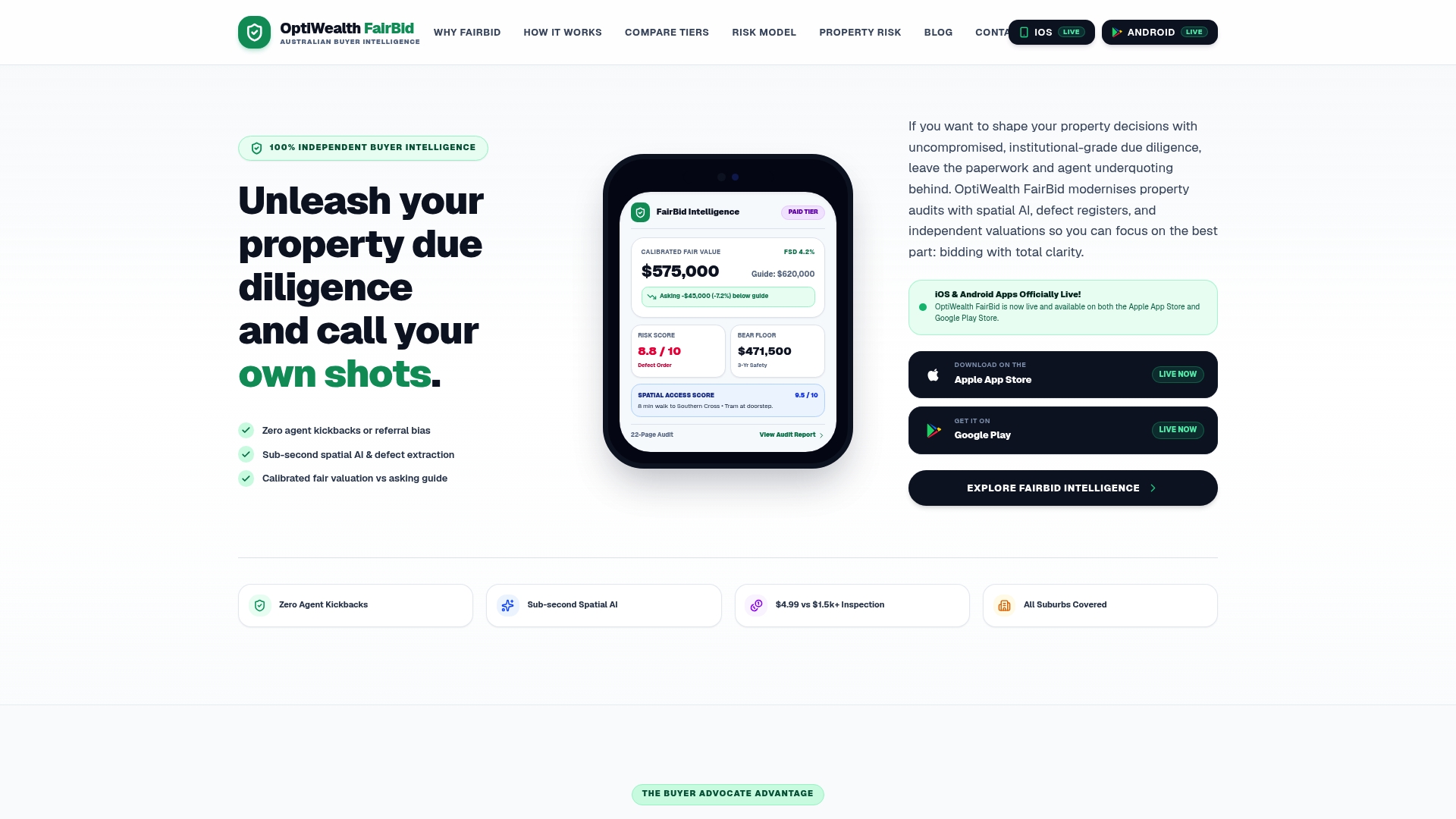
Because FairBid operates without agent commissions or advertising kickbacks, the valuation reflects the property’s own data rather than the campaign built around it. Buyers preparing for an auction who want that independent check before the reserve is even set can start with a property audit ahead of the next open home.
Authoritative government and regulator links for verification
Rules on reserve disclosure and underquoting change periodically, so it is worth checking your own state’s regulator directly before auction day. The sources below cover the main obligations discussed in this article:
- Consumer Affairs Victoria on selling by auction covers vendor obligations, on-market declarations and passed-in outcomes.
- Queensland’s guide to selling by auction covers vendor bids and written reserve requirements.
- NSW Fair Trading’s underquoting guidelines cover advertised price accuracy and buyer protections.
Sources
- Selling property by auction - Consumer Affairs Victoria
- Qld
- Underquoting guidelines for residential property - NSW Fair Trading
FAQ
Can you ask what the reserve price is?
You can ask the agent or auctioneer, but in most Australian states they are not permitted to disclose the reserve before it is met, as outlined in Queensland’s auction guidance. Victoria is moving towards earlier disclosure, with agents required to publish the reserve at least seven days before auction from October 2026 under changes confirmed by Consumer Affairs Victoria.
What are the disadvantages of a reserve price?
A reserve set too high relative to genuine market evidence often leads to a passed-in result, which can dampen bidder urgency and leave a stigma over any follow-up private sale, as noted in Queensland’s guidance on selling by auction. For buyers, the confidentiality of the reserve makes it harder to judge how close a bid is to securing the property until the auctioneer declares it on the market.
How do you calculate an auction reserve price?
Vendors typically base a reserve on recent comparable sales in the suburb, an agent’s comparative market analysis and, ideally, an independent valuation rather than the advertised marketing estimate alone. The reserve is usually finalised and given in writing to the auctioneer before the auction begins, as required in jurisdictions such as Queensland.
Can you bid below the reserve price?
Yes, bidding almost always starts below the reserve, and the auctioneer accepts bids from the floor until the total reaches that confidential figure. Only once bidding reaches the reserve does the auctioneer declare the property “on the market,” at which point the highest bid at the fall of the hammer becomes a binding, unconditional contract, as described by Consumer Affairs Victoria.
Recommended
- FairBid Property Intelligence & Due Diligence
- FairBid Property Intelligence & Due Diligence
- FairBid Property Intelligence & Due Diligence
- Property Risk Audit & Quantitative Valuation
The information provided in this publication is for educational and general information purposes only and does not constitute financial, investment, taxation, or legal advice under the Corporations Act 2001 (Cth). Property buyers and investors should conduct independent physical, legal, and strata due diligence and seek advice from a licensed financial advisor, solicitor, or conveyancer tailored to their personal objectives before entering into any legally binding contract of sale.
OptiWealth Research
Transparent Data Science & EngineeringData Science, Software Architecture & Mathematical Risk Modeling Group
Authored by OptiWealth’s Quantitative & Data Engineering division. Our team specializes in full-stack software architecture, open-source data science, and spatial econometric property valuation (such as hedonic price regression, environmental zoning overlay synthesis, and cash-flow yield analytics). All underlying algorithms and calculation formulas are fully transparent, open to inspection, and designed purely for financial and property data visualization.
Expose Hidden Property Risks & Liabilities
OptiWealth replaces guessing games with algorithmic diagnostics. Use FairBid to audit council overlays, building defects, and calculate true net property yields.