Protect Buyers From 10 Year Special Levy Risk in Strata Levies

This tool is a generic calculator and does not advertise or promote a specific financial product. It is not intended to be relied on for the purposes of making a decision in relation to a financial product. You should consider obtaining advice from a financial services licensee before making any financial decisions.
Protect Buyers From 10 Year Special Levy Risk in Strata Levies
Strata levies are regular contributions all lot owners pay to fund a scheme’s running costs, insurance and long-term repairs. The owners corporation sets levy amounts annually at the annual general meeting, and most schemes bill owners in quarterly instalments. The three largest budget lines are routine maintenance, building insurance and fund administration, with the precise split varying by scheme age, size and condition.
TL;DR:
- Levies fund routine maintenance, building insurance, and sometimes major repairs, with aging assets and higher insurance costs likely to increase fees.
- Separate funds cover recurring operational costs and major capital works, with special levies triggered by unforeseen expenses exceeding the existing reserves.
- Levy calculations depend on each lot’s unit entitlement, which reflects its relative value, and schemes often have ten-year plans to forecast future capital expenses.
- Unpaid levies can lead to interest, debt recovery, and voting restrictions, but owners facing hardship can arrange payment plans and seek mediation if necessary.
- Buyers should review detailed financial statements, recent minutes, and a current 10-year capital works plan, and consider independent audits to assess future levy risks.
Table of Contents
- What levies pay for: running costs, insurance and capital works
- Administrative, capital works and special levy funds explained
- How levies are calculated: unit entitlement and a worked example
- Why the 10-year capital works plan matters to your levies
- Notice periods, arrears and hardship support for unpaid levies
- A buyer’s checklist for levies before you exchange
- How an independent audit can expose hidden levy risk
- Resolving disagreements over strata levies
- Reading levies as a risk signal, not just a cost
- A practical next step: independent levy-risk audits with OptiWealth FairBid
- FAQ
- Sources
What levies pay for: running costs, insurance and capital works
Levies fund two distinct categories of expense, and understanding the split matters because it explains why two buildings of similar size can carry very different fees.
Day-to-day administrative costs cover the operational reality of shared living: cleaning contracts, garden maintenance, caretaking or building management wages, common-area electricity and water, and strata management fees. These are predictable, recurring costs that rarely spike without warning.
Building insurance is a statutory obligation for most owners corporations, and the premium is funded through levies. Premiums have climbed sharply in many parts of Australia in recent years, particularly for buildings in flood-prone or bushfire-affected zones, and that increase flows directly into the next levy notice.
Capital works, by contrast, are funded from a separate account: the capital works fund, often still called the sinking fund. This pays for roof replacement, lift overhauls, facade repairs, structural remediation and other major, infrequent works.
Several factors reliably push levies upward:
- Ageing lifts, roofs or waterproofing membranes approaching the end of their service life
- Rising insurance premiums tied to location risk, including flood and bushfire overlays
- Legal costs from disputes, defect claims or building certification issues
- A history of deferred maintenance that has to be addressed all at once
Administrative, capital works and special levy funds explained
Every strata scheme in Australia operates at least two separate funds, and sometimes a third.
The administrative (or operating) fund covers recurring costs: insurance, utilities, cleaning, minor repairs and management fees. It is replenished every budget cycle and rarely accumulates a large surplus.
The capital works fund, sometimes called the sinking fund, exists for major, irregular expenses: structural repairs, repainting, lift replacement and common-property renewals. In New South Wales, owners corporations are legally required to prepare a 10-year capital works fund plan using a mandatory standard form, which forecasts major works and the levy contributions needed to fund them.
Special levies arise when the existing funds cannot cover an unexpected or underestimated cost, such as a storm-damage repair or a defect remediation project that exceeds the sinking fund balance. Approval typically requires a resolution at a general meeting, and the amount is apportioned according to each lot’s unit entitlement.
Key points to watch in a levy notice or budget:
- Whether the expense belongs in the administrative fund or the capital works fund
- Whether a special levy has been flagged in recent minutes but not yet billed
- Whether a very small scheme has been granted any state-specific exemption from standard fund requirements
How levies are calculated: unit entitlement and a worked example
Levies are not divided evenly between lots. Each lot carries a unit entitlement, sometimes called lot liability, recorded in the strata plan or community management statement, and this figure reflects the lot’s relative value within the scheme. A larger apartment with a bigger balcony or car space typically carries a higher entitlement than a small one-bedroom unit, and pays a proportionally larger share of every levy.
The calculation itself is straightforward once the entitlements are known. The owners corporation sets a total annual budget, then divides that figure by the scheme’s total unit entitlements to find the levy rate per entitlement. Each lot’s levy equals its entitlement multiplied by that rate.
As an illustrative example only, say a scheme has a total annual budget of $200,000 across administrative and capital works funds, and total unit entitlements of 1,000 across all lots. The levy rate works out to $200 per entitlement. A lot with an entitlement of 10 would pay $2,000 a year, typically billed as four quarterly instalments of $500.
Some costs sit outside this standard formula. Building insurance is occasionally apportioned differently where a scheme’s by-laws specify it, interim levies can be raised mid-year if costs exceed the budget, and works that benefit only certain lots, such as a dedicated car park structure, can sometimes be charged only to those lots rather than spread across the whole scheme.
Why the 10-year capital works plan matters to your levies
A scheme’s long-term financial health depends on the accuracy of its capital works forecasting, not just its current levy figure. In New South Wales, the 10-year capital works fund plan must use the mandatory standard form and should be reviewed periodically, ideally updated at least every five years and checked annually against actual spending.
The annual budget links directly to the levy amount owners pay: the owners corporation estimates the year’s likely expenses, including the contribution required to stay on track with the 10-year plan, and divides that total by unit entitlements to set the levy rate and instalment schedule.
Plans prepared by a quantity surveyor or other qualified professional tend to be more reliable than estimates drawn up informally by a committee, and buyers should treat professionally prepared forecasts as a positive signal. A plan that has not been updated in years, or one that defers major works repeatedly without adjusting the budget, is a warning sign that the scheme is accumulating risk that will eventually land on owners as a special levy.
Notice periods, arrears and hardship support for unpaid levies
Owners corporations must give written notice of levies, and the statutory minimum notice is generally at least 30 days for ordinary levies, with shorter periods permitted for urgent or emergency repairs in some jurisdictions.
Unpaid levies attract consequences that escalate quickly. Interest accrues on overdue amounts, the owners corporation can pursue debt recovery action, and an owner significantly in arrears can lose their right to vote at general meetings until the debt is cleared.
Owners facing genuine financial hardship are not without options. Strata committees can approve payment plans for owners struggling to pay, and mediation or tribunal pathways exist for disputed amounts before matters escalate to formal debt recovery. Practical steps include keeping a clear record of every levy notice and payment, prioritising levy payments alongside other essential household costs, and contacting the strata manager early rather than letting arrears build. The National Debt Helpline is a useful starting point for owners who need broader financial guidance.
A buyer’s checklist for levies before you exchange
Before exchanging on a strata property, request the full financial picture rather than relying on a single certificate.
- Obtain the strata certificate and treat it as a snapshot only, not a full history.
- Request the latest financial statements, including fund balances for both the administrative and capital works accounts.
- Read at least two to three years of AGM and committee meeting minutes for mentions of deferred maintenance, disputes or proposed works.
- Check the 10-year capital works plan for its age, who prepared it and whether funding matches the forecast.
- Ask directly whether any special levy has been proposed or approved but not yet reflected in current levy notices.
- Confirm how an outstanding or upcoming special levy is treated at settlement, since liability can sometimes transfer to the new owner depending on timing and contract terms.
- Arrange an independent building inspection where the scheme’s history suggests unresolved structural issues.
Consumer guidance in Victoria specifically warns buyers not to rely solely on the strata certificate, since it may miss hidden defect histories or ongoing disputes that only appear in the minutes.
Pro Tip: Compare the scheme’s levies against a similar-aged building in the same suburb; an unusually low figure often signals deferred maintenance rather than good management.
How an independent audit can expose hidden levy risk
A strata certificate is a point-in-time document, and meeting minutes are only as thorough as the committee that wrote them. Recurring defect repairs, unresolved disputes and overlay risks such as flood or bushfire exposure often sit buried across several years of records rather than in any single document.
An independent audit that combines minutes, levy history, defect records and overlay data builds a more complete picture of likely future costs than the current budget alone. This kind of address-level analysis can flag underfunded capital works accounts, recurring repair patterns and overlay exposure that are likely to translate into a special levy within a few years, even when the current levy figure looks unremarkable.
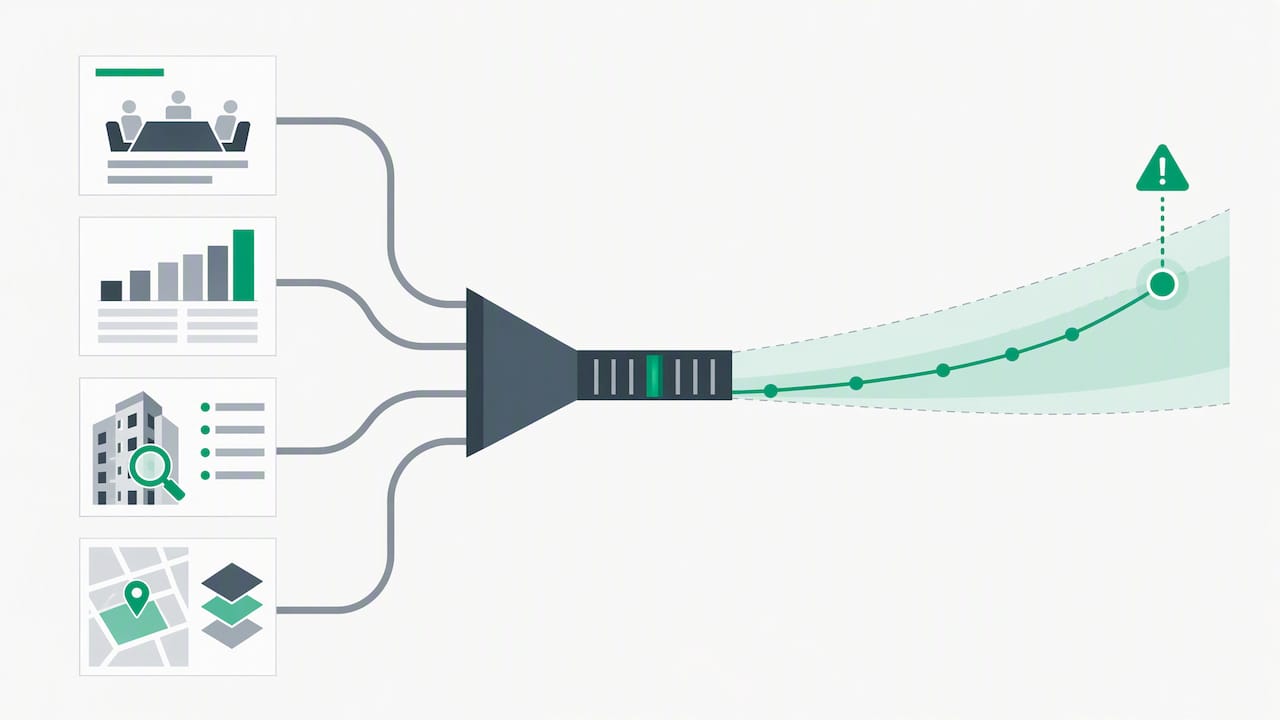
For buyers weighing a purchase, stress-testing a property’s likely future levy trajectory against its documented history is a more reliable approach than taking the current budget at face value.
Resolving disagreements over strata levies
Disputes over levies usually fall into a handful of recurring categories: disagreement over a special levy’s necessity or size, disputes about unit entitlement apportionment, or claims that an owner has been incorrectly charged for works that should benefit only certain lots.
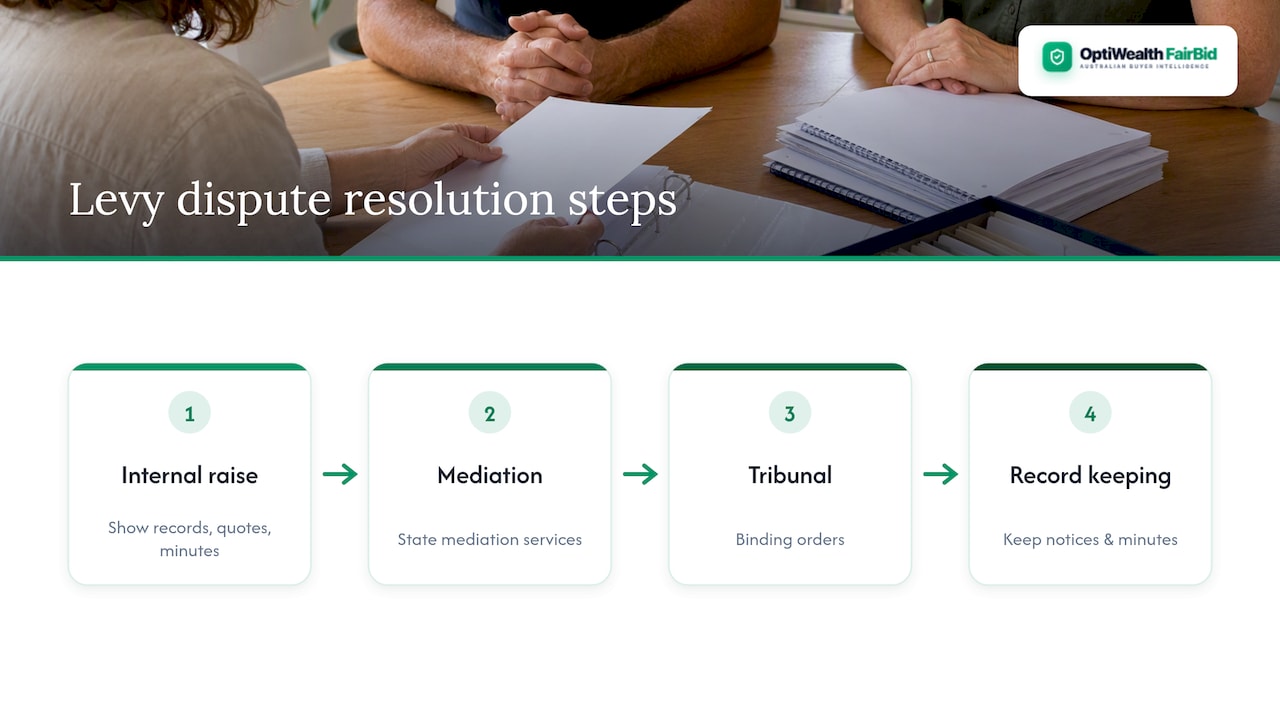
The first step in any dispute is usually internal: raising the issue at a committee meeting or general meeting, supported by the financial records and minutes that explain how the figure was reached. Many disagreements are resolved once an owner sees the underlying quotes, budget breakdown or entitlement schedule.
Where internal resolution fails, most states offer mediation services as a lower-cost, less adversarial next step before matters proceed to a tribunal. Strata or civil and administrative tribunals can hear disputes over levy amounts, special levy approvals and unit entitlement calculations, and can make binding orders.
Common issues that trigger disputes include a special levy raised without proper notice or resolution, a capital works estimate that an owner believes is inflated, or a lot owner disputing their unit entitlement on the basis that it no longer reflects the lot’s relative value. Owners seeking an adjustment to their entitlement generally need to apply through the relevant state tribunal rather than through a simple committee vote, since entitlement changes affect every other lot’s levy share.
Keeping detailed records of notices, minutes and correspondence makes any dispute, whether resolved internally or externally, considerably easier to pursue.
Reading levies as a risk signal, not just a cost
Low levies are not automatically good news. They can just as easily signal deferred maintenance as they can signal efficient management, and high levies can reflect genuine service quality rather than mismanagement. We’d encourage weighing any levy figure against the building’s age, amenities and recent defect history before drawing conclusions.
— JeongSuk Lee
A practical next step: independent levy-risk audits with OptiWealth FairBid
Document checks and minutes reviews go a long way, but they rely on what a committee chose to record. We built our platform to close that gap with independent, address-level audits that combine spatial AI analysis with structural, planning and financial data, without any agent commissions or listing kickbacks shaping the result.
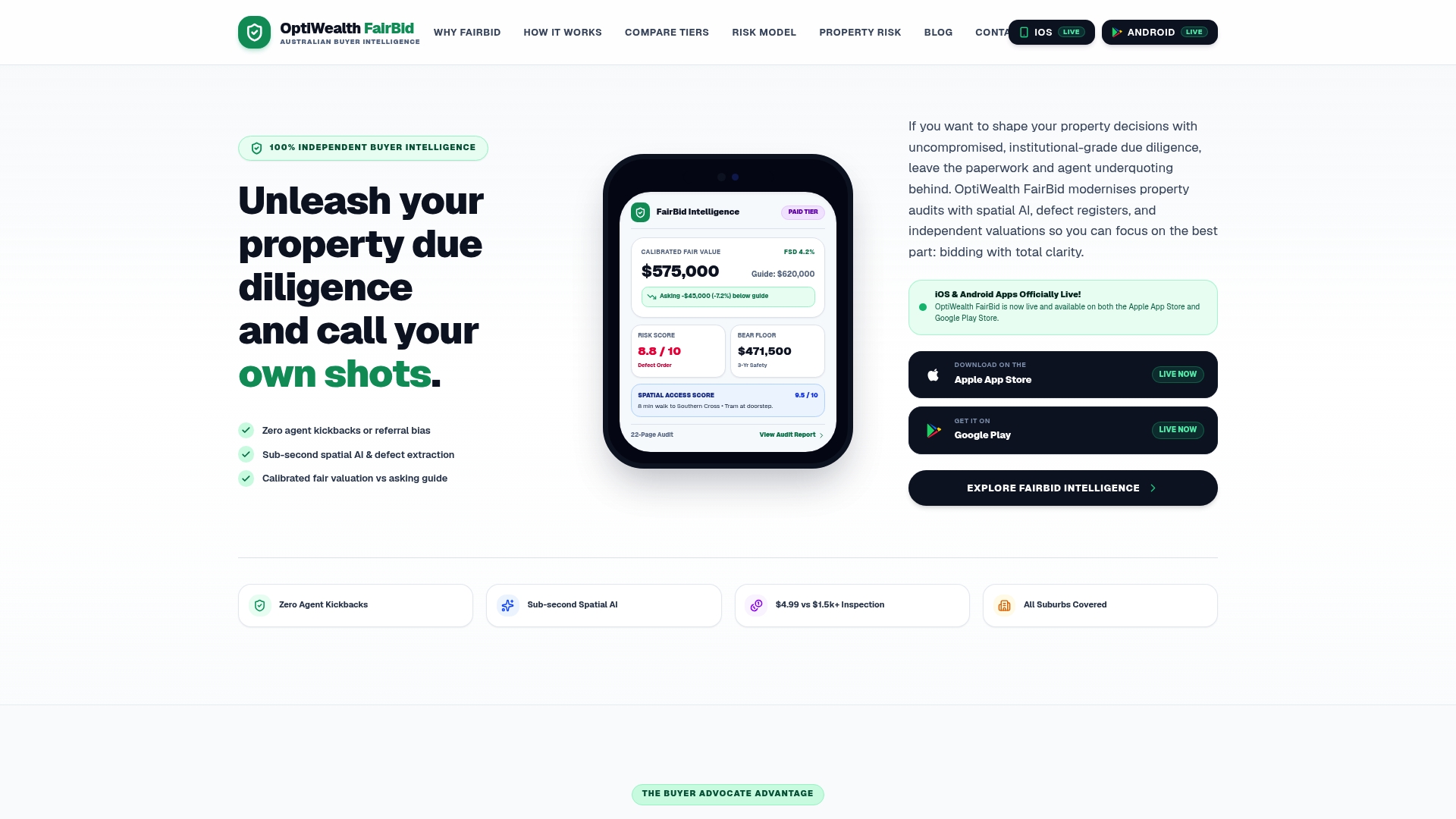
A FairBid audit can surface:
- Likely special-levy triggers based on defect patterns and overlay exposure
- Signs of an underfunded capital works account relative to the scheme’s age and condition
- Comparative levy benchmarking against similar buildings in the same suburb
For buyers who also need an estate or will sort before settlement, WillBuddy’s guide to executor fees is a useful companion resource.
Before you exchange on a strata property, check what an independent audit can show you and start with our free tier or move straight to the Paid Advocate Tier for a full property-level report.
FAQ
How is strata levy calculated?
Levies are calculated by dividing the scheme’s total annual budget by its total unit entitlements to find a rate, then multiplying each lot’s entitlement by that rate. A lot with a higher entitlement, usually reflecting a larger or more valuable unit, pays a proportionally larger share.
Why are some strata fees so high?
High fees usually reflect either a high level of shared amenity and service, such as lifts, pools or concierge staff, or rising insurance premiums tied to a building’s location and risk profile. They can also reflect a scheme catching up on deferred maintenance through increased capital works contributions.
Can I refuse to pay body corporate fees?
No, levies are a legal obligation tied to lot ownership, and refusing to pay can lead to interest charges, debt recovery action and loss of voting rights at meetings. Owners facing financial hardship should contact their strata manager about a payment plan rather than simply not paying.
Do strata levies include building insurance?
Yes, building insurance is typically funded through the administrative fund as part of regular levies, since most owners corporations are required to maintain building insurance. The specific apportionment can vary where a scheme’s by-laws set a different method.
Sources
- Your strata levies, finances and insurance — NSW Government
- Buying an apartment or unit — Consumer Affairs Victoria
Recommended
The information provided in this publication is for educational and general information purposes only and does not constitute financial, investment, taxation, or legal advice under the Corporations Act 2001 (Cth). Property buyers and investors should conduct independent physical, legal, and strata due diligence and seek advice from a licensed financial advisor, solicitor, or conveyancer tailored to their personal objectives before entering into any legally binding contract of sale.
OptiWealth Research
Transparent Data Science & EngineeringData Science, Software Architecture & Mathematical Risk Modeling Group
Authored by OptiWealth’s Quantitative & Data Engineering division. Our team specializes in full-stack software architecture, open-source data science, and spatial econometric property valuation (such as hedonic price regression, environmental zoning overlay synthesis, and cash-flow yield analytics). All underlying algorithms and calculation formulas are fully transparent, open to inspection, and designed purely for financial and property data visualization.
Expose Hidden Property Risks & Liabilities
OptiWealth replaces guessing games with algorithmic diagnostics. Use FairBid to audit council overlays, building defects, and calculate true net property yields.