$4.99 FairBid Audit: Strata Report Explained for NSW, QLD and VIC Buyers

This tool is a generic calculator and does not advertise or promote a specific financial product. It is not intended to be relied on for the purposes of making a decision in relation to a financial product. You should consider obtaining advice from a financial services licensee before making any financial decisions.
$4.99 FairBid Audit: Strata Report Explained for NSW, QLD and VIC Buyers
A strata report (strata search) summarises an owners corporation’s records: finances, levies, insurance, minutes and disputes, and every Australian buyer should obtain one before exchange. It reveals whether the scheme is financially sound or heading towards a special levy, whether disputes are brewing, and whether insurance cover is current. We regard it as the single most useful document in a unit purchase after the contract itself.
TL;DR:
- A healthy sinking fund should cover major repairs for several years, while a near-zero or negative fund signals potential special levies soon.
- Large unpaid levy arrears or repeated dispute mentions, especially related to building defects, indicate financial stress and legal risks for the scheme.
- A valid insurance policy must be current with a reviewed sum insured, as lapses or upcoming expiry date pose significant risks to owners.
- Significant ongoing motions about structural issues or major works, combined with outdated sinking fund forecasts, often warn of upcoming high costs.
- Pairing the strata report with an independent building and pest inspection fills knowledge gaps and reduces the risk of surprise costs after purchase.
Table of Contents
- What a strata report contains: financials, minutes, by-laws and insurance
- Financial health and levies: how to interpret the figures
- Insurance, disputes and legal matters to watch for
- Maintenance, defects and building compliance (including cladding)
- How to get a strata report in Australia and typical costs
- How to read a strata report: red flags and a buyer checklist
- Strata report versus building inspection: what each covers
- Next steps: short checklist for buyers after reviewing a strata report
- Why strata checks save buyers money long term
- How OptiWealth FairBid helps you cross-check what the strata report shows
- FAQ
- Sources
What a strata report contains: financials, minutes, by-laws and insurance
A standard strata report compiles several categories of owners corporation records, each telling a different part of the financial and legal story.
- Financial statements: these separate the administrative (operating) fund, which covers day-to-day costs, from the capital works (sinking) fund, which pays for major items like roof replacement or repainting.
- Meeting minutes: recent AGM and committee minutes often contain motions about proposed works, consultant engagements or disputes well before they appear in the budget.
- By-laws: these can restrict renovations, pets or short-term letting, and a buyer who plans to renovate needs to check them before signing.
- Insurance certificates: these confirm whether building insurance is current, what it covers and when it expires.
- Defect records and compliance notes: consultant reports on cladding, waterproofing or structural issues usually surface here first.
In NSW, a strata search report reviews owners corporation records under the Strata Schemes Management Act 2015 and is built around exactly these categories. Reading all five sections together, rather than skimming the balance sheet alone, is what separates a thorough review from a rushed one.
Financial health and levies: how to interpret the figures
The numbers in a strata report only matter once you know what they imply for future costs.
- A healthy sinking fund holds enough to cover forecast capital works for several years without needing a special levy; a fund that is barely positive signals the scheme is one repair away from a big bill.
- Unpaid levies and rising arrears mean other owners are not paying their share, which can force the scheme to either chase debts through costly legal action or raise levies to cover the shortfall.
- Special levies are typically triggered by capital works such as roof replacement, structural remediation or lift upgrades that the sinking fund cannot absorb.
- Trend checks matter more than a single year’s snapshot: compare levy figures across the last three to five years and search minutes for proposed works that have not yet reached the budget.
Pro Tip: Read the last 12 months of minutes closely. Motions mentioning “consultant report commissioned” or “quotes under review” are often the earliest sign of a special levy still to come.
Insurance, disputes and legal matters to watch for
Owners corporations are generally required to hold building insurance, and a strata report should show whether that cover is current and what it includes.
- Check the expiry date on the certificate of currency, not just the policy name, since a lapsed or soon-to-expire policy is a genuine exposure for every owner.
- Read dispute entries carefully: an unresolved tribunal claim or a long-running dispute between owners can eventually land on the whole scheme as a legal cost or a levy.
- Treat repeated dispute mentions as a red flag, particularly where they relate to building defects or insurance claims, since these often precede either a premium increase or a special levy to cover excess payments.
Maintenance, defects and building compliance (including cladding)
Maintenance records split into two categories that matter for very different reasons. Routine maintenance, such as gardening or minor repairs, is funded from the administrative budget and rarely affects a buyer’s costs. Capital works, by contrast, draw on the sinking fund and can trigger a special levy if that fund is thin.
- Consultant reports and recurring motions about the same structural issue across several sets of minutes usually indicate a systemic defect rather than a one-off repair.
- Cladding and fire safety compliance are among the costliest categories nationally, since remediation can run into significant sums per lot and often cannot be deferred once an order is issued.
- Waterproofing and structural cracking mentioned more than once in consultant notes deserve a direct question to the strata manager about timing and expected cost.
How to get a strata report in Australia and typical costs
The process and the paperwork differ by state, though the goal is the same everywhere: confirm the scheme’s financial and legal position before you are contractually bound.
- Identify who holds the records: this is usually the owners corporation, its appointed strata manager, or the selling agent, and a conveyancer can usually order the search on your behalf.
- In NSW, request a strata search before exchange; agents must disclose known pre-purchase inspection reports once a contract of sale is requested.
- In Queensland, sellers must provide a body corporate certificate and community management statement before contract; accessing records carries set fees, with example costs of $43.45 for some record inspections and $86.95 for a certificate under form 18, plus an optional priority fee.
- In Victoria, the owners corporation certificate is included in the Section 32 / vendor statement, and prospective buyers also have rights to inspect the owners corporation register directly.
How to read a strata report: red flags and a buyer checklist
Once the report arrives, work through it in a deliberate order rather than skimming for a summary page, since the warning signs are usually buried in the detail.
- Scan for proposed or recent special levies, which are the clearest sign that ordinary levies have not kept pace with the scheme’s capital needs.
- Look for outstanding consultant quotes sitting in recent minutes without a funding decision attached.
- Check arrears figures against the total annual levy pool; large unpaid balances point to financial stress across the scheme.
- Confirm insurance is current and that the sum insured has been reviewed recently.
- Note repeated motions about major works, since a single mention can be exploratory but three consecutive sets of minutes on the same item usually means action is imminent.
When red flags appear, request the latest AGM minutes, the sinking fund forecast and any consultant reports by name before proceeding.
Pro Tip: If the sinking fund forecast is more than 12 months old, ask the strata manager for an updated figure before you rely on it in negotiations.
From there, a conveyancer can advise on contractual protections, and an engineer or special-purpose report can quantify a defect that the minutes only describe in general terms.
Strata report versus building inspection: what each covers
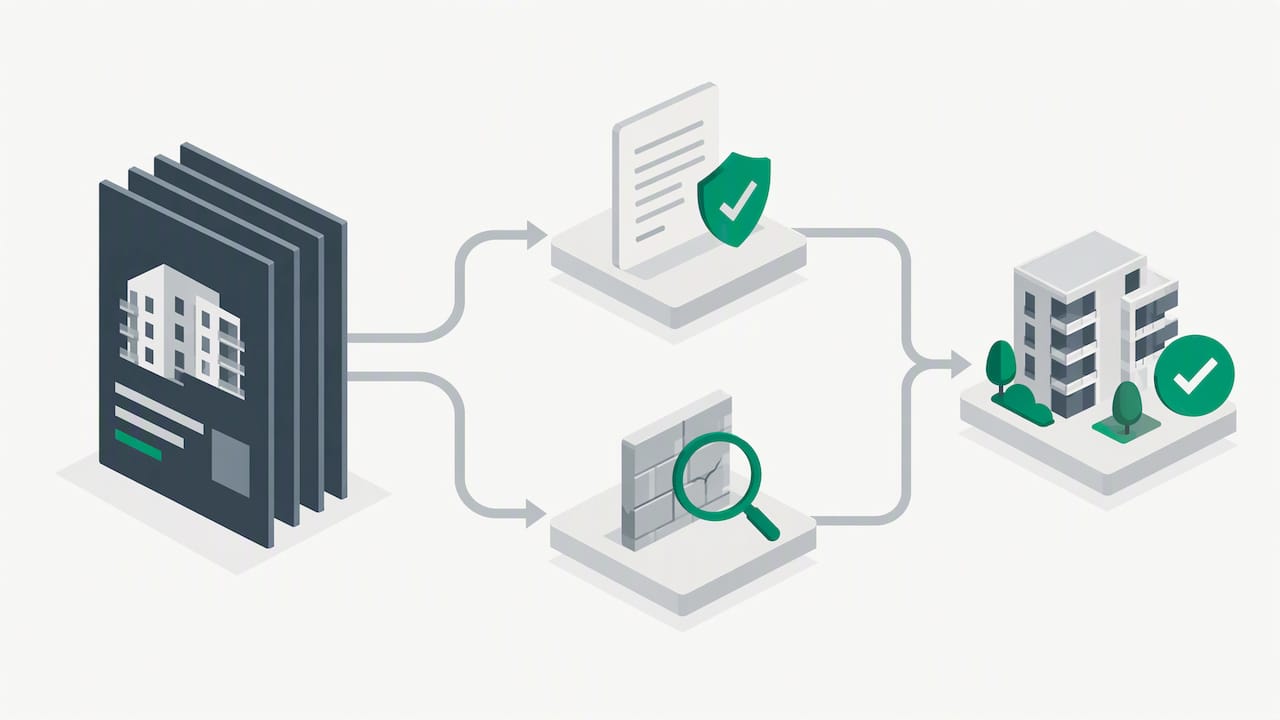
A strata report and a building inspection answer different questions, and most buyers need both.
- A strata report covers documents: finances, minutes, by-laws and insurance for the whole scheme.
- A building inspection (following the AS 4349 standard) covers the physical condition of your specific lot and, where commissioned, pest activity.
- Standard inspections typically exclude common property, such as the roof or shared stairwells, unless a special-purpose report is separately commissioned for those areas.
Relying on one without the other leaves a genuine gap in what you know about the property.
Next steps: short checklist for buyers after reviewing a strata report
Before you commit, work through a short list of final checks.
- Order updated levy figures and the most recent minutes if the report you have is more than a few months old.
- Arrange a building and pest inspection for the lot itself, since the strata report will not cover this.
- Request quotes for any proposed works mentioned in minutes but not yet funded.
- Seek an engineer’s opinion or conveyancer’s advice if red flags like arrears or recurring defect motions appear.
- Cross-check environmental overlays, since the NSW planning portal’s flood dataset can reveal flood risk that sits outside the strata report entirely and still affects insurance and resale value.
In Victoria, a special levy that exceeds double the annual fees requires a special resolution with 75% owner support, which is a useful threshold to keep in mind when assessing how easily a scheme could fund a large repair.
Why strata checks save buyers money long term
We think the biggest misconception among buyers is treating a clean strata report as a guarantee rather than a snapshot. It only describes the past, and minutes mentioning a consultant report or a quote under review are often the first hint of a levy still to land. Pairing documentary checks with an independent, address-based audit closes that gap faster than reading minutes alone.
— JeongSuk Lee
How OptiWealth FairBid helps you cross-check what the strata report shows
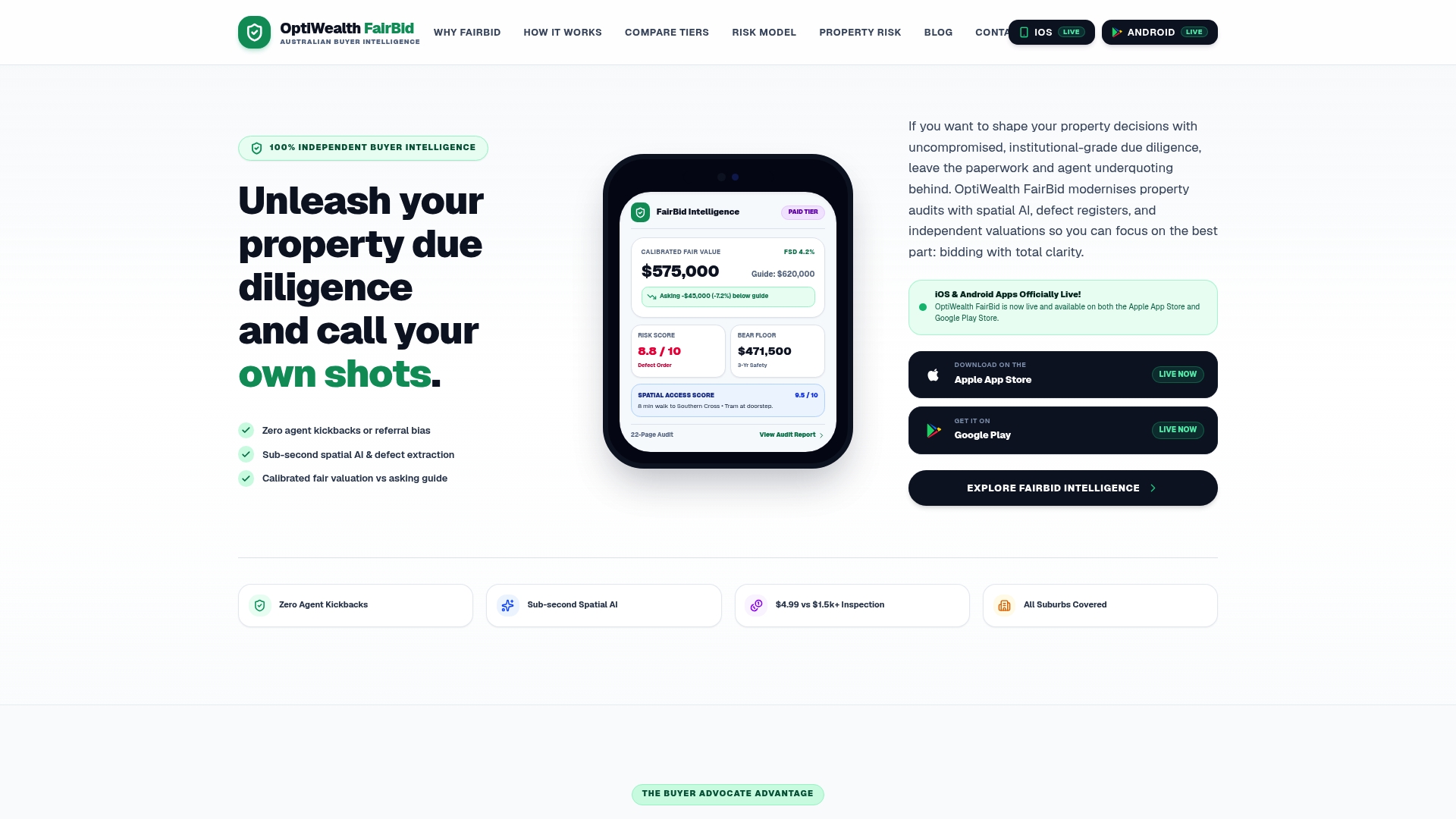
We built OptiWealth FairBid to give Australian buyers an independent, address-based audit that sits alongside the strata report rather than replacing it. Our spatial AI analysis flags council overlays, structural risk indicators and valuation context in one report, with zero agent kickbacks shaping the result. A sample property audit shows the format, and the Free Tier gives you a starting point before deciding whether the Paid Advocate Tier, at $4.99 one-off, suits a specific address you are assessing.
FAQ
What is a strata property in Australia?
A strata property is a unit, apartment or townhouse within a scheme where you own your individual lot outright and share ownership of common property, such as stairwells and gardens, with other owners through an owners corporation or body corporate.
How much does it cost to get a strata report in NSW, Australia?
NSW does not set a single fixed strata search fee, though Queensland’s equivalent records carry set example fees such as $43.45 for some inspections and $86.95 for a body corporate certificate. In NSW, your conveyancer typically arranges the search and can quote the current fee for your specific scheme.
Can a strata title be changed?
Strata titles can be altered through processes such as lot consolidation, subdivision or by-law amendment, but these changes require formal owners corporation resolutions and, in most states, registration with the relevant land titles office. The exact process and required majority vary by state.
Who owns the land in a strata title in NSW?
In a NSW strata scheme, the land and common property are owned collectively by all lot owners through the owners corporation, while each owner holds individual title to their own lot. This structure is set out under the Strata Schemes Management Act 2015.
Sources
- Buying a strata property | NSW Government
- Qld
- Buying an apartment or unit - checklist - Consumer Affairs Victoria
Recommended
The information provided in this publication is for educational and general information purposes only and does not constitute financial, investment, taxation, or legal advice under the Corporations Act 2001 (Cth). Property buyers and investors should conduct independent physical, legal, and strata due diligence and seek advice from a licensed financial advisor, solicitor, or conveyancer tailored to their personal objectives before entering into any legally binding contract of sale.
OptiWealth Research
Transparent Data Science & EngineeringData Science, Software Architecture & Mathematical Risk Modeling Group
Authored by OptiWealth’s Quantitative & Data Engineering division. Our team specializes in full-stack software architecture, open-source data science, and spatial econometric property valuation (such as hedonic price regression, environmental zoning overlay synthesis, and cash-flow yield analytics). All underlying algorithms and calculation formulas are fully transparent, open to inspection, and designed purely for financial and property data visualization.
Expose Hidden Property Risks & Liabilities
OptiWealth replaces guessing games with algorithmic diagnostics. Use FairBid to audit council overlays, building defects, and calculate true net property yields.