Avoid Thousands in Special Levies: Strata or Torrens Title Australia

This tool is a generic calculator and does not advertise or promote a specific financial product. It is not intended to be relied on for the purposes of making a decision in relation to a financial product. You should consider obtaining advice from a financial services licensee before making any financial decisions.
Avoid Thousands in Special Levies: Strata or Torrens Title Australia
Torrens title gives you sole ownership of the land and the building on it, with full autonomy over renovation and maintenance decisions. Strata title gives you exclusive ownership of a lot, typically a unit or town house, plus a proportional share of common property governed collectively by an owners corporation. Buyers seeking control and freedom from shared decision-making generally favour Torrens; buyers prioritising lower-maintenance living and shared amenities lean toward strata. Before bidding or signing, run the due-diligence checklist below.
TL;DR:
- Buyers should verify the financial condition of the scheme’s capital works fund and check for any pending special levies or unresolved disputes before purchasing a strata property.
- Strata owners are liable for ongoing levies that fund common property maintenance and insurance, which may result in unexpected costs if the scheme’s reserves are underfunded.
- Torrens title offers full autonomy and control over maintenance, but it entails full responsibility for all repair costs without shared funding, making it more suitable for buyers seeking independence.
- Lenders assess strata properties based on both land value and scheme health, potentially restricting mortgage approvals or reducing loan-to-value ratios for poorly managed schemes.
- Conducting independent due diligence, including registry searches and scheme reviews, is critical to identify hidden risks like deferred maintenance, defect disputes, or scheme insolvency.
Table of Contents
- Torrens title versus strata title: how ownership, costs and duties compare
- Weighing the trade-offs: pros and cons for buyers and investors
- Hidden risks that change the real cost of buying
- Your due-diligence checklist before you sign or bid
- Matching your goals to the right title
- Who fixes what: maintenance and repair responsibilities compared
- How title type affects financing and mortgage approval
- When buyers typically choose one title over the other
- Resolving disputes: strata schemes versus standalone titles
- Why independent verification matters more than agent summaries
- Getting an independent audit before you commit
- Where to verify these facts yourself
- Sources
- FAQ
Torrens title versus strata title: how ownership, costs and duties compare
The two systems diverge in every practical respect once you own the property, not just on paper.
Under the Torrens system, a single certificate of title records the owner, the land boundaries and any registered interests such as mortgages or easements. The state land register guarantees this record through the principle of indefeasibility, meaning your ownership is protected against most competing claims once registered. You pay council rates directly, and you are solely responsible for maintaining the land and every structure on it, from the roof to the fence line.
Strata title splits ownership into two layers. You hold exclusive title to your lot (generally the interior of your unit) while sharing ownership of common property such as stairwells, gardens and structural walls with every other lot owner in the scheme. An owners corporation, sometimes called a body corporate, manages that common property and collects levies to fund its upkeep and insurance.
The practical differences show up here:
- Torrens owners pay council rates and arrange their own building insurance and repairs.
- Strata owners pay levies into scheme funds, including a capital works fund, and the owners corporation typically arranges building insurance for common property.
- Torrens owners make unilateral decisions about their property, subject only to planning and building rules.
- Strata owners are bound by scheme by-laws and majority votes at owners corporation meetings.
A title search will show a Torrens property as a single lot with one owner and a strata property as a lot linked to a strata plan, with the schedule of unit entitlements determining your share of levies and voting weight.
Weighing the trade-offs: pros and cons for buyers and investors
Torrens title suits buyers who want full control. You can renovate, extend or landscape without seeking approval from anyone but your council, and you avoid strata levies entirely. The trade-off is that you shoulder every maintenance cost alone, from a failing roof to a cracked driveway, and detached houses in desirable suburbs often carry a higher entry price than comparable strata stock.
Strata title suits buyers who want shared costs and less hands-on upkeep. Common property maintenance, building insurance and amenities such as pools or lifts are pooled across owners, and entry prices are typically lower than for an equivalent detached home. The trade-off is exposure to levies, by-laws that can restrict renovations or pets, and outcomes decided by majority vote rather than by you alone.
For investors, the calculation adds two variables: rental demand for the dwelling type in that suburb, and the financial health of the scheme.
- A strata scheme with a well-funded capital works fund and professional management reduces the risk of sudden special levies eating into rental yield.
- A Torrens investment property carries no scheme risk but concentrates all repair costs, and timing, on the investor alone.
Hidden risks that change the real cost of buying
The advertised price rarely reflects the full financial exposure of either title type, and strata carries risks that will not appear on a standard contract summary.
Underfunded capital works funds are the single biggest hidden cost in strata. NSW guidance confirms that schemes must maintain a capital works fund and a 10-year plan, and that works valued at or above a substantial threshold generally require at least two independent quotes, with owners typically given a reasonable notice period to pay a levy, with shorter notice for emergency repairs. A scheme that has deferred major works can hit owners with a special levy running into thousands of dollars with little warning.
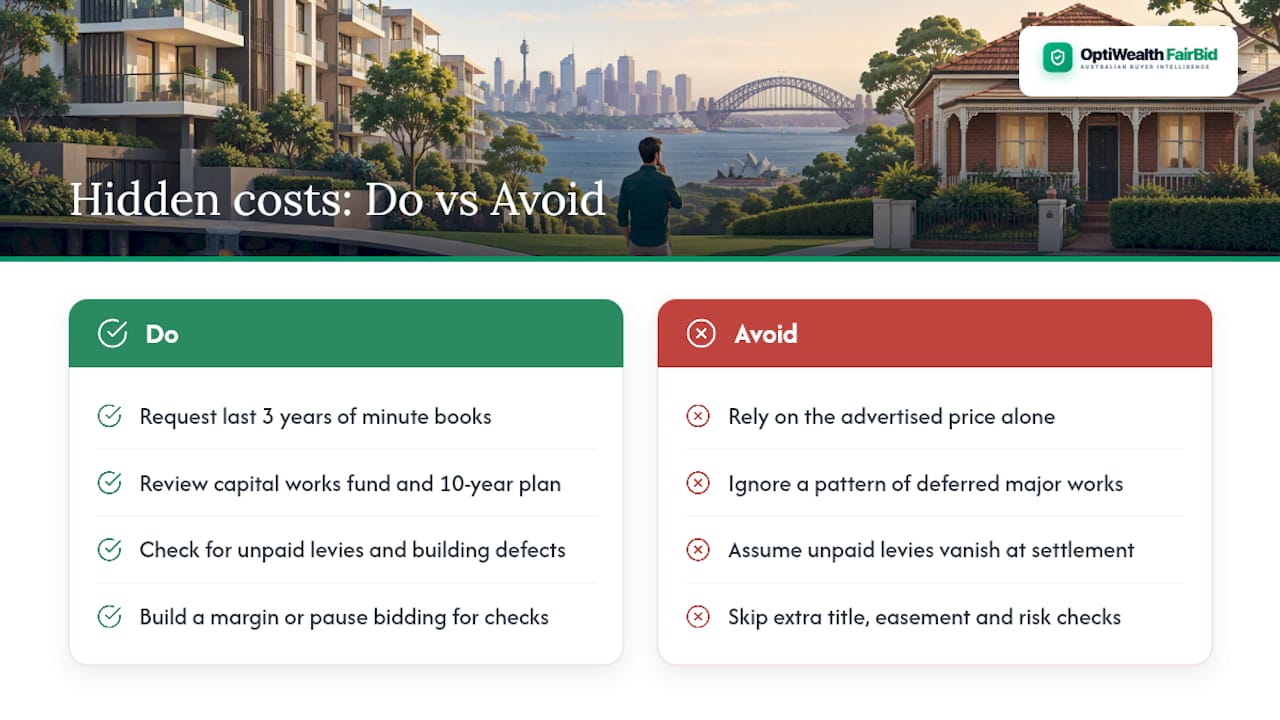
Pro Tip: Ask for the last three years of minute books, not just the current capital works statement. A pattern of deferred motions is a stronger warning sign than any single figure.
Unpaid levies attached to a lot can become the new owner’s liability if not settled at settlement, and building defects in newer strata schemes can trigger long-running rectification disputes that depress resale value. Easements, covenants and overlays for flood or bushfire risk affect both title types, changing insurance premiums and what you can build. At auction, underquoting risk means the advertised price guide can sit well below the eventual sale price, so build a margin into your bidding limit or pause the purchase to complete extra checks.
Your due-diligence checklist before you sign or bid
Work through these steps in order, starting as soon as a property interests you.
- Request the strata plan, minute books, 10-year capital works plan, financial statements, insurance policy and by-laws from the agent or vendor.
- Order a title search plus checks for easements, caveats and planning overlays through your state’s land registry, such as Landgate in Western Australia or an information broker elsewhere.
- Ask specifically about recent or proposed special levies, unresolved disputes and any building rectification notices.
- Engage a solicitor or conveyancer to review the contract of sale and Section 32 (or state equivalent vendor statement).
- Book a building inspector for a standalone house, or request a strata report reviewing the scheme’s financial position for a unit.
Buying a strata property in NSW requires vendors to disclose specified information about the strata corporation, including contributions, assets and liabilities, and buyers can request records such as accounting books within statutory timeframes.
- Order key documents the day you decide to pursue a property, not the week before auction.
- Use any conditional or cooling-off period to complete inspections and registry searches.
- Consider an independent audit report, such as one from OptiWealth FairBid, before finalising your bidding limit.
Matching your goals to the right title
Your intended use of the property, more than personal preference, should drive the decision.
- Choose Torrens title if renovation freedom, land size or full autonomy over your home matters more than shared cost savings.
- Choose strata title if low-maintenance living, shared amenities or a lower entry price fits your budget and lifestyle better.
- Strata can still suit renovation-minded or growth-focused buyers when the scheme is small, well managed and has a robust capital works fund with no deferred maintenance.
- Walk away, or renegotiate, when scheme records are incomplete, a large works project is pending without a funded plan, or defect litigation is unresolved.
Who fixes what: maintenance and repair responsibilities compared
Maintenance obligations follow the ownership split, and misunderstanding this line is one of the most common sources of buyer disputes after settlement.
A Torrens owner is responsible for every part of the property, inside and out. That includes the roof, guttering, plumbing, structural walls and any fencing, with no other party sharing the cost or the decision to act. If a retaining wall fails, the owner arranges and funds the repair.
In a strata scheme, the split is layered. Owners typically maintain the interior of their own lot, fixtures, fittings and internal finishes, while the owners corporation is responsible for common property, which usually includes roofs, external walls, structural elements, lifts and shared gardens. An owner cannot unilaterally alter a structural wall or the building’s exterior without owners corporation approval, even where the change sits within their own lot’s footprint. This division protects individual owners from bearing the full cost of a major structural repair alone, since it is funded through levies across every lot, but it also means an owner cannot act quickly on a shared problem without scheme approval. A slow-moving owners corporation can leave a defect unresolved for months while motions are drafted and voted on.
How title type affects financing and mortgage approval
Lenders assess Torrens and strata properties differently, and the distinction can affect both your borrowing capacity and the conditions attached to your loan.
For a Torrens property, a lender’s valuation focuses on the land and the dwelling as a single asset, with council zoning and land size factored into the security assessment. For a strata property, lenders additionally review the health of the owners corporation, since a poorly funded scheme or one facing a large impending special levy is considered a risk to the value of your security. Some lenders request a strata report or the scheme’s financial statements as a condition of approval, particularly for larger or older buildings, and may adjust their maximum loan-to-value ratio for units in schemes with unresolved defect claims. A scheme under active litigation over building defects can, in some cases, make a lender more cautious about approving finance on a unit within it, since the dispute directly affects the security’s resale value. Buyers should factor potential lender conditions into their settlement timeline, particularly if the strata report is not readily available from the vendor and must be specially requested.
When buyers typically choose one title over the other
A young family wanting a backyard, freedom to extend and no shared decision-making will usually gravitate to a Torrens house, accepting the higher entry price and the full weight of ongoing maintenance in exchange for autonomy.
A downsizer or first-home buyer prioritising low upkeep and lock-up-and-leave convenience often chooses a strata apartment, trading some independence for shared costs and amenities such as security entry or a lift.
An investor targeting rental yield in a unit-dense inner suburb may prefer strata for its lower entry price and stronger rental demand, provided the scheme’s capital works fund is well managed and free of pending special levies. Conversely, an investor seeking a renovation project with resale upside might choose a Torrens house specifically because it carries no scheme constraints on what can be built or altered.
A buyer inheriting or purchasing into a small, well-run strata scheme, perhaps six to ten lots with a healthy funded reserve, may find the trade-offs minimal, since fewer owners generally means faster decision-making and a more transparent view of the scheme’s finances than in a large, complex building.
Resolving disputes: strata schemes versus standalone titles
Dispute pathways differ sharply between the two title types, and this affects how quickly and cheaply a disagreement gets resolved.
On a Torrens property, disputes typically arise with neighbours over boundaries, easements or nuisance, and are usually resolved through direct negotiation, mediation, or, if unresolved, civil courts or a state tribunal depending on the issue. There is no internal governance body to appeal to; the property stands alone.
In a strata scheme, disputes commonly involve by-law breaches, levy non-payment, or disagreement with owners corporation decisions, and most states direct these matters to a specialist tribunal rather than the general court system. The Law Handbook SA notes that joining an owners corporation brings both obligations and voting rights, and that buyers should understand the by-laws and potential liabilities before purchasing, since disputes over shared decisions are a normal feature of collective ownership. This internal governance layer can resolve some disputes faster than a court process, but it also means an individual owner’s preferred outcome may be overridden by a majority vote, with limited recourse beyond a tribunal appeal.
Why independent verification matters more than agent summaries
Vendor statements and agent summaries are written to sell, not to disclose risk in full. An independent valuation or audit report cross-checks the asking price against comparable sales and flags scheme or structural risk that a listing will not volunteer. Buyers who rely solely on agent-supplied documents miss the pattern-level warning signs, such as deferred capital works or repeated special levies, that only appear across several years of records. Independent audit tools exist to give buyers an impartial, no-commission view before they commit.
— JeongSuk Lee
Getting an independent audit before you commit
Buyers doing their own registry searches and reading strata minutes will catch most obvious risks, but a paid audit adds a layer of independent analysis that is hard to replicate manually within a short settlement or auction timeline. OptiWealth FairBid produces audit reports built on spatial AI valuation models, checking a property’s fair market value against council overlays, structural defect flags and, where relevant, strata levy risk indicators.

Free registry checks and vendor documents remain the starting point for any purchase. A paid audit report through the Paid Advocate Tier, available for $4.99 as a one-off purchase, becomes useful once you have a specific address and want a second, independent view before your bidding limit is set. The Free Tier gives buyers a no-cost starting point, while a sample property audit shows the level of detail included before you decide whether to purchase a full report.
Where to verify these facts yourself
Cross-check any figure or rule against its primary source before relying on it in a negotiation.
- NSW strata repairs and maintenance guidance: confirms levy notice periods and capital works fund rules.
- NSW buying a strata property guidance: sets out vendor disclosure obligations.
- Land Victoria on Torrens title: explains how the state register guarantees ownership.
Sources
- Managing strata finances and insurance | NSW Government
- Buying a strata property | NSW Government
- Types of land in Victoria | Land Victoria
FAQ
Is Torrens title better than strata title?
Neither is inherently better; the right choice depends on whether you value full autonomy or shared, lower-maintenance living. Torrens suits buyers wanting control over renovations and no levies, while strata suits buyers prioritising shared costs and amenities.
What are the disadvantages of strata title compared with Torrens?
Strata owners are bound by scheme by-laws and majority votes, which can restrict renovations, pets or other private decisions. They also carry exposure to special levies if the capital works fund is underfunded, a risk Torrens owners do not face.
Can a strata title be changed to Torrens title?
Converting an individual strata lot to a standalone Torrens title generally is not possible while the lot remains part of a registered strata scheme, since the scheme’s plan and common property structure govern the title. Whole-scheme changes, such as collective sale or subdivision, are separate legal processes handled through your state’s land registry and require professional advice.
What are the advantages of holding a Torrens title?
Torrens title gives the owner full control over the land and dwelling, including renovation and use decisions, subject only to council planning rules. It also carries the indefeasibility guarantee provided by the state land register, offering strong protection over your registered ownership.
What documents should I check before buying a strata property?
Request the strata plan, minute books, 10-year capital works plan, financial statements, insurance policy and by-laws from the vendor or agent. NSW guidance confirms buyers can request scheme records within statutory timeframes to assess financial and maintenance risk before signing.
The information provided in this publication is for educational and general information purposes only and does not constitute financial, investment, taxation, or legal advice under the Corporations Act 2001 (Cth). Property buyers and investors should conduct independent physical, legal, and strata due diligence and seek advice from a licensed financial advisor, solicitor, or conveyancer tailored to their personal objectives before entering into any legally binding contract of sale.
OptiWealth Research
Transparent Data Science & EngineeringData Science, Software Architecture & Mathematical Risk Modeling Group
Authored by OptiWealth’s Quantitative & Data Engineering division. Our team specializes in full-stack software architecture, open-source data science, and spatial econometric property valuation (such as hedonic price regression, environmental zoning overlay synthesis, and cash-flow yield analytics). All underlying algorithms and calculation formulas are fully transparent, open to inspection, and designed purely for financial and property data visualization.
Expose Hidden Property Risks & Liabilities
OptiWealth replaces guessing games with algorithmic diagnostics. Use FairBid to audit council overlays, building defects, and calculate true net property yields.