Uncovering Hidden Liabilities: The True Adjusted Net Yield
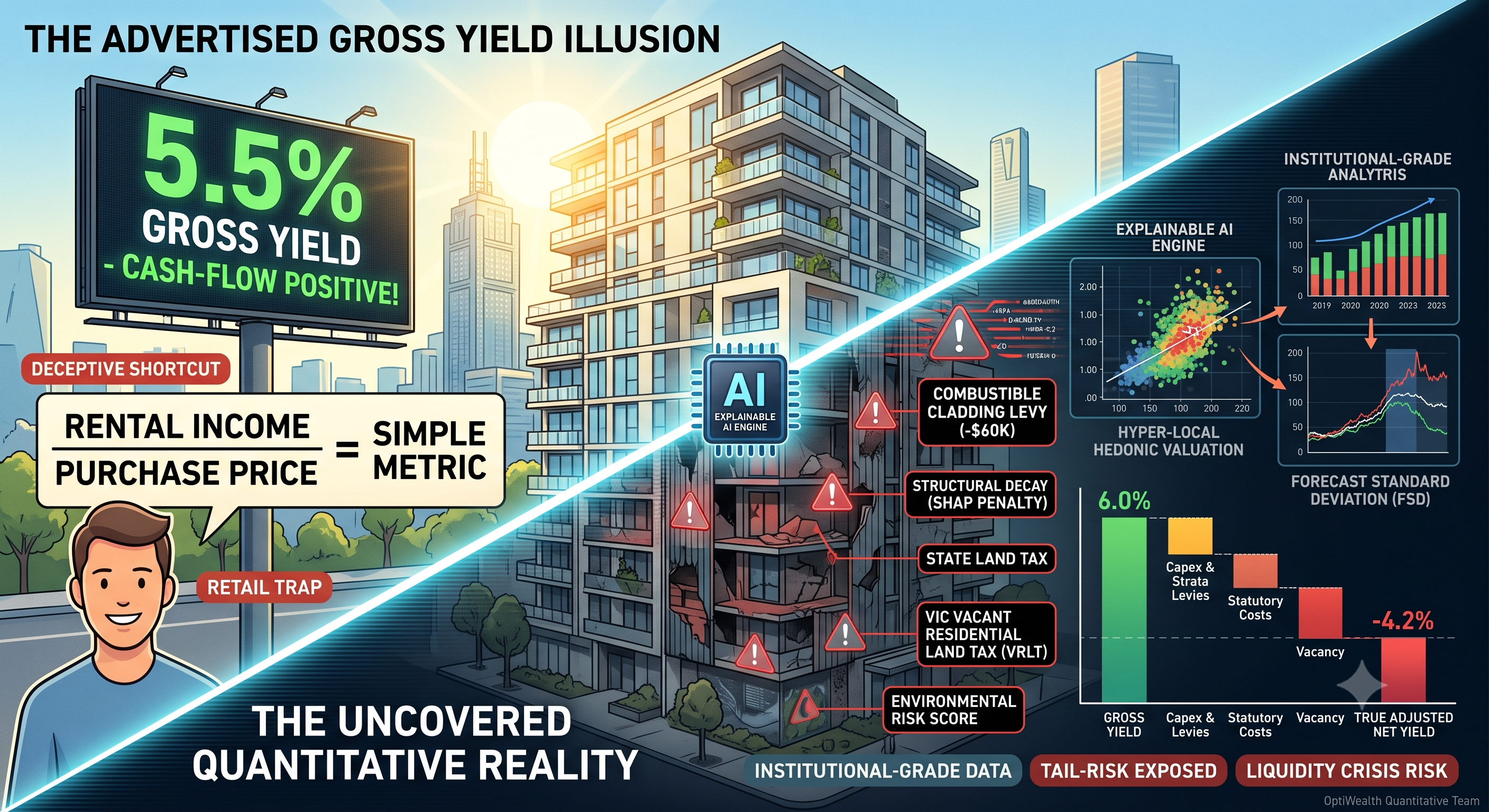
When browsing property portals, retail buyers are consistently presented with a simple mathematical shortcut: the "advertised gross yield". It is a seductive calculation—taking the annual rental income and dividing it by the purchase price. For decades, this metric has been used to justify highly leveraged property acquisitions across Australia.
However, in the realm of quantitative finance, relying solely on gross yield is an incomplete strategy. It largely ignores the physical degradation of the asset, the regulatory environment, and the compounding holding costs that can quietly drain liquidity.
At OptiWealth AU, we replace guesswork with algorithmic precision. By leveraging Explainable AI and our proprietary Conflict Resolution Engine, we peel back the marketing facade to calculate a critical metric for your property's solvency: the True Adjusted Net Yield.
The Fallacy of "Advertised Gross Yield"
Imagine purchasing a high-density apartment in Melbourne or Sydney boasting a seemingly robust 5.5% gross yield. On paper, it looks like a cash-flow positive asset that will comfortably service your mortgage.
Institutional investors and regulatory bodies approach risk with far stricter scrutiny. While the Australian Prudential Regulation Authority (APRA) mandates strict serviceability buffers—stress-testing a borrower's ability to absorb interest rate hikes—institutional investors go a step further. They stress-test the asset itself, understanding that a property is not just a financial vehicle; it is a physical structure bound by relentless physical entropy.
Relying purely on gross yield fails to account for tail-risks that can trigger a liquidity squeeze for an unprepared owner-occupier or investor. To achieve Institutional-Grade Tail-Risk management, we must systematically deduct hidden liabilities.
Deducting the Hidden Indicators
To accurately calculate the True Adjusted Net Yield, OptiWealth’s AI Qualitative Engine systematically categorises liabilities, assessing the friction costs of property ownership without overlaps or gaps.
1. Structural Reserves & Capital Expenditure (Capex)
Every building decays. Standard valuations often ignore this, but our models deduct an annualized structural reserve based on the property's age and condition. This includes anticipated roof replacements, HVAC upgrades, and special strata levies. The older the property, the higher the degradation penalty applied to its baseline valuation—a factor we isolate using advanced machine learning models (like SHAP, which transparently show exactly which features drive risk).
2. Statutory Costs & Infrastructure Taxes
Holding land in Australia comes with recurring statutory liabilities, including localized council rates, surging state land taxes, and the Victorian Vacant Residential Land Tax (VRLT). Our Infrastructure Tax Risk indicator evaluates state and local policy shifts to ensure your net yield calculations account for future developer contributions and tax bracket creep.
3. Vacancy Defaults & Insurances
A property is rarely occupied 100% of the time in perpetuity. We deduct a mathematically derived vacancy default rate based on hyper-local suburb surveys and localized economic headwinds. Furthermore, we overlay Environmental Risk scores—including flood mapping and bushfire zones—to forecast escalating landlord and building insurance premiums that standard models frequently miss.
Case Study: The Hidden Defect Wipeout
Consider a scenario where a buyer purchases a 10-year-old apartment complex relying on a 6% advertised gross yield. The valuation appears sound, but the buyer's broker failed to run an institutional risk audit.
Three months post-settlement, the owners corporation uncovers non-compliant combustible cladding. The building is slapped with a rectification order.
Suddenly, the property is hit with a $60,000 special strata levy per lot. In our system, the AI Qualitative Engine is designed to identify these high-probability risks, flagging this asset with a severe Capex & Structural Risk (e.g., 9/10) by analyzing the specific building era and developer profile.
When this hidden liability is factored into the equation, the True Adjusted Net Yield drops from a positive +6.0% to -4.2%. The investor is now bleeding capital, triggering a spike in their Cash Flow & Insolvency Risk. This highlights the difference between speculative guessing and data-driven probability.
Algorithmic Insights Over Emotional Guesswork
You want to buy your biggest asset with eyes wide open. Before you bid at auction, it is vital to understand the true financial utility of the property.
OptiWealth AU’s Hyper-local Hedonic Valuation model calculates exactly how much value is added or lost based on specific neighborhood features—from non-linear transit distance decay to school catchment ratings. But we don't stop there. We cross-reference this quantitative valuation against our qualitative risk indicators to calculate a dynamic Forecast Standard Deviation (FSD). In plain English, this establishes a data-driven 3-Year Bear Case downside bound, helping you prepare for worst-case scenarios.
If a property requires a multi-million dollar maintenance reserve that heavily impacts its capital growth potential, our engine is built to highlight it. We look past the illusion of gross yield to prioritize the reality of capital preservation.
Don't let a hidden liability compromise your wealth. Run a Real Estate Risk Model audit with OptiWealth AU today, and step into your next property transaction with institutional-grade data.
Disclaimer: The information provided in this article is for educational and data analytics purposes only. It does not constitute personal financial, investment, or legal advice. OptiWealth AU provides data-driven insights; you should always consult with a licensed financial professional before making any purchasing or investment decisions.
Expose Hidden Portfolio & Property Risks
OptiWealth replaces guessing games with algorithmic diagnostics. Create a free account to audit your stock variance or calculate true net property yields.