Independent Property Valuation: Visual AI and Risks That Change Bids
This tool is a generic calculator and does not advertise or promote a specific financial product. It is not intended to be relied on for the purposes of making a decision in relation to a financial product. You should consider obtaining advice from a financial services licensee before making any financial decisions.
Independent Property Valuation: Visual AI and Risks That Change Bids
An independent property valuation, in the buyer’s sense, combines an AI-driven market estimate with a pre-purchase risk audit covering strata levies, structural defects and council overlays. It is distinct from a formal valuer’s report prepared for lending or legal purposes. For Australian residential property, OptiWealth FairBid delivers this buyer-centred valuation ahead of auction or contract signing.
TL;DR:
- Models that combine aerial and street imagery with property attributes outperformed comparable sales baselines in Australian studies, while SHAP tools can explain estimate drivers.
- The report gives a market estimate, LVR guidance, a downside threshold, and risk flags, but it cannot replace a lender valuation or legal advice.
- Order the audit when shortlisting, then reconcile its flags with building and pest findings, strata records, and the vendor statement before signing.
- Set a written bid ceiling at the bear case plus expected repair or levy costs, rather than relying on an agent’s potentially understated price guide.
- FairBid reports arrive instantly; the Free Tier suits early research, while its full Paid Advocate Tier costs $4.99 once for a shortlisted property.
Table of Contents
- What a buyer-focussed independent valuation actually covers
- How spatial AI and visual data sharpen valuation accuracy
- Auction timing, underquoting and what to do before you bid
- Hidden risks an independent audit is built to catch
- Reading the report: turning metrics into a bid strategy
- Pre-bid checklist: what to do in the days before auction or signing
- Why buyer-centred audits matter more now
- Getting an independent valuation through OptiWealth FairBid
- FAQ
- Sources
What a buyer-focussed independent valuation actually covers
A buyer-focussed independent valuation is an AI-generated market estimate paired with a structured audit of risk factors that could alter the true cost of a property. It differs from an accredited valuer’s report, which is prepared under formal standards for a lender or for legal purposes and carries a different scope and liability profile.
The typical outputs we generate for a residential address include a fair market estimate, loan-to-value ratio (LVR) guidance for finance discussions, a bear-case downside threshold for conservative bidding, flags for strata irregularities and council overlays, a defect screening summary and a rental yield estimate for investors. Each of these metrics answers a specific pre-purchase question: what is this property worth, what could it be worth if conditions turn, and what hidden costs sit behind the listing price.
This type of valuation is not a substitute for a formal lender valuation or legal advice. It is built for the window before you bid or sign, when speed and independence from the selling agent matter more than compliance with lending standards.
How spatial AI and visual data sharpen valuation accuracy
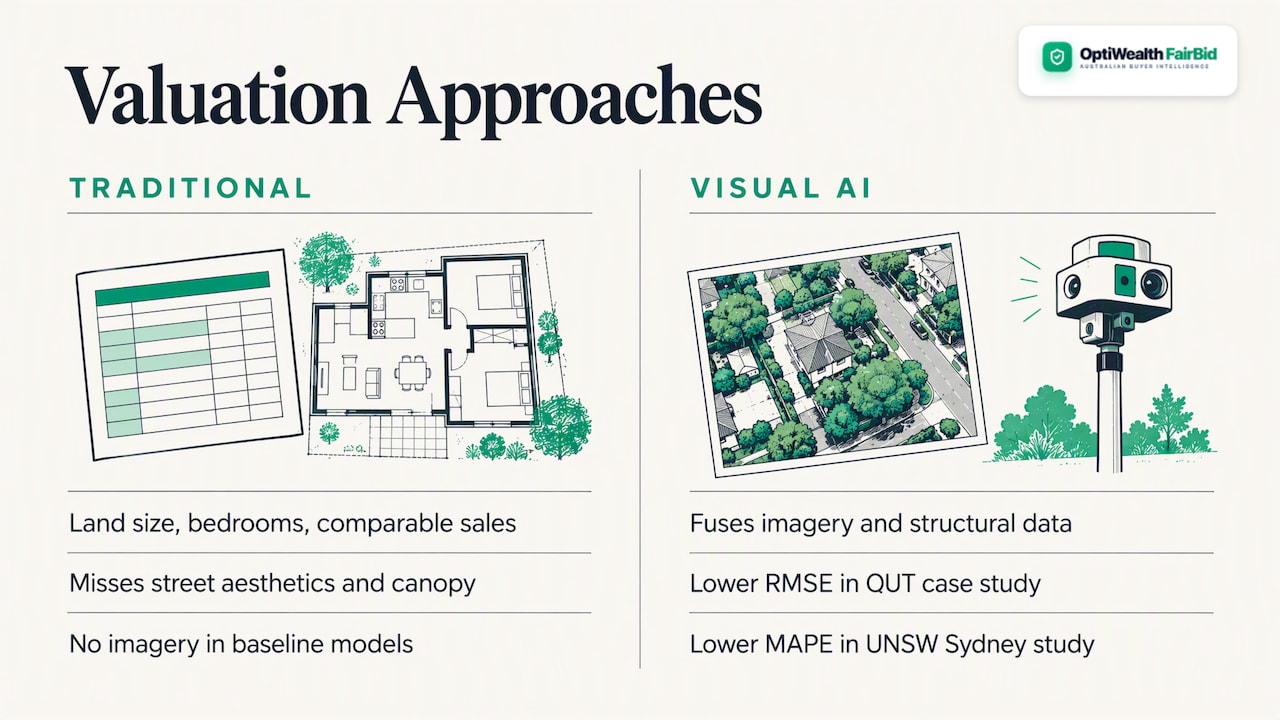
Traditional hedonic pricing models rely on structural attributes such as land size, bedroom count and recent comparable sales. They tend to miss intangible factors buyers notice instantly: street aesthetics, tree canopy, frontage quality, proximity to a busy road. Research from the Queensland University of Technology found that AI-enabled automated valuation models incorporating aerial and street-level imagery achieved a significant reduction in RMSE compared with models that excluded visual data, using an Australian city case study.
A separate University of New South Wales study of Greater Sydney properties found that machine learning models fusing convolutional neural network outputs for spatial and visual layers with multilayer perceptron inputs for structural attributes produced materially lower MAPE than baseline models. Interpretability tools such as SHAP values help explain which inputs drove a given estimate, which matters when a buyer wants to understand why one street commands a premium over its neighbour.
For buyers, the practical effect is a market estimate that reflects what a property actually looks and feels like on the ground, not just what a spreadsheet of comparable sales suggests.
Auction timing, underquoting and what to do before you bid
Auctions compress decision-making into days, and sellers’ agents set the pace. That timeline leaves little room to discover that the advertised price guide was never realistic.
Investigations by ABC News document that underquoting, advertising a price below the likely or expected sale price, remains widespread across Australian markets, with agents using artificially low guides to draw crowds. Victoria has responded with rules requiring reserve price disclosure at least seven days before auction, part of a broader shift toward price guide transparency across several states.
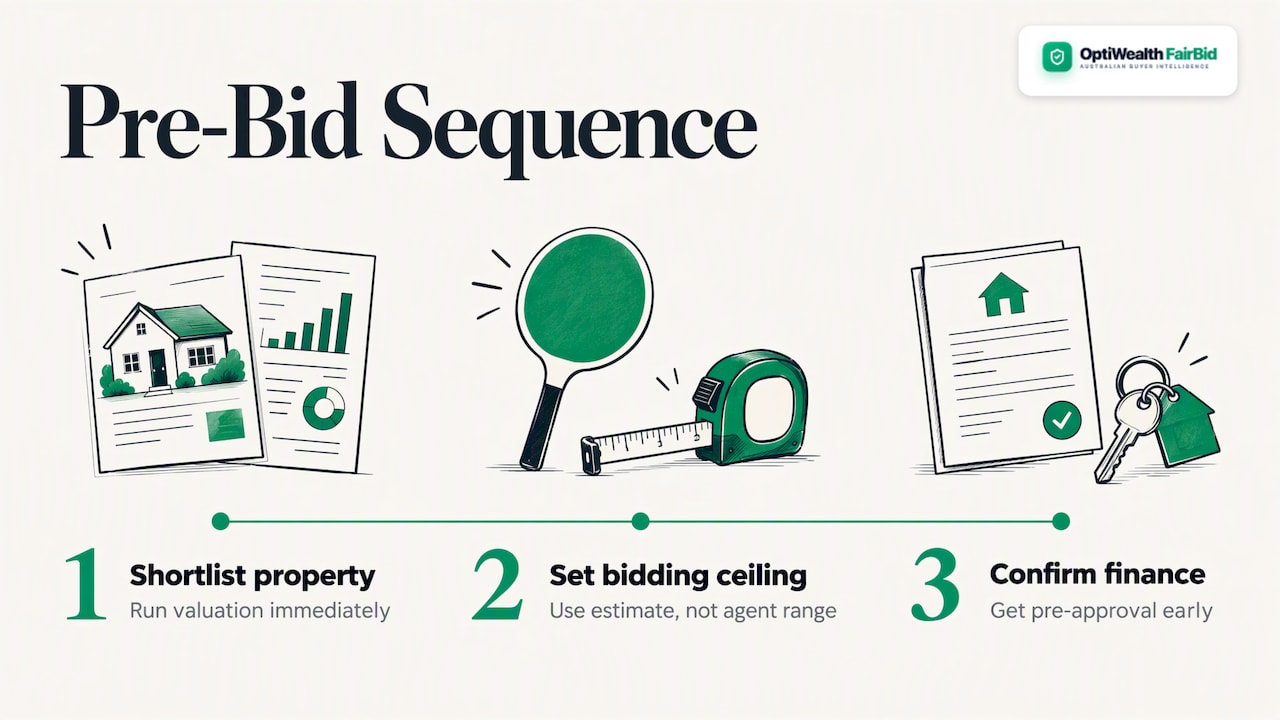
Given that environment, the sequence that protects a buyer is straightforward: run an independent valuation as soon as a property is shortlisted, not the week of auction. Set a conservative bidding ceiling based on that estimate rather than the agent’s quoted range, and confirm finance pre-approval early enough that a strong valuation does not arrive too late to use. Our reserve price verification case study shows how this sequencing plays out in practice.
Hidden risks an independent audit is built to catch
A listing price rarely reflects the full cost of ownership. The risks below sit outside the contract price but can materially change what a property actually costs.
-
Strata irregularities: special levies, restrictive by-laws, and gaps in the 10-year capital works plan, all of which NSW Government guidance recommends checking through a strata search before purchase.
-
Structural and pest issues: physical inspections catch visible defects but have limits in scope and consistency across states; an audit adds a second, data-driven layer of screening.
-
Council overlays: flood, bushfire and heritage overlays can restrict renovations or increase insurance costs well after settlement.
-
Hidden holding costs: insurance premiums, strata levies and council rates that shift the real affordability of a property beyond the advertised price.
A single unbilled special levy sitting in strata meeting minutes can exceed a year’s worth of routine levies, and it rarely appears anywhere in a standard listing.
Reading the report: turning metrics into a bid strategy
The fair market estimate and the bear-case downside threshold work together to define a bidding envelope. The market estimate tells you what the property is likely worth under normal conditions; the bear-case threshold tells you what it could be worth if the market softens or a flagged risk materialises. Bidding above the bear-case figure without a clear reason to do so increases exposure unnecessarily.
The independent LVR guidance gives you a figure to bring to a lender conversation that is not anchored to the agent’s price guide, which helps when negotiating finance buffers; our explainer on loan-to-value ratios covers how this number interacts with deposit size and borrowing capacity.
Audit flags are not a final verdict. They are a checklist to reconcile against a building and pest inspection and against the Section 32 vendor statement before a contract becomes unconditional. When an audit flag and a vendor statement disagree, that discrepancy is worth raising with a conveyancer before signing.
Pre-bid checklist: what to do in the days before auction or signing
A short sequence, followed in order, keeps a buyer from missing a step under time pressure.
- Order an independent valuation and audit as soon as a property is shortlisted, leaving time to act on flagged issues.
- Arrange a building and pest inspection, and a strata search where relevant, then reconcile the findings with the audit flags.
- Confirm finance pre-approval using the conservative LVR figure from the independent valuation, not the agent’s price guide.
- Set a strict bid or offer cap at the bear-case threshold plus a buffer for likely levies or repairs identified in the audit.
Pro Tip: Lock in your bid cap in writing before auction day. A number agreed on under pressure at the podium is rarely the number you would have chosen the night before.
Why buyer-centred audits matter more now
Spatial AI valuation models now measurably outperform traditional comparable-sales approaches on Australian data, and underquoting remains a documented, persistent problem rather than an isolated issue. Together, those two facts shift the balance of information away from selling agents and toward buyers who are willing to run their own numbers.
An independent audit exists to close that information gap before money changes hands, not after. The cost of skipping it is rarely visible until settlement, when a special levy or an overlay restriction appears for the first time.
— JeongSuk Lee
Getting an independent valuation through OptiWealth FairBid
A report can provide an instant market estimate, LVR guidance, strata and overlay flags, defect screening and a bear-case downside figure for a specific Australian address, drawn from spatial AI approaches.
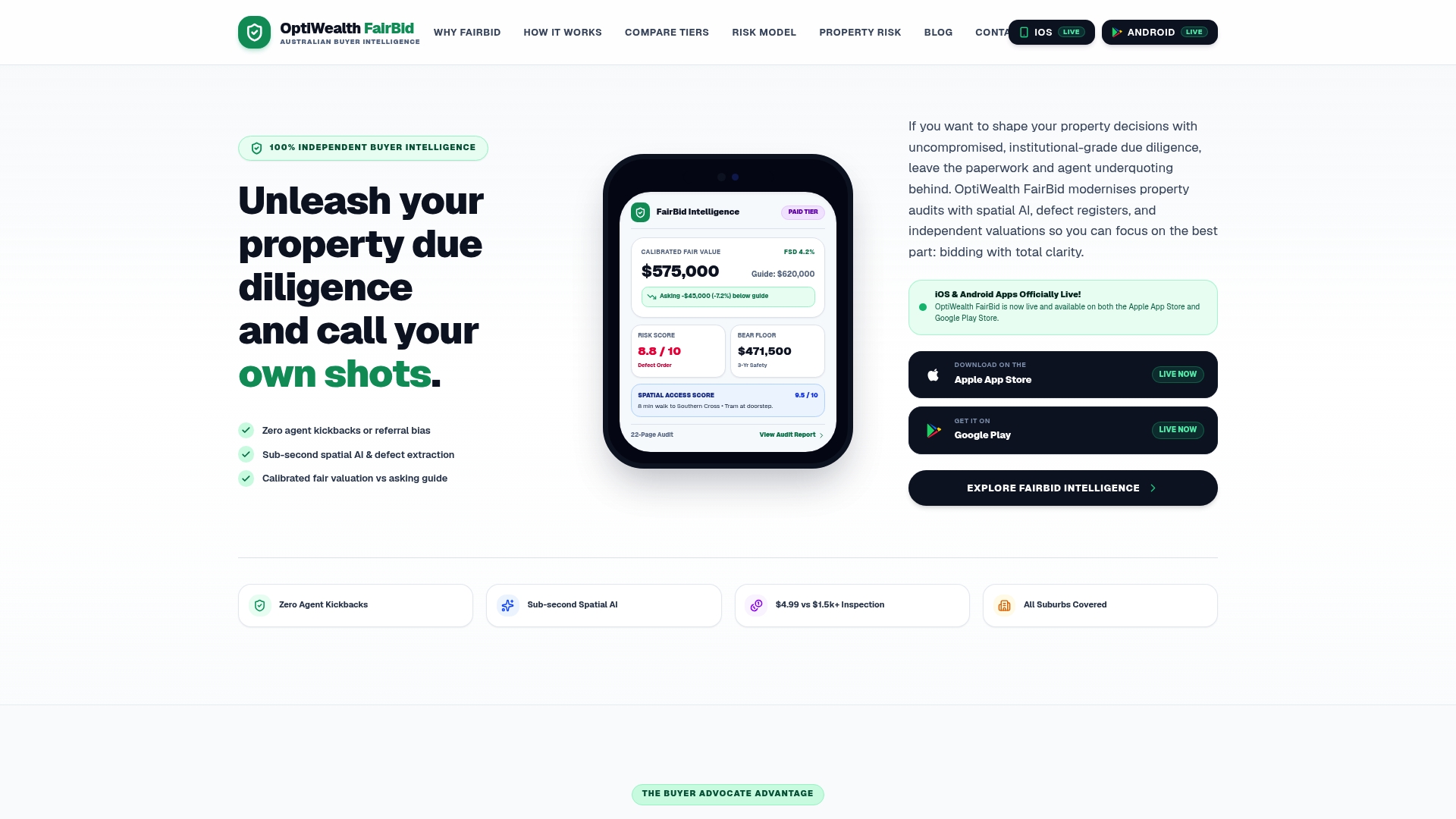
The Free Tier is built for early research: a first look at a property’s market position before you commit time to a shortlist. The Paid Advocate Tier, at $4.99 one-off, is built for the property you are actually planning to bid on or sign for, where the full audit detail justifies the small cost against what it can save you. You can preview the sample report format before buying, and when you are ready to move on a specific address, get your report at OptiWealth and take it into the auction or the contract review with a figure that is yours, not the agent’s.
FAQ
What is an independent property valuation for buyers?
It is an AI-generated market estimate combined with a pre-purchase risk audit covering strata, defects and council overlays, built for buyers rather than lenders. It differs from a formal valuer’s report prepared for legal or lending purposes.
How much does an independent property audit cost in Australia?
A FairBid report starts with a Free Tier at no cost, with the detailed Paid Advocate Tier priced at $4.99 one-off. Pricing for other independent valuation services varies and is best confirmed directly with the provider.
How long does it take to get a full independent valuation report?
A FairBid report is generated instantly once you enter a property address, since the underlying models process spatial and listing data automatically rather than requiring a manual site visit.
Can an independent valuation replace a building and pest inspection?
No. An independent audit screens for defects and risk flags using data analysis, while a physical building and pest inspection remains a separate, hands-on check; the two are complementary, and ABC News reporting notes inspection regulation varies by state.
How do I know a property valuation provider is truly independent?
Check whether the provider earns commissions or referral fees from selling agents, since that relationship can bias price guidance toward higher sale prices. A genuinely independent model has no financial link to the agent or vendor side of the transaction.
Sources
- Unlocking visual data to enhance the accuracy of AI-enabled mass valuation of urban houses: An Australian city case study | QUT ePrints
- Automated Valuation Model for Residential Properties using Machine Learning Approaches: A Case Study of Greater Sydney, Australia
- The art of price baiting — how real estate agents lure buyers to auction - ABC News
- Buying a strata property — NSW government guidance
Recommended
- Property Risk Audit & Quantitative Valuation
- Decoding Real Estate Risk: The AI Qualitative Engine
- How We Calculate Fair Market Value: The Hedonic Pricing Model & Explainable AI
The information provided in this publication is for educational and general information purposes only and does not constitute financial, investment, taxation, or legal advice under the Corporations Act 2001 (Cth). Property buyers and investors should conduct independent physical, legal, and strata due diligence and seek advice from a licensed financial advisor, solicitor, or conveyancer tailored to their personal objectives before entering into any legally binding contract of sale.
OptiWealth Research
Transparent Data Science & EngineeringData Science, Software Architecture & Mathematical Risk Modeling Group
Authored by OptiWealth’s Quantitative & Data Engineering division. Our team specializes in full-stack software architecture, open-source data science, and spatial econometric property valuation (such as hedonic price regression, environmental zoning overlay synthesis, and cash-flow yield analytics). All underlying algorithms and calculation formulas are fully transparent, open to inspection, and designed purely for financial and property data visualization.
Expose Hidden Property Risks & Liabilities
OptiWealth replaces guessing games with algorithmic diagnostics. Use FairBid to audit council overlays, building defects, and calculate true net property yields.