Property Due Diligence: Section 32 to Independent Audits in Australia
This tool is a generic calculator and does not advertise or promote a specific financial product. It is not intended to be relied on for the purposes of making a decision in relation to a financial product. You should consider obtaining advice from a financial services licensee before making any financial decisions.
Property Due Diligence: Section 32 to Independent Audits in Australia
Completing a property due diligence checklist before exchange or auction means finishing six priority checks: title and ownership, planning certificate and overlays, building and pest, strata minutes and finances where relevant, contract review against the Section 32 or vendor statement, and outstanding rates. At auction, most states offer no cooling-off period, so every check must be finished before the gavel falls. An independent audit through a spatial AI-powered tool can verify these findings against spatial data before you commit.
TL;DR:
- At auction, most states offer no cooling off period, so finish building, pest, strata, finance, and contract checks before bidding.
- For higher risk or former industrial sites, request both Section 10.7(2) and 10.7(5) certificates, then check public environmental registers for contamination notices.
- For units, review two years of minutes, current financial statements, insurance, and the sinking fund against planned capital works; unfunded projects may trigger special levies.
- A standard building report is visual and noninvasive, so seek specialist assessments for suspected asbestos, termite evidence, or unclear structural, moisture, and crack findings.
- Commercial buyers should confirm with an accountant whether the sale qualifies as a going concern, because otherwise GST at 10% may apply to taxable components.
Table of Contents
- Legal and ownership checks: title, encumbrances and vendor statement
- Conveyancing and contract checks: cooling off, conditions and deposit terms
- Planning, zoning and overlays: reading Section 10.7 certificates and council constraints
- Building and pest inspections: what to commission and defects to prioritise
- Strata and owners corporation checks: minutes, finances and levies
- Contamination and environmental risks: registers, audits and when to go further
- Title boundaries, easements and surveys: confirming what you can build and use
- Financials and ongoing costs: stamp duty, rates, insurance and GST
- Auctions and timing: a practical checklist for auction day
- Action checklist: the order of tasks to complete before you commit
- Verification of market valuation accuracy using advanced spatial AI technology
- Assessment of latent property risks through independent audit reports
- Detailed analysis of hidden holding costs beyond typical taxes and levies
- Investigation of structural defects beyond standard building inspections
- Review of historical agent underquoting patterns and implications
- Cross-referencing specialist reports with spatial AI data to confirm property value and risks
- Author perspective: an independent, data-driven view of buyer due diligence
- OptiWealth FairBid: what it provides buyers and how to get a report
- FAQ
- Sources
Legal and ownership checks: title, encumbrances and vendor statement
A title search confirms who legally owns the property and discloses mortgages, caveats and registered easements that survive settlement. We treat this as the foundation check because an unresolved caveat or an undischarged mortgage can delay or derail settlement regardless of how attractive the property looks.
The Section 32 or vendor statement is the seller’s legal disclosure document, and it must set out zoning, outgoings, any notices from authorities, and building approvals for recent works. A vendor statement missing a required disclosure, or one that references works without matching council approvals, is a signal to query the vendor’s solicitor before going further.
Buyers and their conveyancers typically run these searches in parallel with the vendor statement review:
- Land titles office search to confirm current ownership and registered interests.
- Personal Property Securities Register (PPSR) search for any security interests attached to fixtures or equipment.
- Request copies of any building approvals referenced in the vendor statement, not just a summary.
Conveyancing and contract checks: cooling off, conditions and deposit terms
A conveyancer or solicitor reviews the contract of sale for special conditions, deposit handling terms and any conditions that protect you if a later check turns up a problem. Standard buyer conditions include a building and pest clause, a finance clause and, for units, a strata records clause that lets you withdraw if the records reveal unacceptable risk.
Cooling-off periods vary by state. Private treaty sales commonly allow a statutory period, such as 5 business days in Queensland and NSW, while auction purchases generally carry no cooling-off right at all, which means every check listed here needs to be finished before you raise a paddle.
- Ask for a building and pest condition unless a report has already been commissioned and reviewed.
- Confirm deposit percentage and what happens to it if a condition is not satisfied.
- Request vendor warranties for anything disclosed verbally but not written into the contract.
Conveyancer turnaround for a first contract review is typically a few business days, faster if the vendor statement and title are already in hand.
Planning, zoning and overlays: reading Section 10.7 certificates and council constraints
A Section 10.7(2) planning certificate sets out the zoning, permitted land uses and any mandatory planning controls attached to a property in New South Wales. A Section 10.7(5) certificate goes further and can disclose council-held information on contamination or site-specific risks that the mandatory certificate does not cover, which is why we recommend requesting it for properties in higher-risk or former industrial suburbs.
Overlays worth checking before you commit include flood, bushfire, contamination, heritage and airport noise, each of which can change what you are allowed to build, what insurance costs, and how a future sale is priced.
- Request both the 10.7(2) and 10.7(5) certificates, not just the standard one.
- Check council records for recent development applications nearby that could affect amenity or value.
- Review any draft planning instruments that might rezone the area before you settle.
Pro Tip: Request the Section 10.7(5) certificate even when your solicitor only orders the standard one, because the gap between the two documents is exactly where contamination and hazard history tends to hide.
Building and pest inspections: what to commission and defects to prioritise
A building and pest inspection should be commissioned early enough to act on the findings before exchange, or before auction day if that is how the property is being sold. Choose a licensed inspector with professional indemnity insurance and ask for a written report, not a verbal summary.
- Confirm the inspector holds current licensing and insurance before booking.
- Prioritise structural movement, roof condition, drainage and subfloor moisture as the defects most likely to be expensive.
- Treat termite evidence and any suspected asbestos as non-negotiable items requiring a specialist follow-up quote.
- Get a costed repair estimate for anything flagged as significant, not just a pass or fail rating.
Our building inspection checklist for Australian buyers sets out the specific audit points worth raising with your inspector before the report is finalised.
Strata and owners corporation checks: minutes, finances and levies
Buying a unit or townhouse means the building’s financial health matters as much as the title. Request the last two years of minutes, the current financial statements, the insurance policy, any management contracts and the most recent AGM minutes before you commit.
- Scan recent minutes for upcoming major works that have not yet been costed into a special levy.
- Check the sinking fund balance against any quoted capital works to see whether it can absorb them.
- Ask the strata manager directly about unresolved disputes, defect claims or insurance excess increases.
Strata minutes often reveal pending capital works and disputes that are not visible from the outside, which is why reviewing the paperwork matters as much as inspecting the common property. Our strata report explainer for NSW, QLD and VIC buyers walks through what a $4.99 FairBid audit adds to a standard strata search.
Pro Tip: A healthy sinking fund with no mention of deferred maintenance in the minutes is a stronger signal than a glossy building facade.
Contamination and environmental risks: registers, audits and when to go further
Planning certificates alone can understate contamination risk. NSW EPA guidance notes that planning certificates can omit contamination details, and that the EPA’s Record of Notices and List of Notified Sites hold information a standard certificate does not.
- Check the EPA’s public registers for the specific address and the surrounding suburb.
- Commission a phase 1 desktop assessment where the site has an industrial or agricultural history.
- Escalate to a phase 2 site investigation if the desktop review flags a plausible contamination pathway.
For a property with former industrial use nearby, a contaminated land search from $34 can confirm whether a deeper assessment is warranted before you factor remediation risk into your offer.
Title boundaries, easements and surveys: confirming what you can build and use
Obtain the title plan and check it against any recent survey before assuming the fence line matches the legal boundary. Encroachments and unmarked boundary pegs are common enough that a visual inspection alone will not catch them.
- Compare visible boundary markers against the registered title plan.
- Identify any easements for drainage, sewer or shared access that restrict where you can build.
- Commission a cadastral or peg survey where boundaries are unclear, particularly on older subdivisions.
Council rules on structures near a boundary, such as fence height limits, can also affect what you are permitted to build; Victorian buyers planning fencing works should check the front fence height rules that apply in Victoria before relying on the existing structure.
Financials and ongoing costs: stamp duty, rates, insurance and GST
Budget for stamp duty and settlement adjustments as upfront acquisition costs, and confirm outstanding council rates and water charges will be adjusted correctly at settlement rather than assumed.
- Request a current council rates notice and water authority statement to confirm no arrears exist.
- For commercial property, check whether the ATO’s going concern GST exemption applies, since strict criteria must be met or GST at 10% typically applies to the taxable components of the deal.
- Set aside a contingency for immediate maintenance, building insurance and any owners corporation levy increases flagged in the strata minutes.
GST treatment on commercial deals turns on whether the sale qualifies as a going concern under ATO criteria, so confirm this with your accountant before finalising the price, not after settlement.
Auctions and timing: a practical checklist for auction day
Government guidance for NSW buyers is direct on this point: complete building, pest and strata reports before bidding, because there is no cooling-off period once the hammer falls.
- Confirm finance pre-approval in writing before auction day, not a verbal indication.
- Have your solicitor or conveyancer’s contact details on hand in case a condition needs clarifying on the spot.
- Carry copies of the building and pest report, strata summary and planning certificate to cross-check against the contract terms.
- Confirm deposit arrangements, including how and when it must be paid if your bid succeeds.
Action checklist: the order of tasks to complete before you commit
Run these checks in a sequence that lets each one inform the next, rather than leaving them until the week before exchange.
- Order the title search first, since it is usually returned the same day and underpins every later check.
- Request the planning certificate and overlays within the same week.
- Commission the building and pest inspection, typically returned in 48 to 72 hours.
- For units, request the strata report, usually available in 2 to 5 business days.
- Run a contamination check if the site history warrants it, in parallel with the strata report.
- Confirm finance approval and review the contract with your conveyancer before deciding to exchange or bid.
| Task | Typical turnaround | Who completes it |
|---|---|---|
| Title search | Same day | Conveyancer or solicitor |
| Planning certificate | A few business days | Local council |
| Building and pest inspection | 48 to 72 hours | Licensed inspector |
| Strata report | 2 to 5 business days | Strata manager or search provider |
A go decision depends on every one of these checks clearing without an unresolved red flag; a no-go is any unresolved caveat, a failed structural item, or strata minutes showing an unfunded special levy.
Verification of market valuation accuracy using advanced spatial AI technology
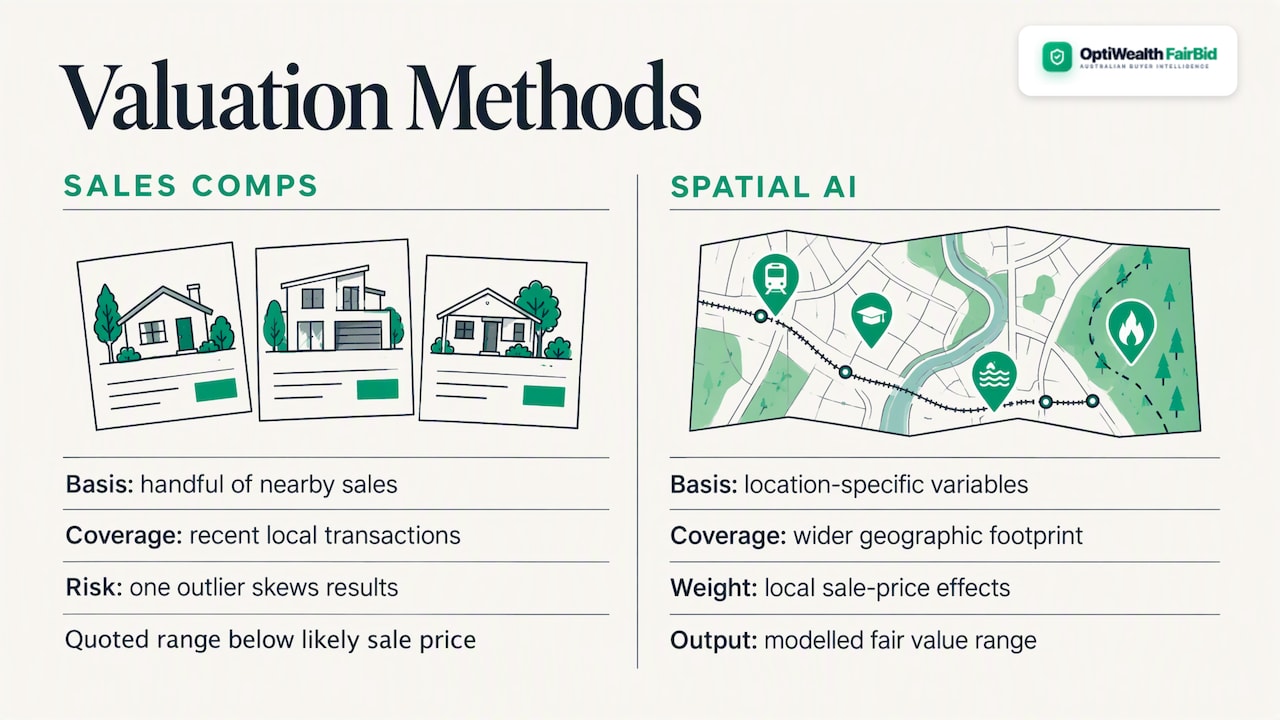
A due diligence checklist tells you what a property is legally and physically, but not whether the asking price reflects genuine market value. Traditional comparable sales analysis relies on a handful of recent sales nearby, which can be skewed by one unusually high or low result or by an agent’s quoted range that sits below likely selling price.
Spatial AI valuation models work differently. They analyse location-specific variables, such as proximity to transport, school catchments, flood and bushfire overlay status, and historical price movements across a wider geographic footprint, then weight each factor by its demonstrated effect on sale price in that specific area. This produces a modelled fair value range rather than a single agent-quoted figure.
For a buyer weighing up whether a quoted price range is realistic, cross-checking it against an independent valuation model adds a second, data-driven opinion that does not depend on who is selling the property. This approach produces a fair value estimate alongside the legal and physical checks already covered in this checklist, so the valuation question is addressed with the same rigour as the title search or the building report.
Assessment of latent property risks through independent audit reports
Many of the risks that matter most are not visible on an open inspection and do not always appear in a standard vendor disclosure. Structural issues hidden behind cosmetic renovation, drainage problems that only surface in heavy rain, and overlay constraints buried in council records can all sit outside what a buyer sees on a Saturday open home.
An independent audit report consolidates these latent risks into a single reference point rather than requiring a buyer to chase down six separate documents from six separate sources. This matters because the standard checklist, title, planning certificate, building and pest, strata and contamination, each comes from a different provider on a different timeline, and a buyer juggling all of them under auction deadline pressure can miss a connection between, say, a flood overlay and a drainage defect noted in the building report.
Certain audit reports structure their findings around exactly this kind of cross-referencing: overlay data, structural defect flags and strata levy risk are presented together so a buyer can see how they interact, rather than reading five documents in isolation and trying to hold the whole picture in their head before a bidding deadline.
Detailed analysis of hidden holding costs beyond typical taxes and levies
Stamp duty, council rates and strata levies are the holding costs most buyers budget for, but they are rarely the only ones. A property with an ageing roof or an underfunded sinking fund carries a holding cost that will not appear on any rates notice: the maintenance bill that arrives in year two or three once the current owner’s deferred repairs become unavoidable.
Insurance is another hidden cost that varies more than buyers expect. A property sitting inside a mapped flood or bushfire overlay can carry a materially higher premium than an equivalent property a few streets away outside the overlay, and that premium difference compounds every year of ownership.
For strata properties, a sinking fund that looks adequate today but has no allowance for a known upcoming expense, such as a lift replacement flagged in the AGM minutes, effectively defers a holding cost onto the next owner, which may be you. Factoring these costs into your offer, rather than discovering them after settlement, is where a buyer-side audit earns its place alongside the standard checklist.
Investigation of structural defects beyond standard building inspections
A standard building and pest inspection is a visual, non-invasive assessment, which means it will flag visible movement, obvious moisture damage and accessible termite evidence, but it will not open walls or dig test pits. For older properties, properties with recent renovations, or properties on reactive clay or fill, that limitation matters.
Where a standard report notes a crack or a moisture reading that falls short of a clear verdict, a buyer has two practical options: commission a specialist structural engineer’s assessment for a costed opinion, or weigh the finding against independent risk data that flags the suburb’s known soil conditions and defect history. Cross-referencing a building report against broader risk data, rather than treating the report as the final word, is how a buyer avoids being caught out by a defect that sits just outside the inspector’s non-invasive scope.
Review of historical agent underquoting patterns and implications
Underquoting, where an advertised price range sits below the price a property is realistically expected to sell for, remains a recurring complaint from Australian buyers, particularly at auction. The practical effect is that buyers budget, arrange finance and commission inspections based on a quoted range that never reflected genuine market expectation, then find themselves priced out on the day or forced to stretch beyond their pre-approval.
Because underquoting is assessed property by property and agency by agency, the most useful defence for a buyer is comparing the quoted range against an independent valuation model before investing time and inspection costs into a property. Our analysis of underquoting and negotiation tactics sets out how buyers can read a quoted range against comparable sales data before committing further time or money to a specific listing.
Cross-referencing specialist reports with spatial AI data to confirm property value and risks
The checklist in this guide produces a stack of separate documents: a title search, a planning certificate, a building and pest report, strata minutes and a contamination check where relevant. Each is accurate on its own terms, but none of them, read individually, answers the single question a buyer actually needs answered: is this price justified given everything these reports say about the property.
Cross-referencing works by layering these specialist findings against spatial AI valuation data so that a defect flagged in the building report, an overlay noted on the planning certificate and a levy risk from the strata minutes are weighed together against the fair value estimate, rather than assessed as unrelated facts. A property with a clean building report but a high flood overlay exposure carries a different risk profile to one with a minor defect but no overlay exposure, and only a combined view makes that difference visible before you sign.
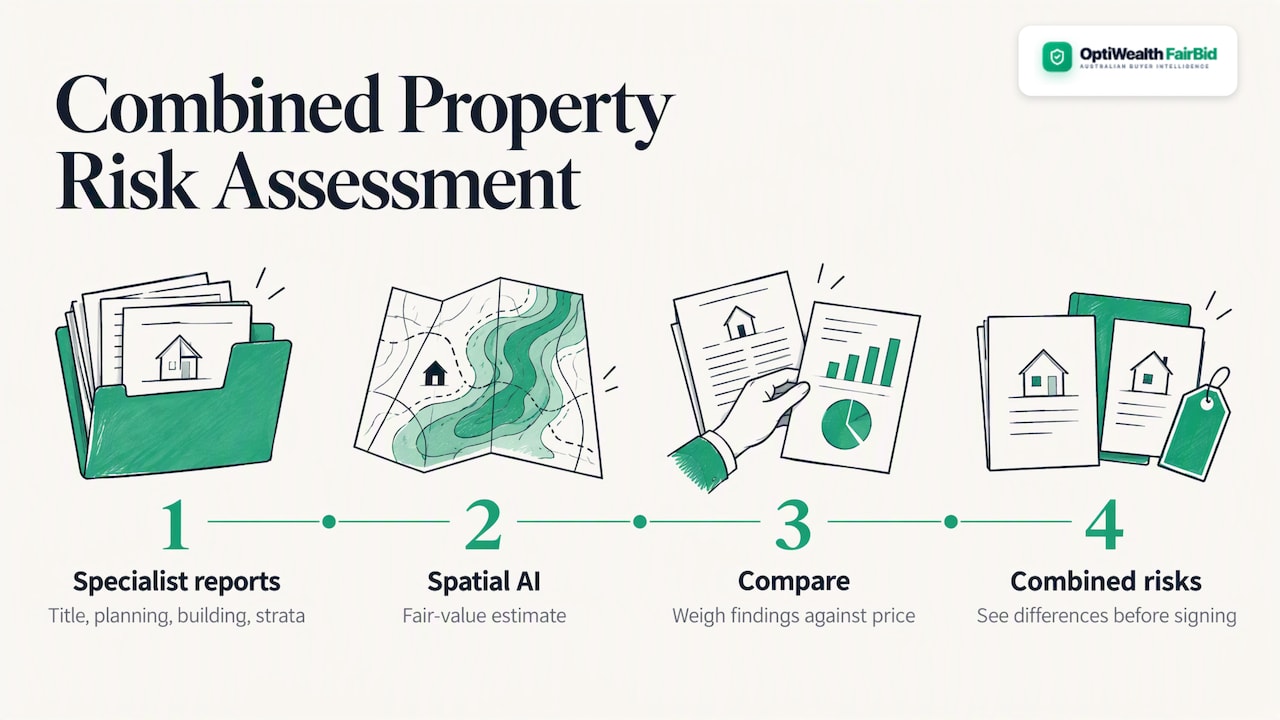
This is the structural reason an independent audit report adds value on top of the individual checks: it is not another document to add to the pile, it is the layer that reconciles the pile against the price.
Author perspective: an independent, data-driven view of buyer due diligence
The strongest due diligence checklist is only as useful as the independence of the information behind it. Vendor statements, agent-quoted price ranges and even some inspection referrals carry an inherent bias toward the sale proceeding, which is why we favour cross-referencing every legal and physical check against data that has no stake in whether the deal closes.
Spatial AI valuation modelling, applied specifically to Australian suburbs and overlay data, gives buyers a second opinion that sits outside the selling chain. Readers comparing this checklist against their own current workflow should ask one question of every report they receive: who benefits if I proceed without questioning it.
— JeongSuk Lee
OptiWealth FairBid: what it provides buyers and how to get a report
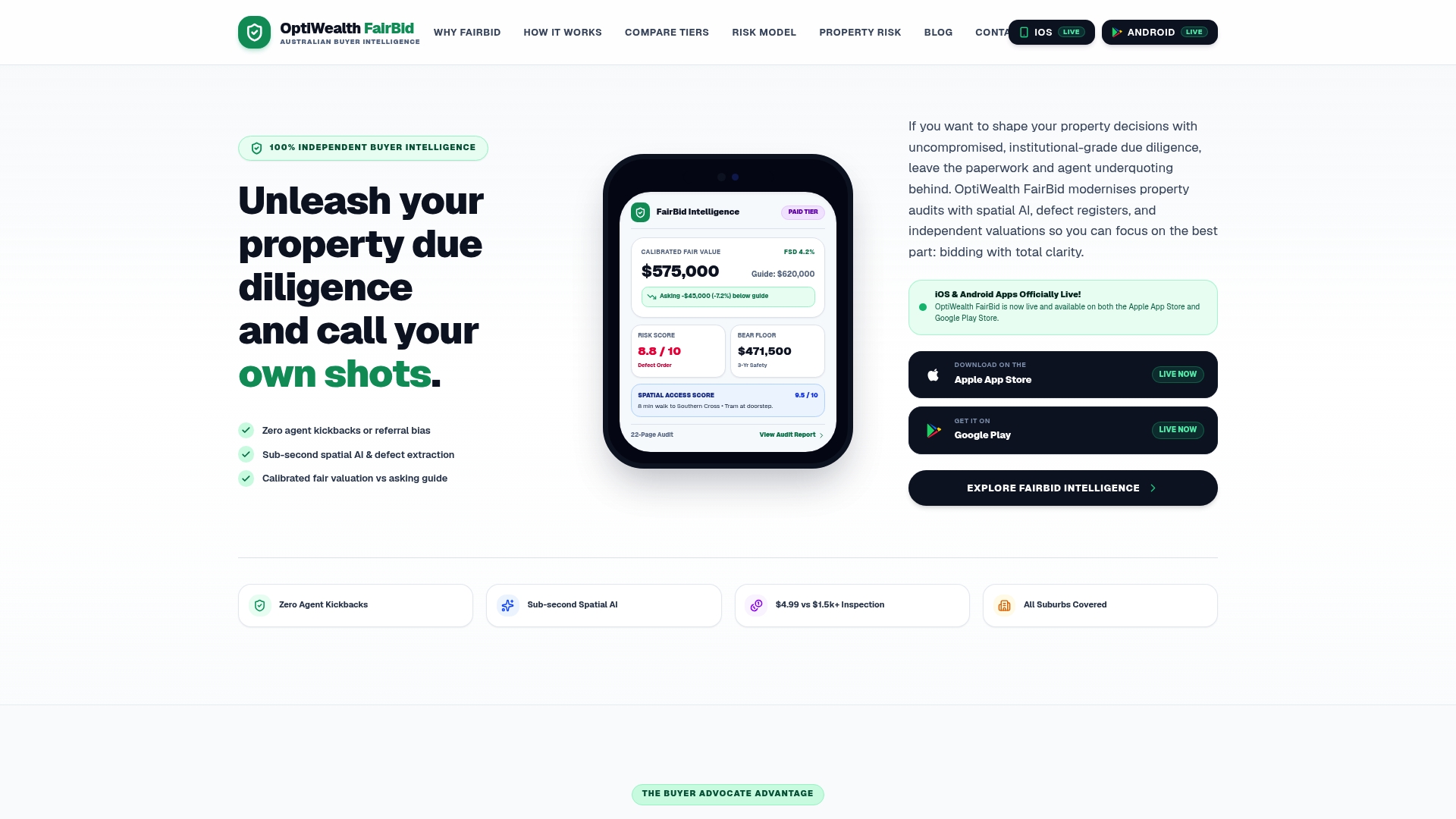
We built FairBid to give Australian buyers the independent layer this checklist keeps pointing back to: a fair value estimate, overlay and zoning risk, defect flags and strata levy risk in one audit, cross-referenced against spatial AI data rather than an agent’s quoted range. Our Free Tier gives you a starting view at no cost, and our Paid Advocate Tier, priced at $4.99 one-off, unlocks the full audit report for a specific address.
Where this checklist asks you to chase a title search, a planning certificate, a building report and strata minutes separately, a FairBid audit accelerates the cross-referencing step, letting you see how those findings interact with our valuation and risk data before you commit to exchange or raise a paddle at auction. Start with the OptiWealth landing page to compare the Free Tier against the Paid Advocate Tier for your next property.
FAQ
What should be included in a due diligence checklist?
A complete checklist covers title and ownership, planning certificates and overlays, building and pest inspections, strata records for units, contract and vendor statement review, and confirmation of outstanding rates. Each check should be finished before exchange, or before bidding if the property is going to auction.
What is a due diligence checklist in real estate?
It is the structured set of legal, physical and financial checks a buyer completes before committing to a property, covering everything from title searches to planning certificates and building reports. Consumer Affairs Victoria’s due diligence checklist is a practical government-backed version buyers can follow.
How much does a due diligence report typically cost?
Costs vary by report type: a title search is usually a modest flat fee, a building and pest inspection runs into several hundred dollars, and a contaminated land search can start from $34. A FairBid audit report through the Paid Advocate Tier costs a small one-off fee for the full property audit.
What should I check on my home inspection checklist in Australia?
Prioritise structural movement, roof condition, drainage, subfloor moisture, termite evidence and any suspected asbestos, each of which can carry a significant repair cost if missed. Our building inspection checklist sets out the specific points worth raising with your inspector before the report is finalised.
Sources
- Queensland Government — cooling-off period guidance
- NSW Planning Portal — Section 10.7 planning certificate guidance
- Australian Taxation Office — GST and commercial property guidance
- NSW Government — buying property at an auction
- Consumer Affairs Victoria — due diligence checklist for home buyers
Recommended
The information provided in this publication is for educational and general information purposes only and does not constitute financial, investment, taxation, or legal advice under the Corporations Act 2001 (Cth). Property buyers and investors should conduct independent physical, legal, and strata due diligence and seek advice from a licensed financial advisor, solicitor, or conveyancer tailored to their personal objectives before entering into any legally binding contract of sale.
OptiWealth Research
Transparent Data Science & EngineeringData Science, Software Architecture & Mathematical Risk Modeling Group
Authored by OptiWealth’s Quantitative & Data Engineering division. Our team specializes in full-stack software architecture, open-source data science, and spatial econometric property valuation (such as hedonic price regression, environmental zoning overlay synthesis, and cash-flow yield analytics). All underlying algorithms and calculation formulas are fully transparent, open to inspection, and designed purely for financial and property data visualization.
Expose Hidden Property Risks & Liabilities
OptiWealth replaces guessing games with algorithmic diagnostics. Use FairBid to audit council overlays, building defects, and calculate true net property yields.