Australian Investment Property Analysis: Strata and Overlay Risks
This tool is a generic calculator and does not advertise or promote a specific financial product. It is not intended to be relied on for the purposes of making a decision in relation to a financial product. You should consider obtaining advice from a financial services licensee before making any financial decisions.
Australian Investment Property Analysis: Strata and Overlay Risks
Several factors decide whether an investment property is worth buying: local market momentum, rental yield, and condition, strata and overlay risk. Start with comparable rents and vacancy for the exact address, then price the holding costs against what the ATO lets you deduct. Before you bid, run an independent address-level audit such as OptiWealth FairBid.
TL;DR:
- Use national figures only as context: vacancy was 1.3% in July 2026 and advertised rents rose 7.2% year over year; verify comparable rents locally.
- Calculate net operating income after vacancy, rates, water, insurance, management, strata, and repairs, then subtract interest and test higher rates, vacancy, and special levies.
- The ATO allows immediate deductions for routine expenses, but initial defect repairs and capital works are claimed over time; capital works may span 40 years.
- For units, standard inspections may miss shared area defects; review strata minutes, accounts, insurance, and the 10 year capital works plan before bidding.
- Check title, council overlays, zoning, and pending applications; hire a specialist if constraints affect the building, planned renovations, subdivision, or insurance quotes.
Table of Contents
- How do you read the location and market for an address?
- How do you calculate yield, NOI and cash flow?
- Which costs and tax rules change your returns?
- What do inspections and strata records need to show?
- How do overlays and hazards change a property’s value?
- What is the step-by-step workflow for any address?
- How do you diversify within property investments?
- Why do independent audits matter before you exchange?
- What does an OptiWealth FairBid audit give you before you bid?
- FAQ
- Sources
How do you read the location and market for an address?
A suburb earns its rent from the people it can hold: workers, students and families who need transport, schools and employment within reach. Planned infrastructure matters too, because a new rail stop or hospital changes both rental demand and resale appeal. Check each of these before you trust any yield figure.
The national backdrop gives you direction, not a forecast for your suburb. The ABS reports that the mean price of a residential dwelling in Australia was $1,100,400 in the June quarter 2026, with the value of the dwelling stock falling 0.3% over the quarter but sitting 8.5% higher than a year earlier.
Rental pressure is the other half of the picture: SQM Research reports a national vacancy rate of 1.3% for July 2026, with advertised rents about 7.2% higher year on year. National figures can hide a soft pocket, so treat them as context for your rent assumption, not a substitute for local evidence.
Quick checks to run on any address:
- Recent comparable sales of similar dwellings within the same suburb
- Current advertised rents for the same bedroom count and dwelling type
- Council planning notices and major projects within a few kilometres
- Walking distance to a station or bus interchange, and the nearest schools
- Local employment hubs and how long the commute takes
How do you calculate yield, NOI and cash flow?
Gross rental yield is annual rent divided by purchase price, multiplied by 100. For an illustrative example, take a unit’s advertised rent and purchase price. Annual rent is the weekly rent multiplied by the number of weeks in a year, so gross yield is annual rent divided by the purchase price, multiplied by 100. Gross yield ignores every cost, which is why it flatters the result.
Net operating income (NOI) is rent actually collected, after a vacancy allowance, minus operating expenses. Net yield is NOI divided by price. Cash flow then subtracts loan interest from NOI. The cap rate is NOI divided by market value, a lens for comparing properties regardless of how each is financed. We explain the distinction further in our guide to cap rate versus yield.
Work through it in this order:
- Take advertised rent and apply a vacancy allowance.
- Subtract council rates, water, insurance, management fees, strata levies and a repairs allowance.
- Divide the result by the purchase price to get net yield.
- Subtract annual loan interest to find cash flow.
- Add an assumed growth rate to net yield to test total return under different scenarios.
If the deal only works on the optimistic inputs, it does not work. Our rental yield formula guide walks through this stress test.*
Which costs and tax rules change your returns?
Costs are where yield quietly erodes. Regular outgoings sit on the property for as long as you own it, while one-off costs hit before you have collected a dollar of rent.
Line items to budget:
- Council rates, water charges and landlord insurance
- Agent letting fees and ongoing property management
- Strata levies for units, plus any special levy
- Maintenance, with a separate allowance for ageing fixtures
- Pre-purchase building and pest inspections, conveyancer fees and a strata search
The tax side turns on one distinction. ATO guidance allows immediate deductions for items such as agent fees, council rates, water, insurance and repairs, while initial repairs to defects present at acquisition and capital works are claimed over several years, often 40 for capital works. The ATO’s rental properties guide covers apportionment and record keeping.
Underfunded sinking funds are the cost most buyers miss. Low levies today can signal a large special levy tomorrow, so hold a contingency. Our explainer on strata levies and 10 year special levy risk shows how to size one.
What do inspections and strata records need to show?
A standard building inspection is often limited for units. The NSW Government notes that shared structures call for special-purpose reports and a separate pest inspection, because standard reports can miss common-area defects that later become levies. Our building inspection checklist sets out checks to cover.
For a strata scheme, NSW guidance advises reading the by-laws, obtaining a strata report, and reviewing the minutes, accounts and 10-year capital works plan. Also confirm insurance cover and any outstanding levies.
Red flags in minutes and financials:
- Repairs deferred year after year
- Legal disputes with builders, neighbours or the strata manager
- Large works planned without matching reserves
- Repeated special levies or a thin capital works fund
Pro Tip: Order the strata search before you exchange or bid, not after. Allow time for the search, and treat the cost as a small premium against a potentially large levy.
How do overlays and hazards change a property’s value?
Flood, bushfire and heritage overlays alter what you can build, what insurance costs and how much a rebuild would run. A flood-affected lot can face higher premiums, and a heritage listing can limit renovations that a yield model assumed. A Section 32 or vendor statement tells you what the seller discloses, but it does not replace your own checks against council records.
Verify in this sequence:
- Run a title search to find easements, covenants and other encumbrances.
- Check the council planning portal for overlays, zoning and pending applications.
- For NSW addresses, SiteScope offers instant zoning and constraints checks, with paid reports for fuller feasibility.
- Order specialist searches for contamination, drainage and easements as needed.
- Escalate to an environmental or planning consultant if anything remains unclear.
Engage a consultant when an overlay touches the building footprint, when you intend to subdivide or extend, or when insurers will not quote. Surprises here usually cost far more than the report.
What is the step-by-step workflow for any address?
Follow this order and you can screen a property in an evening before spending money on reports.
- Scan the market: recent comparable sales, advertised rents and vacancy.
- Run yield and NOI with conservative vacancy and repair allowances.
- If the numbers hold, order building, pest and strata reports, and run overlay and title checks in parallel.
- Stress-test an interest rate rise, a vacancy spike and a special levy, then set your go or no-go threshold.
Keep your spreadsheet to these columns:
- Weekly rent and vacancy percentage
- Council rates and water
- Strata levies and insurance
- Repairs allowance
- Loan interest
How do you diversify within property investments?
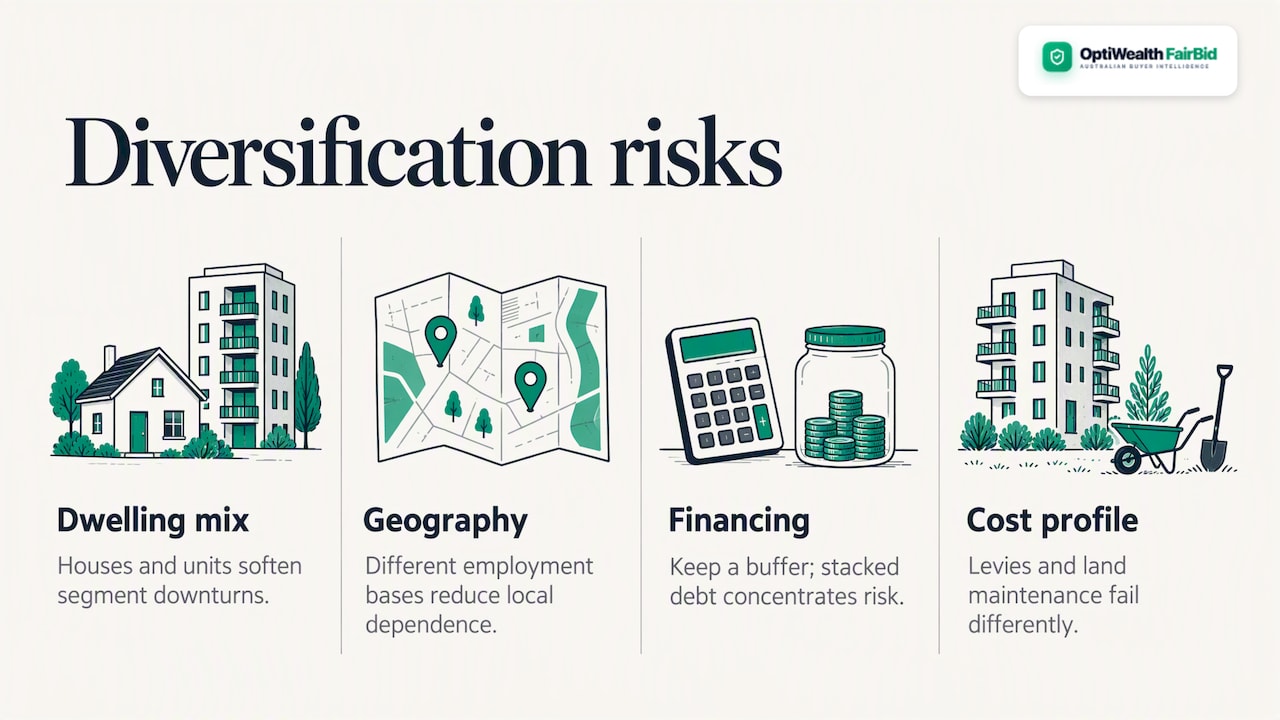
Diversification inside property means spreading exposure to different risks, not simply owning more of the same thing. Two inner-city apartments in one building share one set of strata decisions and one tenant pool. Houses and units behave differently, so mixing dwelling types can soften the impact when one segment cools.
Geography matters too. Holding properties across suburbs with different employment bases reduces dependence on a single local economy. Interstate holdings add exposure to separate planning rules and market cycles, though they also add the burden of researching unfamiliar markets.
Financing is part of the same exercise. ASIC warns that borrowing to invest carries significant risk and recommends keeping a financial buffer. Stacking several highly geared purchases at once concentrates risk even if the properties differ.
Finally, diversify the cost profile. A strata unit with levies and a freestanding house with land and maintenance risk fail in different ways. Reviewing the portfolio against those risks, not just against total yield, shows where one bad year could hurt most.
Why do independent audits matter before you exchange?
In our view, the weakest assumption in most purchases is the price guide. Auction underquoting leaves buyers anchoring on a number the seller never expected to achieve, then stretching late. Conservative inputs and an independent check against the asking price protect you from that pressure, and a buyer-first audit pulls defects, levies and overlays into the same view before you commit. We built OptiWealth FairBid, available on iOS and Android, for that purpose.
— JeongSuk Lee
What does an OptiWealth FairBid audit give you before you bid?
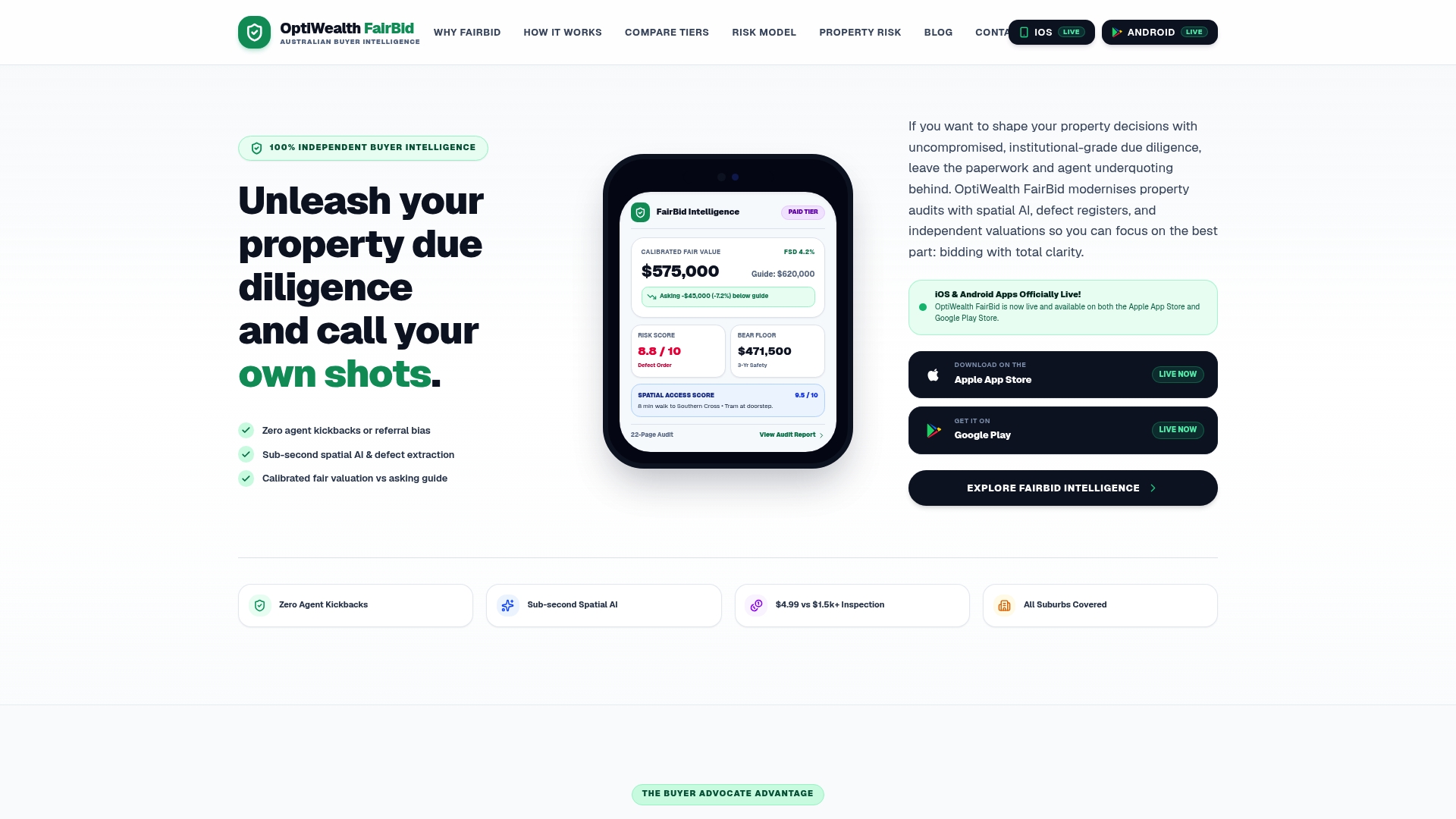
We built OptiWealth FairBid so you see a property’s true price and hidden costs before you sign. It provides independent valuations, spatial AI risk checks, and strata and overlay audits for Australian residential addresses, with no agent commissions or advertising kickbacks.
- Use it before exchange or auction, right after your yield screen
- Start on the Free Tier, or order the Paid Advocate Tier at 4.99 AUD one-off for the detailed audit report
- Browse a sample audit report to see the level of detail
Open FairBid and audit your next address before you bid.
FAQ
How do you assess an investment property?
Check the local market, calculate net yield after costs and vacancy, then inspect condition, strata records and overlays. Compare advertised rents with recent sales to test your assumptions. An independent address-level audit helps confirm nothing is missed before you commit.
Are investment properties still worth it?
They can be, but it depends on the address, the price paid and the buffer you hold. National dwelling values were 8.5% higher over the year to the June quarter 2026, though that says little about a specific suburb. Test every deal against stress scenarios before buying.
What did Warren Buffett say about real estate?
We have no sourced quotation from him on property, so we will not put words in his mouth. What matters for Australian investors is the discipline behind any such advice: buy at a defensible price and keep a margin of safety. Our stress test method applies that in practice.
Should you borrow to invest in property?
Borrowing magnifies both gains and losses. ASIC advises that gearing carries significant risk and that investors should keep a financial buffer. Negative gearing benefits also depend on your individual tax circumstances.
Sources
- Value of dwellings falls 0.3% | Australian Bureau of Statistics
- Ato
- National Vacancy Rate Holds at 1.3%
Recommended
- Avoid Thousands in Special Levies: Strata or Torrens Title Australia
- Property Risk Assessment: Spatial AI Finds Hidden Risks in Australia
- $4.99 FairBid Audit: Strata Report Explained for NSW, QLD and VIC Buyers
- Protect Buyers From 10 Year Special Levy Risk in Strata Levies
The information provided in this publication is for educational and general information purposes only and does not constitute financial, investment, taxation, or legal advice under the Corporations Act 2001 (Cth). Property buyers and investors should conduct independent physical, legal, and strata due diligence and seek advice from a licensed financial advisor, solicitor, or conveyancer tailored to their personal objectives before entering into any legally binding contract of sale.
OptiWealth Research
Transparent Data Science & EngineeringData Science, Software Architecture & Mathematical Risk Modeling Group
Authored by OptiWealth’s Quantitative & Data Engineering division. Our team specializes in full-stack software architecture, open-source data science, and spatial econometric property valuation (such as hedonic price regression, environmental zoning overlay synthesis, and cash-flow yield analytics). All underlying algorithms and calculation formulas are fully transparent, open to inspection, and designed purely for financial and property data visualization.
Expose Hidden Property Risks & Liabilities
OptiWealth replaces guessing games with algorithmic diagnostics. Use FairBid to audit council overlays, building defects, and calculate true net property yields.